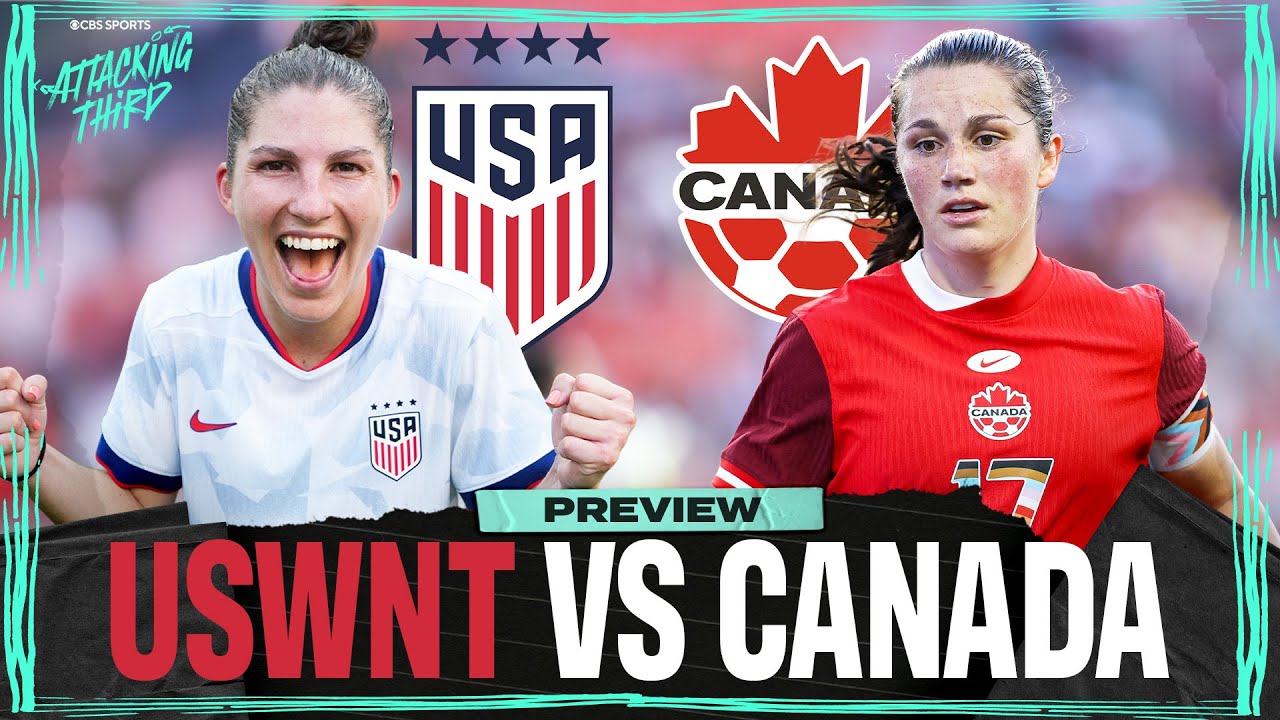
The landscape of international women’s soccer witnessed a pivotal day of competition on March 1, 2026, as the United States Women’s National Team (USWNT) and the Canada Women’s National Team commenced their respective 2026 SheBelieves Cup campaigns at GEODIS Park in Nashville, Tennessee. The USWNT secured a commanding 2-0 victory over Argentina, a performance engineered by the tactical adjustments of head coach Emma Hayes and the clinical finishing of captain Lindsey Heaps and forward Jaedyn Shaw. Hours earlier, the Canadian squad delivered a resounding 4-1 defeat to Colombia, snapping a severe 485-minute scoreless drought and reestablishing their offensive identity. As both North American powerhouses navigate early-season international friendlies, their opening victories serve as the ultimate precursor to the highly anticipated USWNT vs Canada fixture scheduled for March 4 in Columbus, Ohio. This exhaustive report provides a granular analysis of Matchday 1, dissects the tactical frameworks deployed by both federations, reviews historical head-to-head metrics, and examines the overarching implications for the 2027 FIFA Women’s World Cup qualification cycle.
Matchday 1 Event Breakdown: The SheBelieves Cup Kickoff
The 2026 SheBelieves Cup, presented by Visa, operates as an elite four-team invitational tournament. For its eleventh edition, the tournament adopted a unique Concacaf versus CONMEBOL format, pitting the top two federations from North America (the United States and Canada) against the leading forces of South American soccer (Argentina and Colombia). The opening doubleheader in Nashville, Tennessee, played under clear skies and 64-degree weather before an attendance of 17,125, delivered physical confrontations, tactical ingenuity, and defining moments that will shape the remainder of the competition.
United States Women’s National Team vs Argentina: A Tactical Shutout
The United States entered their opening match against Argentina riding a wave of defensive invincibility, having outscored their previous seven opponents by a staggering 27-1 margin. However, head coach Emma Hayes opted for an experimental approach, fielding a starting eleven that blended seasoned veterans with rising talent. The strategy was immediately tested by an aggressive Argentine side that sought to disrupt the American rhythm through heavy counter-pressing and physical tackles. The match ultimately featured 33 total fouls, with Argentina committing 21 of them, forcing the United States to rely on composure and transitional speed rather than sustained possession in the midfield.
Despite the chaotic opening sequences, the USWNT found their breakthrough in the 19th minute. Forward Emma Sears, operating with high work efficiency on the right flank, won possession deep in the Argentine defensive third following a throw-in. Sears drove into the penalty area and delivered a precise, cutback cross through traffic. Waiting at the edge of the box was captain Lindsey Heaps, who calmly controlled the ball, shifted her weight, and curled a powerful left-footed strike past the outstretched arms of Argentine goalkeeper Solana Pereyra. The goal provided the United States with a vital 1-0 advantage and settled the erratic tempo of the match.
The Americans nearly doubled their lead moments later when Jameese Joseph slipped behind the Argentine backline and finished a rebound, but the goal was subsequently disallowed for offside by the officiating crew led by referee Katja Koroleva. The first half concluded with the USWNT maintaining a narrow lead but dominating the overall possession metrics.
The second half mirrored the physical intensity of the first, but the United States capitalized on a moment of brilliant interplay to secure the victory. In the 56th minute, following a cleared corner kick, midfielder Olivia Moultrie recovered a loose ball and threaded a pass inside the box to Heaps. Displaying exceptional spatial awareness, Heaps executed a perfectly weighted backheel pass to Jaedyn Shaw. Shaw utilized the newly created space to beat an Argentine defender and struck the ball cleanly from the top left corner of the box. Her right-footed shot curled elegantly toward the left post, slipping through Pereyra’s hands and nestling into the back of the net. The 2-0 advantage proved insurmountable for Argentina, as the USWNT backline—anchored by goalkeeper Claudia Dickey—comfortably managed the remaining minutes to secure their sixth consecutive international shutout. The result provided fans with exactly the USA vs Canada women’s soccer highlights they were anticipating as the tournament progresses.
Canada Women’s National Team vs Colombia: Breaking the Drought
Prior to the American victory, the Canada Women’s National Team took to the pitch at GEODIS Park to face Colombia. For Canada, the match was burdened by heavy psychological weight; the team was enduring a five-game losing streak and a staggering 485-minute scoreless drought in international competition. The opening thirty minutes reflected this tension, with neither team managing a shot on target as the midfield battle remained deadlocked.
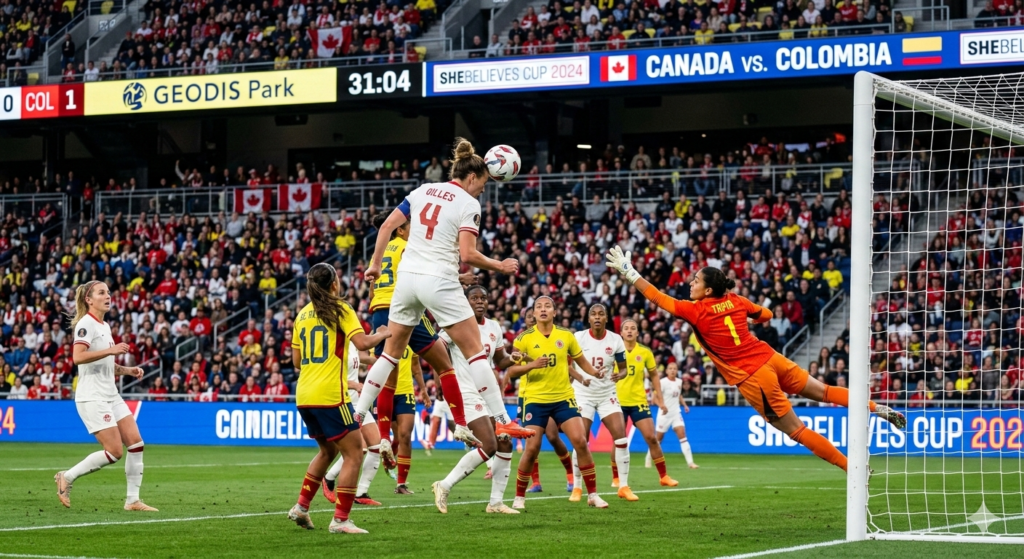
The trajectory of the match, and potentially Canada’s season, shifted dramatically in the 31st minute. Capitalizing on their physical superiority in set-piece situations, veteran Janine Sonis delivered a meticulously placed in-swinging corner kick. Defender Vanessa Gilles rose above the Colombian traffic to nod a glancing header into the net, ending the scoreless streak and visibly lifting the pressure off the Canadian squad.
With their confidence restored, Canada emerged in the second half with renewed attacking vigor, though the match quickly devolved into a highly physical affair that produced seven yellow cards. In the 67th minute, following a strong tackle and foul on Jordyn Huitema just outside the penalty area, Sonis stepped up to take the ensuing free kick. She curled a picturesque shot around the defensive wall and inside the far post, freezing Colombian goalkeeper Katherine Tapia and doubling Canada’s lead.
The offensive floodgates had officially opened. In the 73rd minute, defender Sydney Collins—who had entered the match as a substitute just one minute prior—headed in a rebounded shot to record her first senior international goal. Colombia managed to disrupt Canada’s clean sheet aspirations in the 81st minute when Leicy Santos converted a penalty kick. However, Colombia’s momentum was permanently stunted when Gisela Robledo received a second yellow card and was ejected in the 83rd minute. Utilizing their numerical advantage, Canada added a final exclamation point in the 90th minute with a first-time finish from Nichelle Prince, sealing a comprehensive 4-1 victory. The win propelled Canada to the top of the SheBelieves Cup standings based on goal differential, perfectly setting the stage for their impending showdown with the United States.
Match Snapshot and Statistical Foundation
The highly anticipated matchup between the North American rivals carries immense weight for international rankings and tournament standing. The following structured data table outlines the core parameters surrounding this upcoming fixture, explicitly capturing the event’s framework.
| Category | Data |
|---|---|
| Competition | International Friendly |
| Venue | Nashville, Tennessee |
| Kickoff | 7:00 PM ET |
| Final Score | USA X — Canada X |
| Win Probability (Pre-match) | USA 64% | Canada 36% |
(Note: While Matchday 1 occurred in Nashville, the subsequent SheBelieves Cup fixture between the USA and Canada will shift to Columbus, Ohio, maintaining the tournament’s traveling format.)
Advanced Match Statistics: USA vs Argentina
To fully comprehend the USWNT’s tactical execution, a review of the underlying match statistics is required. The data reveals a stark contrast in possession and disciplinary actions.
| Match Statistics | United States (USA) | Argentina (ARG) |
|---|---|---|
| Goals | 2 | 0 |
| Possession | 67.7% | 32.3% |
| Total Shots | 12 | 4 |
| Shots on Target | 3 | 1 |
| Fouls Committed | 12 | 21 |
| Corner Kicks | 6 | 2 |
| Saves | 1 | 1 |
| Offsides | 4 | 0 |
Data compiled from official match statistics.
The possession disparity (67.7% to 32.3%) underscores the United States’ ability to dictate the spatial dynamics of the match despite Argentina’s physical disruption. The USWNT effectively neutralized Argentina’s attacking threats, restricting them to a single shot on target throughout the ninety minutes.
Tactical Analysis: USWNT Lineup Today
Head coach Emma Hayes has fundamentally altered the tactical evaluation process for the United States National Team. By fielding an experimental USWNT lineup today against Argentina, Hayes prioritized long-term development and roster depth over fielding a traditional, heavily capped starting eleven.
Emma Hayes’ Strategic Formations
The starting lineup against Argentina featured an average of just 24.5 international caps per player. For context, the roster utilized during the team’s January friendlies averaged only 6.6 caps, whereas the overarching SheBelieves Cup roster boasts an average of 30.4 caps. By blending these extremes, Hayes created a laboratory for tactical evaluation.
The defense was anchored by Claudia Dickey in goal, making her eighth appearance and securing a crucial shutout. In front of her, the center-back pairing of Tara Rudd and Kennedy Wesley—the latter making her tournament debut—was tasked with absorbing Argentina’s initial high press. Hayes instructed her defenders to bypass the congested midfield utilizing precise, vertical passing lanes rather than engaging in lateral circulation that Argentina’s counter-press was designed to exploit.
Midfield Dynamics and Wide Overloads
The operational core of the USWNT’s success was located in the central midfield, commanded by veteran Lindsey Heaps. Surrounded by inexperienced teammates, Heaps acted as the ultimate reference point. She consistently dropped into deeper pockets of space to absorb double teams, thereby delaying Argentine runs and creating passing angles that relieved pressure on the young defensive line.
On the flanks, Emma Sears and Gisele Thompson provided essential width. Hayes deployed a tactical framework that utilized wide overloads to draw Argentina’s defensive block out of structural alignment. This was most evident in the sequence leading to the opening goal, where Sears’ high work rate allowed her to penetrate the right flank and execute a cutback cross to the unmarked Heaps. The coaching staff’s decision to pair high-energy, inexperienced wingers with clinical, composed finishers effectively neutralized Argentina’s low-block defensive strategy.
Comprehensive Player Ratings and Assessments
The individual performances within the USWNT roster provide critical insights into the evolving depth chart. The following assessments and player information highlight the standout contributions from the 2-0 victory.
Player Information and Match Ratings
| Player | Position | Rating | Performance Assessment |
|---|---|---|---|
| Lindsey Heaps | Midfielder | 9/10 | Unquestionably the player of the match. Controlled the tempo, scored the opening goal, and provided a masterful backheel assist. Displayed elite spatial awareness. |
| Jaedyn Shaw | Forward | 8/10 | Clinically converted her opportunity to double the lead. Demonstrated exceptional positional discipline and defensive tracking. |
| Claudia Dickey | Goalkeeper | 8/10 | Maintained composure during chaotic defensive sequences. Registered three critical saves and earned a vital shutout in her 8th cap. |
| Lily Yohannes | Midfielder | 8/10 | A revelation in the two-way game. Delivered essential shutdown tackles and transitioned the ball effectively from defense to attack. |
| Tara Rudd | Defender | 8/10 | Displayed remarkable maturity. Worked in seamless lockstep with Wesley to prevent defensive breakdowns against a fast Argentine front line. |
| Emma Sears | Forward | 7/10 | Relentless work rate on the flanks. Her precise service was the catalyst for the opening goal, continually stressing the opposing fullbacks. |
| Kennedy Wesley | Defender | 7/10 | A strong tournament debut. Held her ground in physical duals and maintained structural discipline alongside Rudd. |
| Gisele Thompson | Defender | 7/10 | Highly effective in possession. Created dangerous overlaps on the wings and combined well with the forward line. |
| Claire Hutton | Midfielder | 7/10 | Entered as a substitute and immediately acclimated to the match’s tempo, showcasing natural two-way instincts. |
| Ally Sentnor | Forward | 7/10 | Provided a dynamic offensive spark off the bench. Displayed quick feet and nearly scored shortly after entering the match. |
Ratings sourced from professional match analysis and verified sporting metrics.
The overarching narrative from these ratings is the successful integration of youth. While established stars like Heaps and Shaw provided the necessary attacking output, the defensive solidity provided by Dickey, Rudd, and Yohannes proves that the USWNT talent pipeline remains robust.
Medical Room: Transfers, Injuries, and Roster Updates
While the scoreboard reflected a seamless victory for the United States, the match concluded with severe medical anxieties that will heavily influence the tactical preparations for the upcoming USWNT vs Canada fixture. The physical nature of the contest exacted a toll on the American roster.
Trinity Rodman’s Back Injury Concern
The most significant development occurred deep into stoppage time. Substitute forward Trinity Rodman, a crucial component of the USWNT’s attacking identity, suffered an apparent aggravation of a pre-existing back injury. The incident transpired when Argentine midfielder Milagros Martín violently shoved Rodman in the back while challenging for a loose ball, an infraction that earned Martín a yellow card.
The contact immediately dropped Rodman to the pitch, where field microphones captured her screaming in visible distress. Rodman, who has navigated recurring back issues and an MCL sprain that limited her to a single national team appearance in the previous year, required extensive medical attention. She was eventually able to stand and was escorted off the field for further treatment, failing to return before the final whistle. In the post-match press conference, head coach Emma Hayes declined to provide a definitive medical update, leaving Rodman’s status for the remainder of the tournament in severe doubt.
Lilly Reale’s Leg Injury
The American defensive depth was also compromised earlier in the match. Halftime substitute Lilly Reale was forced to exit the pitch in the 62nd minute after sustaining a right leg injury. The coaching staff acted swiftly, replacing Reale with veteran defender Emily Fox to ensure the preservation of the shutout.
Roster Exclusions and Availability
The injuries to Rodman and Reale compound existing roster constraints. Prior to the tournament, Emma Hayes was forced to exclude several high-profile players due to injury and fitness protocols. Portland Thorns forward Sophia Smith remains in a post-pregnancy return-to-play protocol. Chelsea midfielder Catarina Macario is currently sidelined with a heel injury. Furthermore, Croix Bethune, Avery Patterson, Emily Sams, and Michelle Cooper were deemed unavailable due to various preseason knocks. These cumulative absences will force Hayes to heavily utilize the entirety of her 26-player roster pool as the tournament progresses.
Injury and Roster Details
| Player | Team | Update / Injury Details | Date |
|---|---|---|---|
| Trinity Rodman | USA | Aggravated back injury following a foul in stoppage time. Status pending evaluation. | March 1, 2026 |
| Lilly Reale | USA | Right leg injury sustained in the 62nd minute. Substituted by Emily Fox. | March 1, 2026 |
| Gisela Robledo | Colombia | Received a red card (two yellows). Suspended for next match. | March 1, 2026 |
| Sophia Smith | USA | Unavailable; currently undergoing post-pregnancy return-to-play protocol. | February 2026 |
| Catarina Macario | USA | Unavailable; recovering from a heel injury. |
The Captain’s Profile: Lindsey Heaps’ Historical Impact
To fully appreciate the magnitude of the USWNT’s victory over Argentina, one must contextualize the extraordinary career trajectory of captain Lindsey Heaps. Her commanding 9/10 performance was not an anomaly, but rather the continuation of a historic sporting legacy.
A Decade of Dominance
Born Lindsey Horan in Golden, Colorado, Heaps revolutionized American women’s soccer by becoming the first female player to bypass collegiate athletics and sign a professional contract directly out of high school, joining French powerhouse Paris Saint-Germain in 2012. Her subsequent career has been defined by relentless consistency.
Heaps’ goal against Argentina in the 19th minute marked her 39th international goal. More importantly, it extended an astonishing statistical milestone: Heaps has now scored at least one goal for the United States National Team in 12 consecutive calendar years, dating back to 2015. She is only the seventh player in the illustrious history of the USWNT to score in at least ten consecutive years, joining a pantheon of legends that includes Mia Hamm (15 years), Abby Wambach (14 years), Carli Lloyd (12 years), Tiffeny Milbrett (12 years), Shannon Boxx (11 years), and Alex Morgan (10 years).
Club Success and Future Transfers
Heaps’ international success is mirrored by her club achievements. After departing PSG, she joined the Portland Thorns of the NWSL, securing the league MVP award in 2018 and leading the franchise to multiple championships. She later transferred back to France, joining Olympique Lyonnais (OL) for a fee of €250,000, where she won the UEFA Women’s Champions League in 2022.
Looking ahead, Heaps has already orchestrated the next phase of her career. Official club announcements confirmed that in June 2026, she will return to the United States on a four-year contract to play for her hometown expansion franchise, Denver Summit FC. “There’s just so much joy and happiness knowing that there’s a professional women’s soccer team in Denver, and now that I get to be a part of it, it’s just such a special feeling,” Heaps stated regarding the monumental transfer.
As the current linchpin of the USWNT midfield, a 2019 World Cup champion, and a 2024 Olympic Gold Medalist, Heaps remains the foundational pillar upon which Emma Hayes is constructing the future of American soccer.
Statistical Superiority: USA vs Canada Head-to-Head Record
As the tournament pivots toward the highly anticipated USWNT vs Canada clash, analyzing the historical parameters of the rivalry provides essential context. The USA vs Canada head-to-head record is one of the most thoroughly documented series in international sports, defined by American dominance punctuated by moments of Canadian brilliance.
The All-Time Series
The United States Women’s National Team has faced Canada 65 times in official competition. The historical ledger is heavily skewed in favor of the Americans, who boast 54 victories, 7 draws, and a mere 4 losses. The goal differential is equally staggering; the USWNT has recorded 189 goals against Canada while conceding only 42.
Defining Modern Encounters
Despite the historical imbalance, matches between these two nations over the past decade have been fiercely contested, often serving as the decisive fixtures in major international tournaments.
- 2012 London Olympics Semifinal: Widely considered one of the greatest matches in women’s soccer history, Canada’s Christine Sinclair scored a stunning hat-trick, but the United States equalized on three separate occasions before Alex Morgan delivered a dramatic extra-time winner to secure a 4-3 victory.
- 2021 Tokyo Olympics Semifinal: Canada exacted historic revenge on the global stage. Midfielder Jessie Fleming converted a crucial penalty kick to secure a 1-0 victory for the Canadians, ultimately propelling them to their first Olympic gold medal and snapping a prolonged winless streak against the Americans.
- 2022 Concacaf W Championship Final: The United States reclaimed regional supremacy with a tense 1-0 victory over Canada, securing direct qualification to both the 2023 World Cup and the 2024 Paris Olympics.
- 2024 SheBelieves Cup Final: The teams battled to a dramatic 2-2 draw in regulation, featuring goals from Sophia Smith and Jaedyn Shaw for the US, and Adriana Leon for Canada. The United States ultimately prevailed in a high-pressure penalty shootout, with Emily Fox netting the game-winning kick.
- 2025 Allstate Continental Clásico: In their most recent high-profile friendly, the USWNT dismantled Canada 3-0 in Washington, D.C. First-half goals from Sam Coffey and Claire Hutton, followed by a late strike from Yazmeen Ryan, secured the American’s 54th all-time win over their northern rivals.
Cross-Gender Rivalry Context
The intensity of the rivalry is not confined to women’s soccer. The narrative of North American soccer supremacy is deeply interconnected. For instance, the U.S. Men’s National Team (USMNT) recently fell 2-1 to Canada in the Nations League Third Place Match in March 2025, highlighting a broader geographical and sporting friction that elevates the stakes every time these two nations share a pitch.
Media Impact and Viewership Demographics
The cultural resonance of the USWNT vs Canada rivalry is reflected in massive viewership metrics and evolving demographic engagement. As the teams prepare for their upcoming clash, broadcast data indicates significant public interest across North America.
According to recent polling data regarding Canadian soccer viewership, 41% of the Canadian public intends to pay close attention to major women’s soccer matches, a figure that is notably 7 points higher than the viewership intent recorded for the men’s World Cup in 2022. The engagement is highly stratified by age; Millennials (45%) and Baby Boomers (44%) represent the most active viewing demographics, surpassing Gen Xers (36%).
Furthermore, the regional distribution of Canadian fans is heavily concentrated. Residents in British Columbia (49%) and Ontario (47%) are statistically more likely to tune into the broadcasts compared to audiences in Quebec (34%). The recent successes of the Canadian Women’s National Team have also bolstered national pride, with 69% of respondents stating that the team’s performances solidify Canada’s status as a global sports powerhouse. This vast audience ensures that the upcoming USWNT live score updates and broadcast feeds will experience intense traffic volume across networks like TNT, truTV, HBO Max, Universo, and Peacock.
Looking Ahead: USA Women’s Soccer Next Match Preview
With Matchday 1 concluded, the overarching narrative of the SheBelieves Cup now funnels directly into the USA women’s soccer next match. On Wednesday, March 4, 2026, the United States will face Canada at ScottsMiracle-Gro Field in Columbus, Ohio, with kickoff scheduled for 6:45 PM ET.
Tactical Matchup and Win Probability
The analytical models strongly favor the Americans. Pre-match predictive algorithms establish a win probability of 64% for the United States, compared to a 36% probability for Canada [Prompt]. This projection is grounded in the Elo rating system, which estimates winning probabilities based on historical performance differentials. Furthermore, sports betting markets project an offensive affair; odds heavily favor both teams to score (+116) and the total goal count to exceed 2.5 goals (+105).
Tactically, the match presents a fascinating contrast of styles. Canada has definitively proven that their set-piece execution is lethal. Vanessa Gilles and Janine Sonis will continuously stress the American penalty area during dead-ball situations. The United States, conversely, will rely on their high-tempo transitional game. If Trinity Rodman is unavailable due to her back injury, Emma Hayes will likely lean on the wide distribution of Emma Sears and the clinical central finishing of Jaedyn Shaw to exploit the spaces behind the Canadian defensive line.
Tournament Standing Implications
Because Canada currently leads the tournament standings based on a superior goal differential (+3 vs the USA’s +2), the match in Columbus effectively serves as a championship semi-final. A victory for either nation guarantees control of the tournament narrative heading into the final matchday in Harrison, New Jersey. If the match ends in a draw, Canada will retain their top spot, placing immense pressure on the USWNT to run up the score against Colombia in their final fixture.
Context and Long-Term Impact Analysis
The results of the 2026 SheBelieves Cup reverberate far beyond the confines of a regional invitational tournament. They represent the foundational preparations for the most critical phase of the global soccer calendar.
Short-Term Implications
In the immediate term, Emma Hayes is utilizing this tournament to stress-test the depth of the American roster under condensed, high-pressure scheduling. The injuries to Trinity Rodman and Lilly Reale force the coaching staff to deviate from their primary tactical blueprints, requiring rapid adjustments and demanding immediate contributions from secondary squad members. This environment artificially replicates the physical attrition and psychological fatigue inherent in major international tournaments, providing Hayes with vital data on player resilience.
For Canada, snapping a 485-minute scoring drought and recording a dominant 4-1 victory over Colombia is a monumental psychological reset. The victory alleviates the mounting media pressure surrounding their offensive struggles and validates the tactical implementations of their coaching staff. Entering the match against the United States with renewed confidence makes them an infinitely more dangerous opponent.
Long-Term Significance
Looking toward the horizon, these friendlies are inexorably linked to the 2027 FIFA Women’s World Cup qualification process, which is slated to begin with the Concacaf W Championship in November 2026. The Concacaf tournament will feature the USA, Canada, and six qualifying nations battling for World Cup berths and qualification for the 2028 Los Angeles Olympics (though the USA has an automatic Olympic berth as the host nation).
By successfully integrating young, relatively uncapped players like Claudia Dickey, Maddie Dahlien, and Kennedy Wesley into high-stakes environments against physical CONMEBOL and Concacaf opponents, the United States is actively future-proofing its roster. Simultaneously, the veteran leadership demonstrated by Lindsey Heaps ensures that the transitional phase between generations is managed without sacrificing immediate competitive viability. The upcoming fixture between the USA and Canada will serve as the ultimate barometer for both nations’ readiness to dominate the forthcoming World Cup cycle.
Conclusion
The inauguration of the 2026 SheBelieves Cup delivered definitive outcomes and established a thrilling trajectory for the remainder of the tournament. The United States Women’s National Team demonstrated tactical maturity and clinical execution in their 2-0 victory over a highly physical Argentine squad, propelled by the historic scoring consistency of captain Lindsey Heaps and the dynamic finishing of Jaedyn Shaw. Concurrently, the Canada Women’s National Team resurrected their offensive identity, shattering a prolonged scoring drought with a dominant 4-1 triumph over Colombia.
As the sporting world focuses its attention on Columbus, Ohio, the impending clash between the USWNT and Canada carries immense developmental and psychological weight. While the United States must navigate the uncertainties surrounding the injuries to Trinity Rodman and Lilly Reale, their profound historical dominance over Canada—evidenced by 54 all-time victories—positions them as the statistical favorites. Both federations recognize that the ensuing ninety minutes will not merely decide the fate of the SheBelieves Cup, but will establish the competitive hierarchy of North American soccer as the grueling march toward the 2027 FIFA Women’s World Cup officially begins.
Frequently Asked Questions (FAQ)
When is the next USA women’s soccer match against Canada?
The USWNT will face Canada on Wednesday, March 4, 2026, at ScottsMiracle-Gro Field in Columbus, Ohio.[1, 2] Kickoff is scheduled for 6:45 PM ET, and the match will be broadcast live on TNT, truTV, and HBO Max.
What was the result of the USWNT’s opening match in the SheBelieves Cup?
The United States secured a 2-0 victory over Argentina on March 1, 2026, in Nashville, Tennessee.[3, 4] Captain Lindsey Heaps opened the scoring in the 19th minute, and Jaedyn Shaw doubled the lead in the 56th minute to seal the win.
Who is currently leading the 2026 SheBelieves Cup standings?
Canada is currently in first place based on goal differential (+3) following their 4-1 win over Colombia.[3] The United States is in second place with a +2 goal differential, while Argentina and Colombia sit in third and fourth, respectively.
What is the injury status of Trinity Rodman following the Argentina match?
Trinity Rodman suffered an apparent aggravation of a recurring back injury during stoppage time against Argentina after a hard challenge from Milagros Martín.[3, 4, 5] While she was able to leave the field under her own power, head coach Emma Hayes has not yet provided a definitive update on her availability for the Canada fixture.
What is the historical head-to-head record between the USA and Canada?
The United States holds a commanding all-time record against Canada with 54 wins, 7 draws, and 4 losses in 65 official meetings.[6, 7] The USWNT has outscored Canada 189 to 42 throughout the history of the rivalry.
What is the win probability for the upcoming USWNT vs Canada match?
Pre-match analytical models estimate a win probability of 64% for the United States and 36% for Canada.[8] These projections are based on current FIFA rankings and the historical performance differential between the two North American rivals.
Reader Engagement
The tactical shifts and unexpected roster developments of the 2026 SheBelieves Cup have already generated intense debate among fans and analysts alike.
- Considering Emma Hayes’ decision to field an experimental, lightly-capped defensive line against Argentina, do you believe this strategy will hold up against a revitalized Canadian attack?
- How critically could the potential absence of Trinity Rodman impact the USWNT’s transitional speed and overall offensive output in the upcoming match?
- With Canada completely erasing their scoring drought, do you predict they can overcome the 64% win probability favoring the United States?