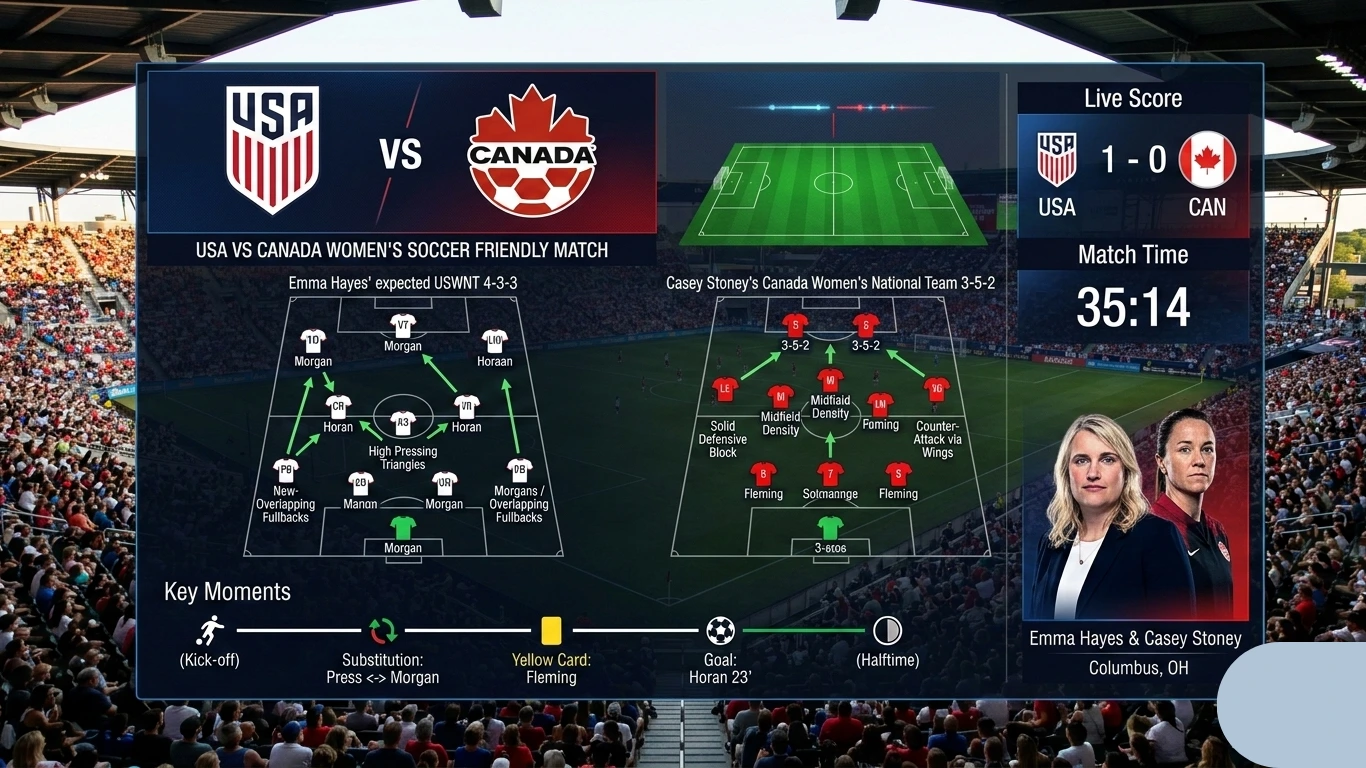
As the 2026 SheBelieves Cup continues, the United States Women’s National Team prepares to face its northern rival on Wednesday, March 4, 2026, at ScottsMiracle-Gro Field in Columbus, Ohio. This comprehensive report covers the USA vs Canada Women’s Soccer Friendly: Match Time, Lineups, Live Score & Key Moments, exploring the tactical nuances and historical weight of this fixture. Following commanding opening victories over Argentina and Colombia, respectively, both squads are vying for tournament supremacy. This analysis delivers an exhaustive breakdown of the upcoming clash, contextualizing recent team developments, injury impacts, and strategic adjustments ahead of this highly anticipated North American rivalry matchup.
USA vs Canada Women’s Soccer Friendly: Match Time, Lineups, Live Score & Key Moments
The narrative surrounding the upcoming match is deeply rooted in the historical and competitive significance of the SheBelieves Cup. Now in its 11th edition, the tournament represents a crucial preparatory phase for the 2027 FIFA Women’s World Cup qualification cycle. The competition features a round-robin format inviting four of the top-ranked nations in the Americas: the United States, Canada, Colombia, and Argentina.
The second matchday of this premier tournament brings the North American neighbors together in what is historically a fiercely contested battle. The United States enters the match seeking to solidify its tactical identity under head coach Emma Hayes, while Canada, guided by Casey Stoney, looks to build upon a revitalizing opening victory that snapped a prolonged winless drought.
Match Logistics and Broadcast Information
The organizational structure of the 2026 SheBelieves Cup emphasizes premium venues and extensive broadcast accessibility. The match between the USWNT and Canada is scheduled to take place at ScottsMiracle-Gro Field in Columbus, Ohio, a venue known for its intense atmosphere and pristine playing surface.
| Category | Event Data |
|---|---|
| Date | Wednesday, March 4, 2026 |
| Match Time | 6:45 p.m. ET / 3:45 p.m. PT |
| Venue | ScottsMiracle-Gro Field, Columbus, Ohio, USA |
| Tournament | 2026 SheBelieves Cup, Presented by Visa |
| English Broadcast Networks | TNT, truTV, HBO Max, TBS |
| Spanish Broadcast Networks | Universo, Peacock, Telemundo |
| Radio Broadcast | Westwood One Sports (English), Futból de Primera (Spanish) |
The comprehensive broadcast strategy ensures that the event reaches a global audience, reflecting the escalating commercial and athletic value of women’s international soccer. The availability of matches across Turner Sports networks (TNT, truTV, HBO Max) and NBCUniversal’s Spanish-language platforms (Universo, Telemundo, Peacock) underscores the heavy media investment in the USWNT’s journey toward the next World Cup cycle

Timeline of Developments and Historical Context
To fully grasp the implications of the upcoming match, one must examine the extensive timeline of developments that have defined this rivalry. The United States and Canada have met on the pitch 67 times prior to this tournament, forging a competitive history that dates back to July 7, 1986.
The United States has historically maintained a dominant position in the head-to-head record. Over the course of 67 matches, the USWNT has secured 54 victories, recorded 9 draws, and suffered only 4 defeats. This record includes a staggering +150 goal differential, with the United States scoring 194 goals compared to Canada’s 44. Despite the lopsided overall statistics, the rivalry has intensified significantly over the past decade, producing some of the most memorable moments in global women’s soccer.
High-Stakes Encounters in Major Tournaments
The dynamic between the two nations shifted profoundly during the 2012 London Olympics. The semifinal match of that tournament is widely regarded as a modern classic, featuring a hat-trick by Canadian legend Christine Sinclair. The United States was forced to equalize three times before Alex Morgan secured a dramatic extra-time victory, propelling the USWNT to an eventual gold medal.
Canada exacted a measure of retribution nearly a decade later during the Tokyo 2021 Olympics. In a tense semifinal clash, Canada defeated the United States 1-0 via a penalty converted by Jessie Fleming. This historic victory eliminated the heavily favored Americans and served as the catalyst for Canada’s eventual Olympic gold medal triumph against Sweden.
The momentum swung back to the United States during the 2022 Concacaf W Championship Final, where the USWNT claimed a narrow 1-0 victory. This crucial win not only secured regional dominance but also guaranteed the United States a berth in both the 2023 FIFA Women’s World Cup and the 2024 Paris Olympics, a tournament where Emma Hayes ultimately guided the squad to another gold medal.
The July 2025 Allstate Continental Clásico
The most direct precursor to the current SheBelieves Cup matchup was an international friendly contested on July 2, 2025. Played at Audi Field in Washington, D.C., the match drew an attendance of 19,215 fans and was contested in 86-degree weather under partly cloudy skies. The fixture, branded as the Allstate Continental Clásico, resulted in a commanding 3-0 victory for the United States.
This match was a masterclass in American transitional play and defensive solidity. The scoring opened in the 17th minute when Sam Coffey, assisted by Avery Patterson, netted her third goal of the year and the fourth of her international career. The USWNT doubled its advantage in the 36th minute when 19-year-old Claire Hutton scored her first international goal in just her sixth cap, capitalizing on an assist from veteran Rose Lavelle.
The United States effectively neutralized Canada’s attacking threats throughout the second half. The defensive unit, anchored by captain Naomi Girma and goalkeeper Claudia Dickey, preserved a fifth consecutive shutout for the USWNT. Yazmeen Ryan provided the final punctuation mark in the 89th minute, finishing a sequence assisted by Tara McKeown to seal the 3-0 result. The statistics from this friendly highlight the American dominance, as the USWNT outshot Canada 22-7, restricting the Canadian side to merely three shots on target despite the efforts of Canadian goalkeeper Kailen Sheridan, who recorded five saves.
Matchday One Retrospective: Form and Execution
The current form of both squads is best evaluated through their performances on the opening matchday of the 2026 SheBelieves Cup. On Sunday, March 1, 2026, both the United States and Canada secured vital victories at GEODIS Park in Nashville, Tennessee, setting the stage for a clash of the tournament leaders.
Canada’s Resurgence Against Colombia
Canada entered the tournament burdened by a severe offensive drought and a five-match losing streak that included a 1-0 defeat to Japan in December 2025. Head coach Casey Stoney faced immense pressure to orchestrate a turnaround against a physical Colombian side that had recently finished as runners-up in the 2025 Copa América Femenina.
The Canadian response was emphatic, resulting in a 4-1 dismantling of Colombia. The victory snapped a grueling 485-minute scoreless streak for the national team. The breakthrough occurred in the 31st minute through a meticulously executed set-piece. Janine Sonis, deployed effectively at right-back, delivered an in-swinging corner kick that found the head of center-back Vanessa Gilles, who nodded the ball past the Colombian defense.
The second half saw an increase in physical intensity, marked by aggressive tackles and escalating tensions. Following a foul on forward Jordyn Huitema just outside the penalty area, Janine Sonis doubled Canada’s lead in the 67th minute with a beautifully struck free-kick that curled inside the far post, leaving Colombian goalkeeper Katherine Tapia frozen.
Canada’s depth was showcased when substitute defender Sydney Collins entered the match in the 72nd minute and immediately made an impact, heading in a rebounded shot from Marie-Yasmine Alidou in the 73rd minute to record her first senior international goal. Although Colombia disrupted Kailen Sheridan’s clean sheet with an 81st-minute penalty kick converted by Leicy Santos, Canada maintained control. The match’s chippy nature culminated in an 83rd-minute red card for Colombia’s Gisela Robledo following her second yellow card. Canada finalized the 4-1 scoreline in the 90th minute with a decisive first-time finish from substitute Nichelle Prince, assisted by Cloé Lacasse.
United States’ Tactical Patience Against Argentina
Later that afternoon, the USWNT faced Argentina in a contest characterized by physical disruption and tactical patience. The United States emerged with a 2-0 victory, managing the game effectively despite facing 21 fouls committed by the Argentine squad.
Head coach Emma Hayes utilized an experimental starting lineup, blending seasoned veterans with emerging prospects. The starting XI averaged just 24.5 caps, with captain Lindsey Heaps accounting for 170 of the combined 269 caps on the field. Forward Maddie Dahlien earned her first career start, while players like Jameese Joseph, Claudia Dickey, and Kennedy Wesley made their SheBelieves Cup debuts.
The United States opened the scoring in the 19th minute through a sequence initiated by intense counter-pressing. Forward Emma Sears won possession deep in the attacking third, cut inside the penalty area, and delivered a cutback pass to Lindsey Heaps. The captain controlled the ball at the top of the penalty arc and curled a precise left-footed shot past Argentine goalkeeper Solana Pereyra. This goal marked a historic milestone for Heaps, who has now scored in 12 consecutive calendar years for the national team, joining an elite cohort of only seven USWNT players to achieve such longevity.
The USWNT doubled its advantage in the 56th minute. Following a cleared corner kick, midfielder Olivia Moultrie recycled possession and found Heaps inside the box. Displaying exceptional vision, Heaps executed a backheeled pass to Jaedyn Shaw, who curled a right-footed shot into the net for her 10th international goal in just her 32nd appearance.
The scoreline could have been more pronounced, as the United States saw two additional goals disallowed for offside. Jameese Joseph capitalized on a rebound in the first half, and substitute Ally Sentnor slotted a shot around the goalkeeper in the 66th minute, but the assistant referee’s flag negated both efforts. Defensively, the USWNT was resolute, dominating possession (67.7%) and restricting Argentina to a single shot on target, allowing goalkeeper Claudia Dickey to register her seventh career clean sheet in her eighth appearance.
Roster Analytics, Transfers, and Injury Details
The tactical frameworks of both federations are currently heavily influenced by player availability. Injuries have forced significant roster attrition, requiring both Emma Hayes and Casey Stoney to rely on expanded player pools and integrated youth prospects.
USWNT Roster Composition and Injury Updates
Emma Hayes has cultivated a highly competitive environment within the USWNT, prioritizing meritocracy and developmental exposure. In her first 32 matches as head coach, Hayes awarded 32 players their first international caps, fundamentally altering the program’s demographic profile.
The 26-player roster selected for the 2026 SheBelieves Cup reflects this philosophy. Only three players on the roster boast more than 100 caps: Lindsey Heaps (171), Rose Lavelle (116), and Emily Sonnett (113). Conversely, twelve players entered the camp with 10 caps or fewer, illustrating a deliberate generational transition.
However, the physical toll of the opening match against Argentina has introduced structural complications. The USWNT suffered key injuries that will impact defensive rotations against Canada.
| Player | Position | Status | Injury or Transfer Details |
|---|---|---|---|
| Trinity Rodman | Forward | Available / Probable | Suffered a back injury after a hard collision with Argentina’s Milagros Martin in the 90+1 minute. Despite remaining on the turf and exiting the match, coach Emma Hayes confirmed Rodman is on track to play against Canada. Rodman recently signed a landmark three-year contract with the Washington Spirit. |
| Lilly Reale | Defender | Out | The 2025 NWSL Rookie of the Year was substituted on at halftime against Argentina but was forced to exit in the 62nd minute after sustaining a right foot injury. She has been ruled out for the remainder of the SheBelieves Cup camp. |
| Jordyn Bugg | Defender | Out | Exited the national team camp prior to the tournament’s commencement due to a hamstring injury. |
| Avery Patterson | Defender | Active |
Comprehensive USWNT Player Statistics
The depth of the American squad is evident in the statistical output of its attacking and midfield personnel. Detailed internal metrics updated ahead of the tournament highlight the efficiency of the current roster configuration
| Player | Position | 2026 Games Played | 2026 Goals | 2026 Assists | Total Career Caps | Total Career Goals |
|---|---|---|---|---|---|---|
| Trinity Rodman | Forward | 2 | 2 | 0 | 49 | 13 |
| Emma Sears | Forward | 2 | 2 | 1 | 14 | 6 |
| Ally Sentnor | Forward | 2 | 2 | 0 | 15 | 6 |
| Lindsey Heaps | Midfielder | 2 | 1 | 1 | 171 | 39 |
| Jaedyn Shaw | Midfielder | 2 | 1 | 0 | 32 | 10 |
| Croix Bethune | Midfielder | 2 | 1 | 1 | 7 | 1 |
| Emily Sams | Defender | 2 | 1 | 1 | 9 | 1 |
| Olivia Moultrie | Midfielder | 2 | 0 | 1 | 13 | 5 |
| Yazmeen Ryan | Forward | 1 | 0 | 1 | 16 | 2 |
| Maddie Dahlien | Forward | 2 | 0 | 0 | 3 | 0 |
(Note: Statistical data verified from official U.S. Soccer documentation, updated early 2026.)
Canada WNT Roster Composition and Injury Deficits
Casey Stoney’s tenure as Canada’s head coach has been complicated by an unprecedented injury crisis, particularly along the defensive backline. The Canadian federation was forced to navigate the withdrawal of several foundational athletes prior to the tournament.
The absences are glaring. Elite center-backs Kadeisha Buchanan (Chelsea FC) and Shelina Zadorsky (West Ham United FC) are unavailable, fundamentally altering the defensive architecture. Furthermore, starting fullbacks Jayde Riviere (Manchester United WFC) and Ashley Lawrence were omitted from the squad list due to physical limitations. Goalkeeper Sabrina D’Angelo (Aston Villa Women) and Lysianne Proulx (Ipswich Town FC) are also sidelined.
The offensive unit suffered a significant blow just days before the tournament when forward Olivia Smith (Arsenal W.F.C.) suffered a concussion during an FA Cup match against Bristol City. She was stretched off the pitch and subsequently withdrawn from the Canadian squad, replaced by Denver Summit FC defender Megan Reid.
Despite these setbacks, the 24-player roster features robust representation from the National Women’s Soccer League (NWSL) and European domestic leagues, underscoring the global footprint of Canadian talent.
| Player | Position | Current Club Affiliation | Status |
|---|---|---|---|
| Kailen Sheridan | Goalkeeper | North Carolina Courage (USA) | Active |
| Vanessa Gilles | Defender | FC Bayern Munich (GER) | Active |
| Janine Sonis | Defender | Denver Summit FC (USA) | Active |
| Sydney Collins | Defender | Bay FC (USA) | Active |
| Gabrielle Carle | Defender | Washington Spirit (USA) | Active |
| Jessie Fleming | Midfielder | Portland Thorns FC (USA) | Active |
| Julia Grosso | Midfielder | Chicago Red Stars (USA) | Active |
| Marie-Yasmine Alidou | Midfielder | Portland Thorns FC (USA) | Active |
| Jordyn Huitema | Forward | Seattle Reign FC (USA) | Active |
| Cloé Lacasse | Forward | Utah Royals FC (USA) | Active |
| Nichelle Prince | Forward | Boston Legacy FC (USA) | Active |
| Olivia Smith | Forward | Arsenal W.F.C. (ENG) | Out (Concussion) |
| Kadeisha Buchanan | Defender | Chelsea FC (ENG) | Out (Injury) |
The heavy reliance on NWSL personnel—including Denver Summit’s Emma Regan, Megan Reid, and Janine Sonis, alongside Portland’s midfield duo of Fleming and Alidou—ensures that the Canadian squad possesses an intimate tactical familiarity with their American counterparts.
Tactical Analysis and Projected Lineups
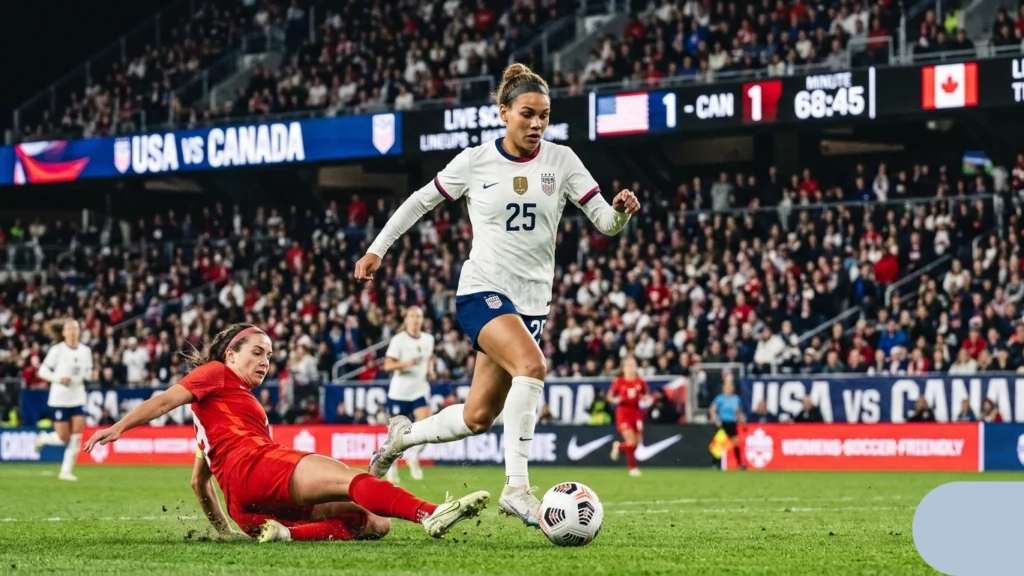
The collision of tactical philosophies between Emma Hayes and Casey Stoney will dictate the rhythm and spatial control of the match in Columbus. The strategic blueprints of both managers highlight distinct approaches to international competition, prioritizing different phases of play.
The USWNT Tactical Framework: Possession and the Double Pivot
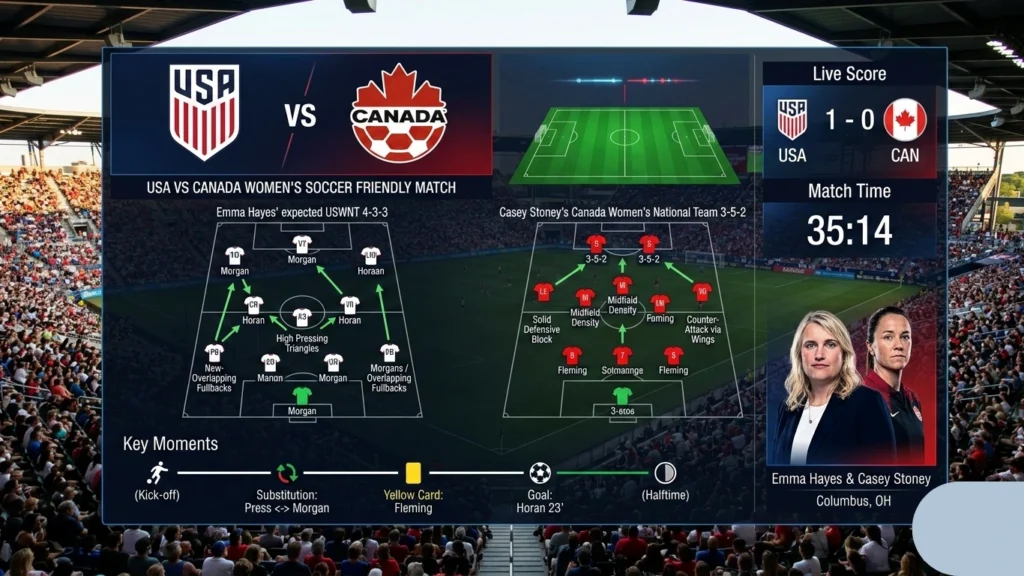
Emma Hayes has systematically overhauled the United States’ tactical approach, transitioning the squad away from a purely direct, transition-based identity toward a more sophisticated possession model. The USWNT typically operates in a fluid 4-3-3 formation, heavily reliant on midfield orchestration to unlock low-block defenses.
A core component of this system is the utilization of a double pivot in the midfield, frequently anchored by Sam Coffey alongside a dynamic partner such as Hal Hershfelt or Olivia Moultrie. This dual-holding structure forms a triangular base that facilitates secure ball circulation and provides structural cover against counterattacks. This allows the fullbacks, such as Emily Fox and Tara Rudd, to push higher up the flanks, creating numerical overloads in the attacking third.
The offensive strategy relies on the half-space exploitation by advanced playmakers like Lindsey Heaps and Rose Lavelle, who operate between the opponent’s defensive and midfield lines. When combined with the pace and verticality of the front three—often comprising Trinity Rodman, Mallory Swanson, and Sophia Smith (the “Triple Espresso” attack)—the United States forces opposing defenses into compromising lateral shifts.
Hayes emphasized the strategic vision driving these tactical decisions during a pre-tournament press conference. “It’s always about working backwards,” Hayes stated. “Our job is to get the team in a position, come World Cup qualification, that we’ve achieved the things we’ve set out to do… From a tactical perspective, first, what do we want the team to be able to master? Then, obviously, breaking it down in the volume of interactions we have… so we have a clear road map for that.”
Projected USWNT Starting Lineup (4-3-3):
- Goalkeeper: Claudia Dickey
- Defenders: Emily Fox, Naomi Girma, Emily Sonnett, Tara Rudd
- Midfielders: Sam Coffey, Lindsey Heaps (Capt.), Jaedyn Shaw
- Forwards: Trinity Rodman, Emma Sears, Jameese Joseph
Canada WNT Tactical Framework: Structural Resilience and Set-Piece Lethality
Conversely, Casey Stoney approaches the tactical design of the Canadian national team through the lens of structural discipline and opportunistic capitalization. Stripped of her preferred central defensive pairing, Stoney has engineered a resilient low-to-mid block strategy that seeks to suffocate central passing lanes and force opponents into wide, less dangerous areas of the pitch.
The victory against Colombia revealed Canada’s primary mechanism for generating offense in the absence of sustained possession: extreme lethality on set-pieces. Utilizing the precise delivery of Janine Sonis and Jessie Fleming, Canada targets the aerial supremacy of Vanessa Gilles and Jordyn Huitema. This reliance on dead-ball situations is a pragmatic adaptation to the squad’s current offensive limitations and injury constraints.
Furthermore, Stoney has instituted a culture of relentless accountability regarding physical fitness and club participation. Addressing the media, Stoney diagnosed the root cause of Canada’s previous tactical failures, explicitly calling out the lack of domestic minutes among her squad. “Get playing or you won’t get picked, because we can’t have that,” Stoney warned. “We want to try to build toward 2027; we need to be a hell of a lot better than we were tonight.”
Stoney, self-described as a “player’s coach,” acknowledges the adversity facing the program but views the structural rebuild as a necessary crucible. “When I look at my career as a player, the good times came from the bad times. We have to have adversity. It also shows us what characters we want along the journey,” she noted.
Projected Canada WNT Starting Lineup (4-2-3-1):
- Goalkeeper: Kailen Sheridan
- Defenders: Janine Sonis, Vanessa Gilles, Jade Rose, Gabrielle Carle
- Defensive Midfielders: Julia Grosso, Jessie Fleming (Capt.)
- Attacking Midfielders: Cloé Lacasse, Marie-Yasmine Alidou, Nichelle Prince
- Forward: Jordyn Huitema
Live Score Tracking and Match Statistics
Monitoring the live score dynamics of this matchup requires an understanding of the tournament’s point distribution and the aggressive nature of the participating teams. The physical metrics from Matchday One suggest that the Columbus fixture will be a grueling, high-contact affair.
During the opening matches, disciplinary actions featured prominently. Canada’s match against Colombia produced seven yellow cards and one ejection (Gisela Robledo). Canadian players Vanessa Gilles, Marie Levasseur, Cloé Lacasse, and Mimi Alidou all entered the referee’s book. Similarly, the United States endured 21 fouls committed by Argentina, resulting in yellow cards for Sofía Dominguez and Milagros Martín. Consequently, set-piece opportunities—Canada’s strength—will likely be abundant, making disciplinary control a critical factor in determining the live score outcome.
Current 2026 SheBelieves Cup Standings
Entering the second matchday at ScottsMiracle-Gro Field, the tournament standings are finely balanced. A victory for either the United States or Canada will secure absolute control of the table heading into the final matchday in Harrison, New Jersey.
| Rank | Team | Matches Played | Wins-Draws-Losses | Goals For | Goals Against | Goal Difference | Total Points |
|---|---|---|---|---|---|---|---|
| 1 | Canada | 1 | 1-0-0 | 4 | 1 | +3 | 3 |
| 2 | USA | 1 | 1-0-0 | 2 | 0 | +2 | 3 |
| 3 | Argentina | 1 | 0-0-1 | 0 | 2 | -2 | 0 |
| 4 | Colombia | 1 | 0-0-1 | 1 | 4 | -3 | 0 |
(Data sourced and verified through official U.S. Soccer SheBelieves Cup Day 1 Recap documentation.)
Context and Impact Analysis
The collision of these two North American powers extends far beyond the immediate ninety minutes of play. The match operates as a critical diagnostic tool for both federations, generating distinct short-term implications and profound long-term significance.
Short-Term Implications
In the immediate context of the 2026 SheBelieves Cup, this match serves as the de facto championship decider. Because the tournament utilizes a round-robin points system—awarding three points for a win, one for a draw, and an additional point for a penalty shootout victory in the event of a regulation tie—the victor of this contest will establish an insurmountable lead assuming typical results on the final matchday.
For the United States, securing a victory validates Emma Hayes’ heavy rotational strategy against Argentina, proving that preserving the core starting XI for the Canadian match was a calculated and successful gamble. For Canada, snapping a grueling historical losing streak against the United States would signal a monumental psychological breakthrough. Given Canada’s previous five-game winless streak entering the tournament, consecutive victories over top-tier opponents like Colombia and the USA would definitively announce the success of Casey Stoney’s tactical reset.
Long-Term Significance
The broader impact of this fixture aligns directly with the federations’ preparations for the 2027 FIFA Women’s World Cup qualification cycle.
The United States is currently executing a rapid generational transfer of power. By capping 32 new players in a condensed timeframe, Emma Hayes is aggressively expanding the player pool to prevent the athletic stagnation that plagued the program during the previous World Cup cycle. Integrating emerging talents such as Maddie Dahlien, Claire Hutton, and Lily Yohannes into high-leverage situations against a top-10 ranked Canadian side accelerates their developmental timeline. The long-term significance of this match lies in testing this youthful depth against elite, highly structured defensive blocks.
For Canada, the stakes involve re-establishing regional authority. The Canadian program possesses undeniable talent, evidenced by their 2021 Olympic gold medal, but injuries and inconsistent club minutes have fractured their tactical cohesion. The match against the United States provides Casey Stoney with a brutal but necessary stress test. Evaluating how makeshift defensive pairings—such as utilizing Janine Sonis out of her natural position or relying on inexperienced center-backs—perform against the pace of Trinity Rodman and Jaedyn Shaw will dictate Stoney’s roster construction decisions heading into the crucial Concacaf W Championship qualifiers at the end of the year.
Conclusion
The impending clash at ScottsMiracle-Gro Field represents the marquee event of the 2026 SheBelieves Cup. As the United States Women’s National Team seeks to maintain its historical dominance and tactical evolution under Emma Hayes, Canada arrives rejuvenated by a decisive opening victory and determined to execute Casey Stoney’s disciplined, set-piece-oriented strategy. The match will likely be determined by the USWNT’s ability to navigate Canada’s physical low block and Canada’s capacity to withstand the relentless pace of the American attack despite severe defensive injury deficits. As the road to the 2027 World Cup narrows, this North American rivalry continues to deliver high-stakes, physically demanding football that serves as a vital barometer for both programs.
Frequently Asked Questions (FAQ)
What time is the USA vs Canada Women’s Soccer match?
The highly anticipated match kicks off at 6:45 p.m. ET (3:45 p.m. PT) on Wednesday, March 4, 2026, at ScottsMiracle-Gro Field in Columbus, Ohio.
Where can I watch the USWNT vs Canada match?
English-language broadcast coverage is available on TNT, truTV, TBS, and streaming via HBO Max. Spanish-language viewers can watch the match on Universo, Telemundo, and streaming on Peacock.
What is the historical head-to-head record between the USWNT and Canada?
As of early 2026, the USWNT leads the extensive all-time series against Canada with 54 wins, 9 draws, and 4 losses across 67 matches, possessing a +150 goal differential.
Who is injured for the USWNT and Canada ahead of this match?
For the United States, defender Lilly Reale (foot) and Jordyn Bugg (hamstring) are officially ruled out, while Trinity Rodman (back) is available. Canada is operating without Olivia Smith (concussion), Kadeisha Buchanan, Sabrina D’Angelo, Lysianne Proulx, Jayde Riviere, and Shelina Zadorsky due to various physical ailments.
What happened the last time USA and Canada played?
The teams most recently met in an international friendly on July 2, 2025, at Audi Field in Washington, D.C. The USWNT secured a commanding 3-0 victory behind goals from Sam Coffey, Claire Hutton, and Yazmeen Ryan.
Join the Conversation
The tactical dynamics of this North American rivalry continue to evolve under the new managerial leadership of Emma Hayes and Casey Stoney. Readers are invited to share their analytical perspectives on the upcoming fixture:
- How might the outcome of this specific match impact the USWNT’s structural development and roster selection for the upcoming World Cup qualifiers?
- Can Canada’s defensive block maintain its resilience against the USA’s attacking depth despite missing key veteran center-backs?
- Which breakout player from either squad do you expect to make the most significant impact on the final scoreline?