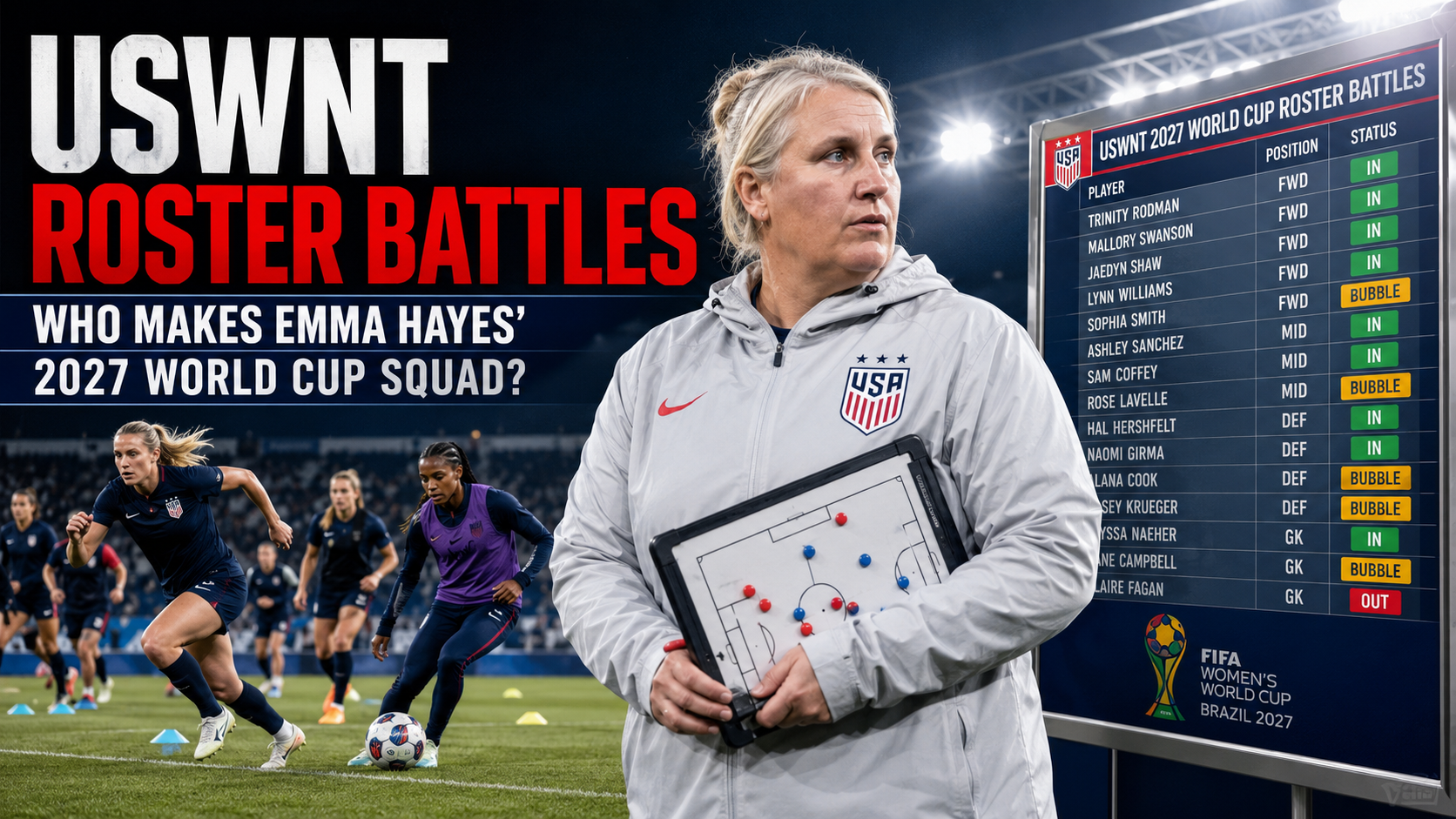
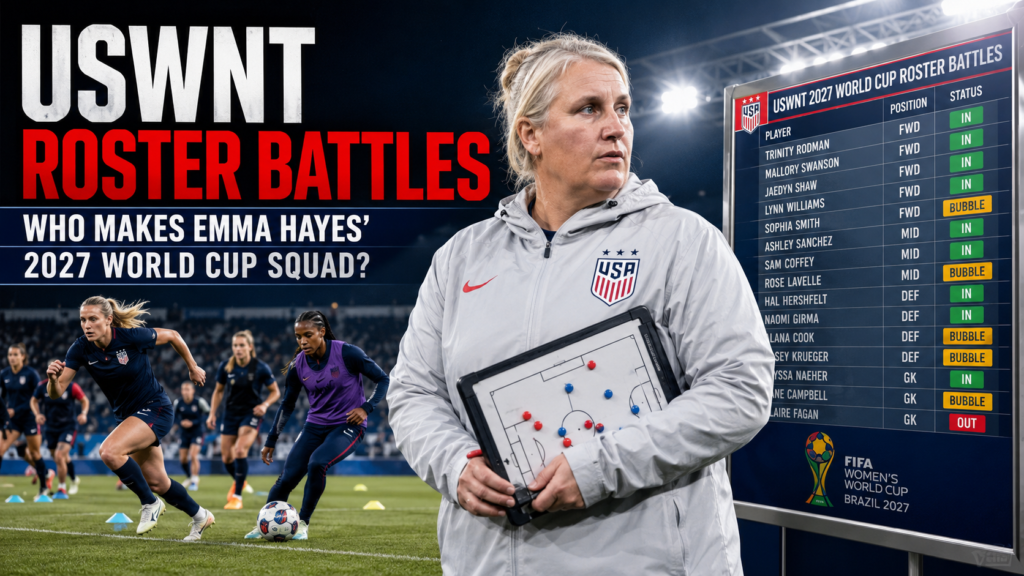
As the U.S. Women’s National Team builds toward the 2027 World Cup, head coach Emma Hayes is navigating intensive USWNT roster battles to finalize her core squad. Following the legendary retirement of veteran goalkeeper Alyssa Naeher and a wave of emerging youth talent, the selection process has become highly competitive. High-stakes testing grounds like the SheBelieves Cup and away fixtures in Brazil provide the coaching staff with essential data on tactical adaptability ahead of the Fall 2026 World Cup qualifiers.
Key Takeaways
- Wide-Open Goalkeeper Race: Following the retirement of Alyssa Naeher, the starting goalkeeper spot remains a wide-open battle among Claudia Dickey, Mandy McGlynn, and Phallon Tullis-Joyce.
- Triple Espresso Reassembled: The iconic forward trio of Trinity Rodman, Sophia Wilson, and Mallory Swanson reunited in June 2026 after 665 days apart.
- Youth Integration Underway: Emma Hayes integrated 12 debutants into the senior squad across 2025 and early 2026, substantially expanding the player selection pool.
- High-Profile Club Transfers: Key roster players like Naomi Girma and Sam Coffey secured major European moves, reshaping the competitive landscape of the player pool.
- Brazilian Mock Exam: Hostile away friendly fixtures in Brazil served as simulated tournament group stages to prepare young players for World Cup conditions.
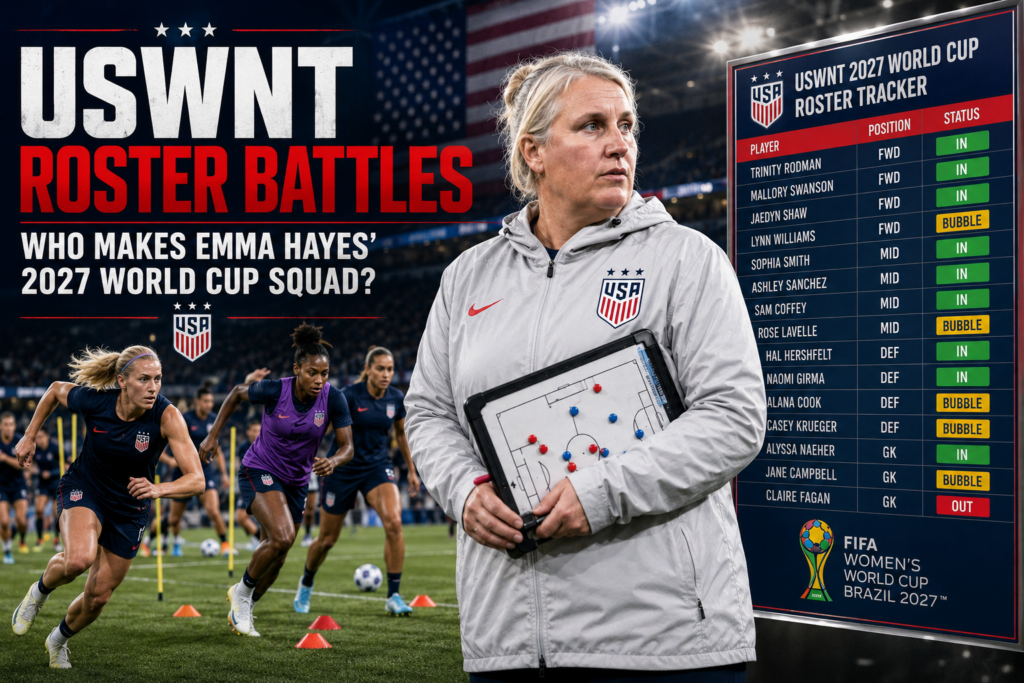
The transition from the golden era of veteran leadership to a new generation of players has accelerated under Emma Hayes. Continuous adjustments to the roster reflect a strategic effort to develop a larger, more resilient selection pool. As players compete for limited spots, the staff remains focused on balancing immediate winning results with long-term international development.
Expanding the player pool is essential for establishing the high standards required to dominate major FIFA tournaments. The intense internal competition within training camps serves to elevate the performance level of both veterans and newcomers. Hayes has emphasized that these competitive dynamics are vital for preparing the program to face elite global opponents.
Current Situation and Roster Evolution
The current training camp rosters highlight a deliberate shift toward younger talent, with over half of recent goal contributions coming from players under the age of 25. Twelve different players earned their senior team debuts during 2025 and early 2026. This influx of youth has disrupted the traditional roster hierarchy, opening up positional battles that were once considered locked down.
To facilitate this transition, Hayes established a Futures Camp and prioritized youth national team integration. These structural developments allow the coaching staff to monitor developmental progress more closely. The immediate result is a highly competitive training environment where roster spots must be earned through consistent club and international performance.
Table 1: Recent USWNT Roster Debutants (2025-2026)
| Player | Position | Current Club | Debut Window |
|---|---|---|---|
| Jordyn Bugg | Defender | Seattle Reign FC | 2025-2026 |
| Maddie Dahlien | Forward | Seattle Reign FC | 2025-2026 |
| Claudia Dickey | Goalkeeper | Seattle Reign FC | 2025-2026 |
| Claire Hutton | Midfielder | Bay FC | 2025-2026 |
| Riley Jackson | Midfielder | North Carolina Courage | 2025-2026 |
| Jameese Joseph | Forward | Chicago Stars FC | 2025-2026 |
| Tara Rudd | Defender | Washington Spirit | 2025-2026 |
| Lilly Reale | Defender | Gotham FC | 2025-2026 |
| Gisele Thompson | Defender | Angel City FC | 2025-2026 |
| Phallon Tullis-Joyce | Goalkeeper | Manchester United (ENG) | 2025-2026 |
| Kennedy Wesley | Defender | San Diego Wave FC | 2025-2026 |
| Kate Wiesner | Defender | Washington Spirit | 2025-2026 |
Tactical Breakdown of Emma Hayes’ Philosophy
Emma Hayes has built her coaching legacy on tactical pragmatism, preferring to adapt her systems to the strengths of her players and opponents. Rather than enforcing a rigid formation, she has won championships utilizing both three-back and four-back systems. This flexibility is a core pillar of her management strategy for the USWNT as they prepare for diverse tactical challenges on the international stage.
Formational Flexibility and Defensive Compactness
When deploying a 4-2-3-1 shape, Hayes utilizes a compact double pivot to screen the back line and protect central spaces. Out of possession, her wingers are instructed to narrow to force the opposition’s build-up into wide channels. Once the ball is directed wide, the full-backs aggressively jump out to press, supported by the sliding midfield line.
In possession, the number ten is given the freedom to roam between lines, creating diagonal passing lanes and combining with the central forward. Hayes’ teams are highly effective in transition, using quick vertical passes to expose unbalanced defensive blocks. The ultimate goal is to control the space in both penalty areas, maximizing high-value crossing targets and box arrivals.
The Brazilian Mock Exam and Halftime Adjustments
The June 2026 friendly matches against Brazil highlighted how these tactical principles are applied under intense physical pressure. Facing a 2-1 halftime deficit in São Paulo due to square-ball defensive errors, Hayes adjusted the team’s pressing structure. She introduced Avery Patterson and Michelle Cooper to inject physical dominance and win crucial ground duels.
The match served as a simulated tournament group stage, testing the squad’s ability to communicate through hostile stadium crowd noise. Hayes used water breaks to deliver quick tactical adjustments, helping younger players adapt to the slippery playing surface. The experience underscored the necessity of rapid ball release and physical resilience against elite global teams.
Squad Assessment and Positional Battles
The ongoing selection process has created direct competition across multiple critical units on the field. Each position group presents Hayes with distinct tactical profiles and experience levels. The coaching staff must balance proven international experience with the dynamic energy of youth.
The Vacant Goalkeeper Position
The retirement of Alyssa Naeher on December 3, 2024, created the most wide-open positional battle in recent program history. Naeher retired as a two-time World Cup champion and Olympic gold medalist, boasting 115 caps and 69 clean sheets. Her departure left a massive leadership vacuum that Hayes is actively working to fill through extensive player rotation.
Currently, Claudia Dickey, Mandy McGlynn, and Phallon Tullis-Joyce represent the primary contenders for the starting role. During the January 2026 camp in Carson, California, Hayes also integrated Bay FC’s Jordan Silkowitz to expand the training pool. No single goalkeeper has claimed the permanent starting spot, making every upcoming window vital for securing the role.
Table 2: Goalkeeper Contender Performance Metrics (Active Pool)
| Player | Club | International Caps | Key Contribution / Status |
|---|---|---|---|
| Claudia Dickey | Seattle Reign FC | 10 | Started key matches in 2026; high possession distribution |
| Mandy McGlynn | Utah Royals | 5 | Regular training camp invitee; strong shot-stopping |
| Phallon Tullis-Joyce | Manchester United (ENG) | 7 | European WSL experience; aerial dominance in the box |
| Jordan Silkowitz | Bay FC | 0 | January camp call-up; developmental prospect |
Midfield Reorganization and Global Transfers
The midfield unit is undergoing a structural evolution influenced by major club transfers to top European leagues. Sam Coffey secured a landmark transfer to Manchester City in January 2026, joining a highly competitive European environment. Additionally, young talents like Claire Hutton and Lily Yohannes are earning consistent minutes alongside established veterans Rose Lavelle and Lindsey Heaps.
Hayes’ double-pivot defensive structure demands midfielders who can cover ground and transition quickly. The integration of Croix Bethune and Riley Jackson provides the squad with creative passing options. This combination of tactical discipline and creative freedom is designed to unlock stubborn defensive low blocks.
The Triple Espresso Reunion and Motherhood on the Pitch
The June 2026 matches vs. Brazil marked the long-awaited reunion of the “Triple Espresso” front line. Trinity Rodman, Sophia Wilson, and Mallory Swanson had not shared a roster since winning Olympic gold in August 2024, spanning nearly 22 months. During their Olympic campaign, the trio combined for 10 goals and 5 assists, proving to be one of the world’s most lethal attacking units.
Both Swanson and Wilson have returned to elite international form after welcoming their children. Wilson made her return to the roster in April 2026, while Swanson rejoined the training camp in June 2026 following the birth of her daughter in November 2025. Their presence as “soccer moms” brings invaluable leadership and big-game experience back to the forward line.
Table 3: “Triple Espresso” Career and Olympic Statistics
| Player | Position | International Goals | Olympic Contributions (Paris 2024) | Motherhood Return Date |
|---|---|---|---|---|
| Trinity Rodman | Forward | 13 | 3 Goals / 1 Assist | N/A |
| Sophia Wilson | Forward | 24 | 3 Goals / 2 Assists | April 2026 (Child born Sept 2025) |
| Mallory Swanson | Forward | 38 | 4 Goals / 2 Assists | June 2026 (Child born Nov 2025) |
Key Challenges and Contextual Significance
The primary challenge facing the USWNT is translating individual talent into cohesive team chemistry under tournament conditions. With limited international windows before the World Cup qualifiers, Hayes has noted that every single minute of preparation is critical. The coaching staff must quickly identify their best starting eleven while maintaining tactical flexibility.
Managing Hostile Environments and Playing Surfaces
Playing elite opponents like Brazil in their home stadiums provides invaluable, high-pressure experience for younger players. Hayes deliberately schedules these difficult road tests to expose the squad to unique crowd noise and variable pitch qualities. Successfully navigating these external factors prepares the team mentally for the hostile environments of World Cup venues.
These fixtures also test the physical limits of the squad, requiring rapid recovery and clinical execution. If players struggle with physical duels or make technical errors under pressure, it directly impacts Hayes’ selection choices. Road matches serve as a brutal filter to determine which players can perform when global expectations are highest.
Integrating Youth in a High-Pressure Pool
Balancing the development of 12 new debutants while keeping expectations high is a delicate management task. Hayes is demanding a fierce training camp environment where standards must keep improving as players gain experience. Younger players must quickly adapt to the speed of international football to remain in the selection pool.
The rise of domestic competition, including NWSL expansion side Boston Legacy FC, further increases the pressure on the national pool. With more professional opportunities available, the talent pool continues to grow, making roster spots even harder to retain. Hayes’ focus on a “team-first” environment ensures that individual accolades are secondary to collective success.
What Comes Next for the USWNT
The USWNT will transition directly from summer training camps into the critical Fall 2026 World Cup qualifying campaign. Hayes will use the remaining matches to solidify her defensive back line and finalize her starting goalkeeper choice. With the roster size likely being trimmed for official competitive tournaments, players face immense pressure to perform in their remaining club matches.
Conclusion
Emma Hayes’ strategic approach to the USWNT roster battles has successfully revitalized the national team pool. By balancing the historic return of the “Triple Espresso” front line with a massive youth movement, the squad is positioned for long-term dominance. As the team enters the crucial qualifying cycle, the standards of performance will remain the primary metric for selection.
FAQ Section
Who are the main goalkeepers in the current USWNT roster battles?
Following Alyssa Naeher’s retirement in December 2024, Claudia Dickey of Seattle Reign, Mandy McGlynn of Utah Royals, and Phallon Tullis-Joyce of Manchester United are the primary contenders. Hayes is utilizing heavy rotation in training camps to evaluate their shot-stopping and distribution skills.
What is the “Triple Espresso” and when did they reunite?
The “Triple Espresso” is the self-monikered attacking trio of Trinity Rodman, Sophia Wilson, and Mallory Swanson. They reunited in June 2026 for matches against Brazil, marking their first joint roster appearance since winning the Olympic gold medal in August 2024.
How many debutants has Emma Hayes integrated into the USWNT?
Under Hayes’ direction, twelve players made their senior international debuts during 2025 and early 2026. These young players include Jordyn Bugg, Maddie Dahlien, Claire Hutton, Riley Jackson, Tara Rudd, Lilly Reale, Gisele Thompson, Phallon Tullis-Joyce, Kennedy Wesley, and Kate Wiesner.
When did Alyssa Naeher officially retire from the USWNT?
Alyssa Naeher retired from international duty on December 3, 2024, after a friendly against the Netherlands. She completed a highly decorated eleven-year international career, earning two World Cup titles, an Olympic gold medal, and recording 69 clean sheets for her country.
Which USWNT players recently completed major European transfers?
Star defender Naomi Girma completed a world-record transfer from San Diego Wave FC to Chelsea FC in January 2025 for a reported £900,000. Midfield star Sam Coffey also completed a landmark transfer from Portland Thorns FC to Manchester City in January 2026.
What was the purpose of the USWNT matches against Brazil in June 2026?
Hayes utilized the away matches against World Cup hosts Brazil as a “mock exam” to prepare her squad for hostile international tournament conditions. The matches tested young players against loud stadium noise, slippery grass pitches, and high-intensity.