Introduction to the 2026 Landscape
The landscape of the United States Women’s National Team (USWNT) in early 2026 represents a profound inflection point. Transitioning from the triumphs of the 2024 Paris Olympics, the program under head coach Emma Hayes is meticulously laying the groundwork for the 2027 FIFA Women’s World Cup. The 2026 SheBelieves Cup serves not merely as an invitational friendly tournament, but as a high-stakes crucible designed to test tactical adaptability, emotional resilience, and roster depth against elite global competition.
Beyond the pitch, the culture of American women’s soccer is simultaneously undergoing a generational paradigm shift. The sport is witnessing the rise of unprecedented youth professionalization within the National Women’s Soccer League (NWSL), while the national team itself grapples with passing the torch of social and ideological leadership. This comprehensive report analyzes the current state of the USWNT, examining the tactical nuances of their 2026 SheBelieves Cup campaign, the ongoing roster attrition, the broader socio-political responsibilities inherited by the new generation, the media narratives that continue to shape the global perception of women’s sports, and the cultural legacy immortalized in upcoming media such as Netflix’s The 99’ers.
Tactical Pragmatism and Game Management Under Emma Hayes
The tactical philosophy instituted by Emma Hayes marks a departure from the historical USWNT reliance on overwhelming athletic superiority and high-scoring transitional play. Hayes has systematically introduced a European-style pragmatism, prioritizing possession control, defensive solidity, and meticulous game management. This strategic pivot was explicitly evident during the 2026 SheBelieves Cup, particularly in the team’s ability to navigate high-pressure situations without conceding structural integrity.
The Value of the “Knife-Edge” Victory
During the second matchday of the SheBelieves Cup on March 4, 2026, the USWNT secured a narrow 1-0 victory over regional rival Canada at ScottsMiracle-Gro Field in Columbus, Ohio. While a narrow one-goal margin might historically induce anxiety among the American fanbase, Hayes actively celebrated the result. She emphasized the developmental necessity of winning matches that remain “on a knife edge at one-nil”.
The underlying rationale is rooted in tournament simulation. In the knockout stages of a World Cup, early multi-goal leads are a rarity. By navigating a tight 1-0 scenario, the team is forced to answer critical questions regarding game management: how to maintain composure, how to dictate the tempo without overcommitting numbers forward, and how to psychologically survive when the insurance of a second goal fails to materialize. Hayes noted that managing the final ten minutes of the Canada match was “indicative of maturity” and praised the squad for “growing up”.
This represents a higher-order evolution in the team’s psychological profile. Hayes deliberately contrasted this tight victory with a previous 3-0 friendly win over Canada in July 2025, which she dismissed as being “surprisingly so” comfortable, implying that such easy victories offer little diagnostic value for a coaching staff preparing for global tournaments. The ability to close out a match against a top-10 FIFA-ranked opponent utilizing possession as a defensive tool highlights a significant step forward in the team’s tactical maturity.
Defensive Dominance and the Shutout Streak
The foundation of this pragmatic approach is an impenetrable defensive block. Following the 1-0 victory against Canada, the USWNT extended a historic defensive streak, notching their seventh consecutive clean sheet. The defensive unit has not conceded a single goal since October 23, 2025, during a 3-1 victory over Portugal, extending their shutout streak to an astonishing 714 minutes of international play.
This defensive solidity is anchored by center-back Naomi Girma, who earned her 51st cap during the Canada match. Girma operates alongside veteran Emily Sonnett, creating a pairing that blends elite spatial awareness with aggressive ball-winning capabilities. The system also integrates aggressive fullbacks, notably the 20-year-old Gisele Thompson. Against Canada, Thompson was deployed at left-back and tasked with a grueling 90-minute shift—her second consecutive full match of the tournament. Hayes explicitly stated that her goal with Thompson is to make her “more durable,” forcing the young defender to adapt to the physical toll required to compete consistently at the international level.
Behind the backline, the integration of new goalkeeping talent has been seamless. Phallon Tullis-Joyce earned the start against Canada, making her first SheBelieves Cup appearance and demonstrating absolute confidence in net to preserve the shutout. The structural discipline of the 4-3-3 formation, heavily reliant on a double pivot in the midfield to shield the center-backs, has effectively neutralized opposing transition attacks.
Offensive Structure and the Hybrid Nine
Offensively, the USWNT system under Hayes relies heavily on possession dominance and the exploitation of half-spaces. Against Canada, the United States commanded 68% of the possession in the first half and outshot their northern neighbors 18-6 over the course of the match, generating 11 corner kicks to Canada’s two.
A central component of this attacking structure is the evolution of the center-forward position. Due to the absences of traditional attackers, 22-year-old Ally Sentnor was deployed as the primary number nine against Canada. While Sentnor operates in different roles for her club, the Kansas City Current, she noted that she grew up playing as a nine and is actively working on specific tactical instructions from Hayes, such as playing with her “back to goal”.
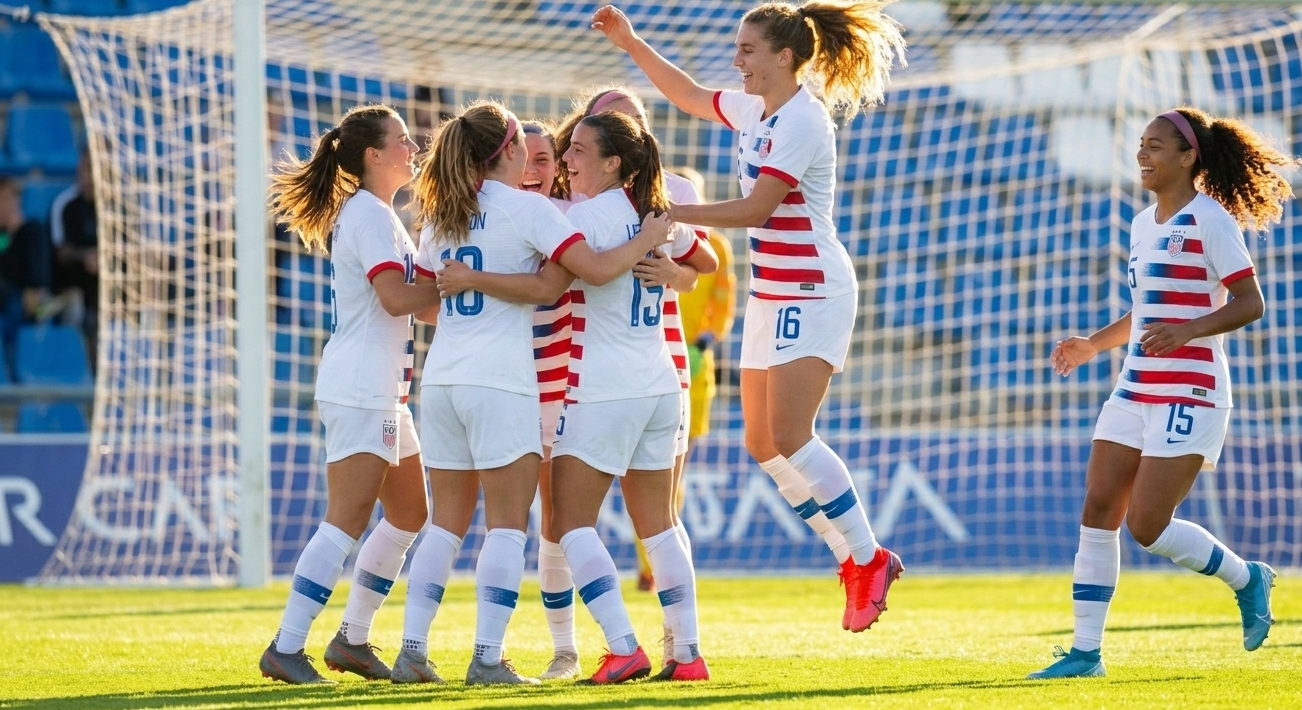
Sentnor’s performance highlighted the effectiveness of a fluid, non-generic striker. Her match-winning goal in the 55th minute was a masterclass in spatial recognition and technical execution. Following a low, curling corner kick, the ball slipped past multiple defenders. Sentnor exhibited elite composure, settling the bouncing ball before executing a left-footed half-volley into the far post, securing her seventh international goal and her team-leading third of the 2026 calendar year. The offensive philosophy is clear: utilize dynamic forwards to initiate a high press, turn the ball over in the attacking third, and capitalize on the resulting structural disorganization of the opponent.
Rose Lavelle and the Ohio Connection
A critical element of the USWNT’s offensive success during the Columbus fixture was the performance of veteran midfielder Rose Lavelle. Operating at the top of the midfield triangle, Lavelle was tasked with breaking lines and creating numerical advantages in the final third. Her impact was magnified by the location of the match; playing at ScottsMiracle-Gro Field in Columbus served as a homecoming for the Cincinnati, Ohio native.
Lavelle, affectionately dubbed the “Skyline Messi” by fans in reference to her Ohio roots and technical brilliance, earned her 117th cap during the match, making her the most experienced player in the starting XI. Her presence provided a vital anchor of veteran leadership for a relatively young squad. Lavelle’s technical interplay with forwards Alyssa Thompson, Trinity Rodman, and Ally Sentnor kept the Canadian defense constantly retreating.
The culmination of Lavelle’s homecoming performance occurred in the 55th minute. Taking an in-swinging corner kick from the left side, Lavelle delivered a perfectly weighted ball that bypassed the first line of Canadian defenders, dropping precisely into the path of Sentnor for the game-winning goal. This marked Lavelle’s 28th career assist for the national team and extended her streak of contributing to scoring plays to three consecutive matches.
The celebration of Lavelle’s Ohio roots underscores a broader strategy by U.S. Soccer to cultivate deep regional connections with its fanbase. By scheduling crucial tournament matches in soccer-rich environments like Ohio, the federation maximizes home-field advantage while honoring the developmental pathways that produced its star players.
Match Analysis: The 2026 SheBelieves Cup Campaign
The SheBelieves Cup format provides a grueling simulation of a World Cup group stage, requiring teams to play three matches in tight succession. The 2026 iteration, featuring the USA, Canada, Colombia, and Argentina, tested the USWNT’s ability to handle diverse tactical styles and physical provocations.
Matchday 1: Chaos and Emotional Control Against Argentina
The USWNT opened their campaign in Nashville, Tennessee, on March 1, 2026, with a 2-0 victory over Argentina. While the scoreline appeared routine, the match devolved into a highly physical, scrappy affair characterized by persistent fouling and escalating tensions. Argentina deployed an aggressive counter-pressing scheme designed to disrupt American passing lanes, relying heavily on cheap shots and physical intimidation to unsettle the younger USWNT players.
The defining moment of provocation occurred in the second half. Argentine midfielder Evelyn Dominguez blatantly pulled the hair of USWNT forward Jaedyn Shaw to halt a dribble. Such an overt act of aggression could easily have incited a retaliatory response, potentially leading to a red card. However, Shaw maintained her emotional discipline, refusing to escalate the physical confrontation, later noting that she focused heavily on maintaining emotional control to avoid jeopardizing the team. Shaw channeled her frustration into her performance, subsequently scoring the team’s second goal in the 56th minute with a spectacular curling shot from the top of the box.
The opening goal was provided by veteran captain Lindsey Heaps in the 19th minute, securing her 12th consecutive calendar year with a national team goal. Heaps’s leadership was instrumental in steadying the squad amidst the chaos, engaging with the officials to advocate for her teammates while keeping the younger players focused on the tactical game plan. Goalkeeper Claudia Dickey also delivered a vital performance, maintaining the clean sheet despite the unpredictable nature of the match.
For Emma Hayes, the chaotic nature of the Argentina match was highly beneficial. She referred to the game as “spicy” and praised her players for their emotional control. Hayes explicitly warned her squad that in a World Cup environment, losing emotional control and suffering a red card over a provocation like a hair-pull could instantly end a tournament run. “If we were seeking perfection, then I might be approaching something differently, but I’m here to develop a whole squad to be ready for these situations,” Hayes remarked, validating the importance of exposure to CONCACAF and CONMEBOL-style physicality.
Roster, Lineups, and Broadcast Distribution
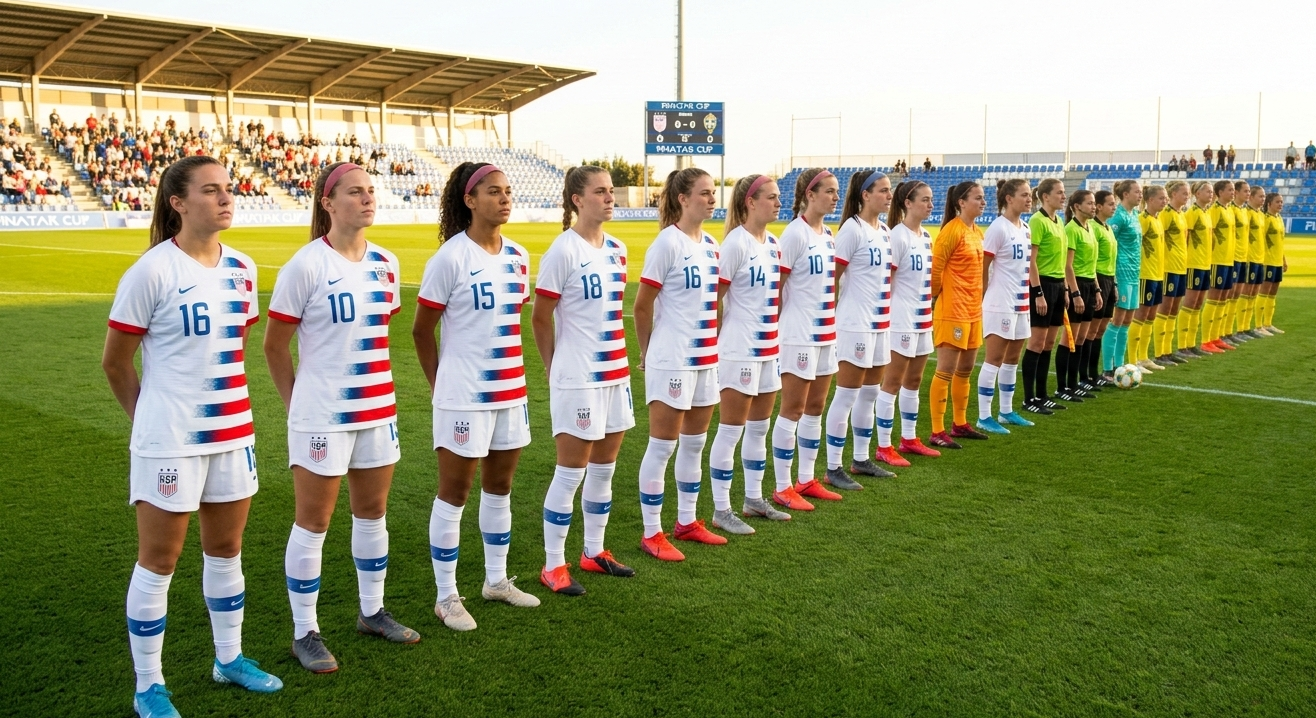
Entering the Canada match, Hayes rotated the squad heavily from the physical battle against Argentina, making ten changes to the starting XI. The starting lineup against Canada featured a blend of World Cup veterans and emerging stars, averaging 47.3 caps per player—the most experienced lineup fielded by the USWNT since October 2025.
The detailed Starting XI and substitutions for the March 4 match against Canada were structured as follows:
| Position | Player | Cap Number (Including Match) | Club Affiliation |
|---|---|---|---|
| Goalkeeper | Phallon Tullis-Joyce | 5 | Manchester United |
| Defender | Emily Fox | 72 | Arsenal FC |
| Defender | Naomi Girma (Capt.) | 51 | Chelsea FC |
| Defender | Emily Sonnett | 114 | Gotham FC |
| Defender | Gisele Thompson | 7 | Angel City FC |
| Midfielder | Sam Coffey | 43 | Manchester City |
| Midfielder | Claire Hutton (Sub: L. Heaps, 79′) | 15 | Bay FC |
| Midfielder | Rose Lavelle (Sub: L. Yohannes, 79′) | 117 | Gotham FC |
| Forward | Trinity Rodman (Sub: E. Sears, 69′) | 51 | Washington Spirit |
| Forward | Ally Sentnor | 17 | Kansas City Current |
| Forward | Alyssa Thompson (Sub: J. Shaw, 90′) | 28 | Angel City FC |
Note: Data derived from official U.S. Soccer Match Reports.
The tournament was heavily distributed across major broadcast networks to maximize viewership. Fans were able to watch the USWNT versus Canada match live on TNT, truTV, and the HBO Max streaming platform in English, with Spanish-language broadcasts available on Universo and Peacock. The final match against Colombia was scheduled for broadcast across TBS, truTV, HBO Max, Telemundo, Universo, and Peacock, ensuring comprehensive national coverage for the title-deciding fixture.
Tournament Standings and Final Scenarios
Entering the final matchday at Sports Illustrated Stadium in Harrison, New Jersey, the tournament standings reflected the USWNT’s dominance :
| Team | Matches Played | Wins | Draws | Losses | Goals For | Goals Against | Goal Differential | Points |
|---|---|---|---|---|---|---|---|---|
| USA | 2 | 2 | 0 | 0 | 3 | 0 | +3 | 6 |
| Canada | 2 | 1 | 0 | 1 | 4 | 2 | +2 | 3 |
| Colombia | 2 | 1 | 0 | 1 | 2 | 4 | -2 | 3 |
| Argentina | 2 | 0 | 0 | 2 | 0 | 3 | -3 | 0 |
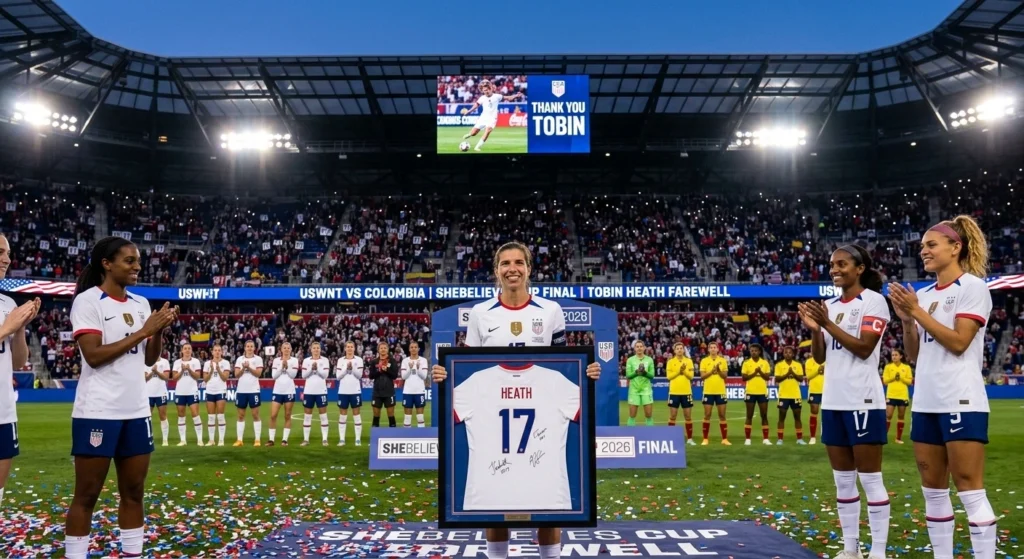
To capture their eighth overall SheBelieves Cup title, the USWNT required only a win or a draw against Colombia in their final match. The finale was also scheduled to serve as a cultural celebration, honoring the retirement and Hall of Fame induction of USWNT legend Tobin Heath in a pregame ceremony.
Roster Attrition, Injuries, and Strategic Absences
The grueling nature of the modern women’s soccer calendar inevitably results in roster attrition. The 2026 SheBelieves Cup camp forced Emma Hayes to navigate significant injury hurdles and strategic absences, testing the “endless depth” of the American player pool.
The Physical Toll on Trinity Rodman
Forward Trinity Rodman entered the 2026 campaign as one of the most dynamic attackers on the roster. Standing at 5-foot-8, the daughter of former NBA star Dennis Rodman blends elite physical attributes with technical precision. However, her physical durability has been a recurring concern. During the final moments of the opening match against Argentina, Rodman suffered a hard challenge that aggravated a lingering back injury—an issue that had plagued her throughout much of the 2025 season and kept her out of national team camps since the previous April.
Despite the scare and visible discomfort that required immediate medical attention, Rodman’s recovery protocol was successful. She was cleared to start against Canada just days later, providing a highly encouraging 69-minute shift before being systematically substituted for Emma Sears to manage her physical load.
In-Camp Injuries and Adjustments
The goalkeeper union suffered a severe setback when Utah Royals goalkeeper Mandy McGlynn was forced to depart the SheBelieves Cup camp due to a severe finger injury. Because tournament regulations prohibit roster replacements once the competition has commenced, the USWNT was forced to proceed with a reduced 24-player squad for the remainder of the cup.
The defensive corps also required recalibration prior to the tournament. Washington Spirit defender Kate Wiesner was ruled out of the camp and subsequently replaced by Houston Dash defender Avery Patterson. Furthermore, Gotham FC defender Lilly Reale, the 2025 NWSL Rookie of the Year, suffered a foot injury during the physical clash with Argentina and had to exit the camp prematurely.
High-Profile Absences
The tactical setup of the front line was heavily influenced by the absence of elite veteran forwards. Sophia Smith (now Wilson) was unavailable, listed as not physically ready for international competition following the offseason, prioritizing recuperation ahead of the club season.
Similarly, Mallory Swanson was conspicuously absent from the roster. Swanson, a historically pivotal figure who scored the gold-medal-winning goal at the Paris Olympics, missed the camp due to “personal commitments” rather than physical injury. Reports indicated that her husband, Major League Baseball player Dansby Swanson, had recently undergone hernia surgery, necessitating her absence from both the national team and the start of the Chicago Stars’ preseason training.
These absences, while challenging, accelerated the developmental timeline for players like Ally Sentnor and Jaedyn Shaw, forcing them to assume primary goal-scoring responsibilities against elite international defenses, ultimately expanding the tactical flexibility of the squad.
The Youth Revolution: Expanding the American Pipeline
The tactical maturation of the USWNT is inextricably linked to a broader, systemic youth revolution occurring within the domestic infrastructure of American soccer. The historical paradigm—where players developed exclusively through the NCAA collegiate system before turning professional in their early twenties—has been permanently shattered.
Shifting Demographics in the NWSL
The vanguard of this demographic shift was Olivia Moultrie, who successfully sued the NWSL in 2021 to dismantle the league’s age limit, signing her first professional contract with the Portland Thorns at the age of 15. Moultrie’s legal victory opened the floodgates for prodigious domestic talent to bypass the collegiate system entirely and enter elite professional environments during their formative developmental years.
This trend reached a new historical milestone in March 2025, when McKenna “Mak” Whitham debuted for NJ/NY Gotham FC at the age of 14 years and 8 months, officially becoming the youngest player to appear in an NWSL regular-season match. Whitham had already made history by signing a four-year professional contract at age 13, alongside securing a groundbreaking Name, Image, and Likeness (NIL) deal with Nike, highlighting the immense commercial viability of elite youth prospects.
The current landscape is populated by teenagers logging significant professional minutes. Players like Melanie Barcenas, who signed with the San Diego Wave at age 15, and Alex Pfeiffer, who signed with the Kansas City Current at 16, have proven that elite youth development in the United States is accelerating rapidly.
Integration into the Senior National Team
Emma Hayes has aggressively capitalized on this expanded pipeline. The integration of 20-year-old Gisele Thompson and 21-year-old Alyssa Thompson into the starting lineup against Canada marks a deliberate strategy to close the experience gap prior to the 2027 World Cup.
Furthermore, U.S. Soccer has institutionalized this pathway. The concurrent scheduling of U.S. Youth National Team Development Camps—featuring players born between 2003 and 2008—alongside the senior team’s January camps in California ensures a seamless tactical transition from the youth ranks to the senior squad. This youth movement ensures that when veterans eventually age out of the system, their replacements already possess years of professional domestic experience and deep integration into the national team’s tactical philosophy.
The Burden of the Crest: Ideological Leadership and Social Responsibility
To wear the crest of the United States Women’s National Team is to assume a dual mandate: unparalleled athletic excellence and uncompromising social advocacy. For over a decade, the program’s identity was defined by figures like Megan Rapinoe, Alex Morgan, and Becky Sauerbrunn, who utilized their global platform to champion equal pay, LGBTQ+ rights, and systemic gender equity. As this vanguard transitions into retirement, the current generation is grappling with how to carry this ideological burden.
Sam Coffey and the Search for Authentic Advocacy
Midfielder Sam Coffey, recently transferred to Manchester City in the Women’s Super League for a fee exceeding $800,000, has emerged as one of the prominent voices attempting to articulate this transitional phase. Ahead of the 2026 SheBelieves Cup, Coffey addressed the media regarding the team’s socio-political footprint.
Coffey candidly acknowledged the vacuum left by the previous generation, noting that younger players previously relied on “the Beckys, the Klings, the Pinoes, [and] the Alex Morgans” to dictate the team’s public stance on complex issues. “But now that responsibility is on us,” Coffey stated, explicitly defining this advocacy as a “duty to this team and a standard to uphold”.
However, Coffey also revealed an internal friction, admitting she has been “personally wrestling” with what collective action looks like for the current, younger iteration of the squad. She stressed that the USWNT must remain a “beacon of light in times of darkness” and an advocate for the voiceless, pointing to past actions such as wearing ‘Protect Trans Kids’ wristbands. Yet, she conceded that the team is still “figuring out” how to be vocal and authentic in a rapidly polarizing political climate. This introspection highlights the intense external pressure placed on USWNT athletes to serve as moral arbiters, a standard rarely demanded of their male counterparts.
Megan Rapinoe’s Enduring Cultural Weight
Even in retirement, former players continue to wield massive cultural influence. Megan Rapinoe remains a lightning rod for socio-political discourse, utilizing her platform, such as the A Touch More podcast co-hosted with Sue Bird, to critique institutional messaging.
In late 2025 and early 2026, Rapinoe directed her ire at the U.S. Men’s National Team (USMNT) and U.S. Soccer over their official marketing campaign for the 2026 FIFA World Cup. The USMNT launched a 90-second promotional film, narrated by Saturday Night Live comedian Marcello Hernández, featuring the slogan “Never Chase Reality”. The federation intended the slogan to signify “ignoring the odds and daring to dream,” embracing the statistical unlikelihood of the American men winning the tournament and framing their ambition as a pursuit of the ultimate American Dream against overwhelming global favorites.
Rapinoe fundamentally deconstructed and rejected this framing. She argued that the slogan inherently projected weakness and an inferiority complex, stating, “I don’t think it’s saying what you think it’s saying… to me it said like you already think you’re not good”. She suggested that a simpler, more confident mandate like “Dream Big” would have been vastly preferable.
This critique underscores a fascinating dichotomy between the men’s and women’s programs. The USWNT, burdened by a history of absolute global supremacy, views anything less than a gold medal as a catastrophic failure, breeding a culture of supreme, sometimes abrasive, self-belief. The USMNT, conversely, operates from an underdog posture on the global stage. Rapinoe’s inability to reconcile with the men’s self-deprecating marketing angle perfectly encapsulates the divergent psychological realities of the two federations.
Deconstructing Misogynistic Tropes in Soccer Media
The intense spotlight on women’s soccer inevitably attracts bad-faith actors who seek to undermine the athletic legitimacy of the sport. The most persistent and weaponized narrative against the USWNT is the historical anecdote regarding a scrimmage against a team of 15-year-old boys.
Contextualizing the “U15 Boys” Scrimmage
In 2017, it was widely reported that the reigning World Cup champion USWNT lost an informal scrimmage 5-2 to the FC Dallas Under-15 boys’ academy team. For years, this isolated data point has been relentlessly circulated across social media and right-wing publications to argue against equal pay, mock the quality of the women’s game, and insert transphobic rhetoric into sports discourse regarding biological advantages.
An objective, expert analysis of this event completely dismantles the bad-faith arguments. As confirmed by USWNT legend Carli Lloyd, the match was a deliberate, highly informal training exercise designed specifically to expose the team’s defensive flaws ahead of a friendly against Russia. Following a poor defensive showing at the Rio Olympics, the coaching staff intentionally sought out the fastest, most physically imposing academy team available to stress-test the women’s transition defense and combination play.
Biologically, elite mid-pubescent male academy players (often aged 15-16) possess significant advantages in absolute top-end sprint speed and fast-twitch acceleration due to the onset of testosterone production. The FC Dallas team in question was not a random assortment of children; it featured future professional and USMNT players, including Tanner Tessmann, who currently plays in Serie B. The USWNT used these scrimmages as dynamic resistance training. They were not attempting to win a competitive match; they were running tactical drills against faster athletes to improve their reaction times. As Lloyd bluntly summarized, “They should beat us. Bigger, stronger, faster! Boys always gave us a run for our money! It was great prep”. Following that specific preparation, the USWNT went on to win the 2019 FIFA Women’s World Cup.
A Global Phenomenon of Weaponized Data
This phenomenon is not isolated to the United States. In recent years, the Swiss Women’s National Team, featuring global stars like Alisha Lehmann, played a behind-closed-doors training match against the Luzern U15 boys team as a warm-up for Euro 2025 and lost 7-1.
Once again, the result was leaked via TikTok and weaponized online by anti-women’s sports advocates to disparage female athletes. This ignores the fundamental reality that elite women’s teams globally use male youth academies as high-speed sparring partners strictly for physiological conditioning. The weaponization of these training exercises highlights a fundamental sports literacy deficit among critics who conflate structured tactical preparation with competitive athletic hierarchy. Professional female tennis players frequently use male hitting partners to practice returning heavier serves; women’s soccer teams utilize male academies for the exact same purpose.
Immortalizing the Vanguard: Netflix’s The 99’ers
While the 2026 squad fights to establish its own legacy, the foundation upon which modern women’s soccer rests is being immortalized in popular culture. In early 2026, streaming giant Netflix finalized casting for The 99’ers, a highly anticipated sports drama chronicling the USWNT’s historic 1999 FIFA Women’s World Cup victory.
Directed by Nicole Kassell and based on Jeré Longman’s seminal book The Girls of Summer, the film captures the cultural explosion of women’s sports that culminated in the Rose Bowl final against China. Played before a staggering 93,000 fans under a scorching summer sun, the match ended in a dramatic penalty shootout victory, universally recognized as the catalyst that funded modern professional leagues and inspired the generations of players now occupying the 2026 roster.
The production has drawn significant mainstream media attention for its star-studded ensemble cast, tasked with portraying the architects of American soccer supremacy :
| Real-Life Figure | Role / Position | Portrayed By (Actor) |
|---|---|---|
| Mia Hamm | Legendary Forward | Emily Bader |
| Marla Messing | U.S. Soccer Executive | Zoey Deutch |
| Brandi Chastain | Defender (Scored winning PK) | Julia McDermott |
| Briana Scurry | Goalkeeper | Shaunette Renée Wilson |
| Michelle Akers | Forward / Midfielder | Perry Mattfeld |
| Carla Overbeck | Defender / Team Captain | Annabel O’Hagan |
| Kristine Lilly | Midfielder | Lizzy Greene |
| Joy Fawcett | Defender | Isabelle Fuhrman |
| Julie Foudy | Midfielder | Emilia Jones |
| Tony DiCicco | Head Coach | Alessandro Nivola |
Note: Data aggregated from official Netflix casting announcements.
The development of this film serves as a poignant mirror to the current state of the national team. The ’99ers built the initial infrastructure that allows a 14-year-old McKenna Whitham to sign a professional Nike contract today, and they established the culture of ideological advocacy that Sam Coffey and her teammates are currently wrestling to uphold.
Conclusion
As the U.S. Women’s National Team navigates the complex demands of the 2026 season, the program is operating on multiple, highly sophisticated fronts. On the pitch, Emma Hayes is successfully transitioning the squad away from a historical reliance on sheer athleticism toward a European model of tactical pragmatism, defensive suffocation, and emotional control. This was perfectly evidenced by their meticulous, drama-free management of the 1-0 victory over Canada in the SheBelieves Cup, supported by the tactical brilliance of veterans like Rose Lavelle and emerging stars like Ally Sentnor.
Simultaneously, Emma Hayes is expertly managing the physical realities of roster attrition, balancing the loads of star players like Trinity Rodman while compensating for the absences of elite scorers like Mallory Swanson and Sophia Smith. The integration of exceptionally young talent, driven by the dismantling of age restrictions in the NWSL, ensures that the American pipeline remains heavily stocked with tactically astute professionals.
Off the pitch, the ecosystem of women’s soccer remains a battleground of cultural ideologies. The players are navigating an intense socio-cultural landscape, burdened with an inherited legacy of social justice activism. Players like Sam Coffey are actively searching for the squad’s authentic voice in a polarized era, while veterans like Megan Rapinoe continue to hold broader soccer institutions accountable for their messaging. Furthermore, the sport continues to defend itself against weaponized, bad-faith media narratives regarding biological comparisons, requiring constant contextualization of their training methodologies.
Ultimately, the 2026 iteration of the USWNT is not merely preparing for the 2027 World Cup; they are actively renegotiating what it means to be an elite female athlete in America, standing firmly on the shoulders of the ’99ers while forging a decidedly modern, highly tactical path forward.
Frequently Asked Questions (FAQs)
Q: Who scored the winning goal for the USWNT against Canada in the 2026 SheBelieves Cup?
A: Ally Sentnor scored the game-winning goal in the 55th minute of the 1-0 victory over Canada, assisted by Rose Lavelle.
Q: Why didn’t Mallory Swanson play in the 2026 SheBelieves Cup?
A: Mallory Swanson missed the camp due to “personal commitments” as she prepared for the upcoming NWSL season.
Q: Who is the youngest girl to go pro in soccer?
A: McKenna “Mak” Whitham is the youngest player to appear in an NWSL regular-season match, debuting for NJ/NY Gotham FC at the age of 14 years and 8 months in March 2025.
Q: Did a team of 15-year-old boys beat the women’s soccer team?
A: Yes, the USWNT lost an informal 2017 training scrimmage 5-2 against the FC Dallas U-15 boys team. Former players like Carli Lloyd have clarified that elite women’s teams frequently use male youth academies as high-speed sparring partners strictly for physiological conditioning and tactical preparation.
Q: How tall is Trinity Rodman?
A: Trinity Rodman, daughter of former NBA star Dennis Rodman, is listed as being 5-foot-8.
Q: Who is starring in the new Netflix movie about the ’99ers?
A: The upcoming Netflix film The 99’ers features Zoey Deutch as Marla Messing, Emily Bader as Mia Hamm, Julia McDermott as Brandi Chastain, and Shaunette Renée Wilson as Briana Scurry