


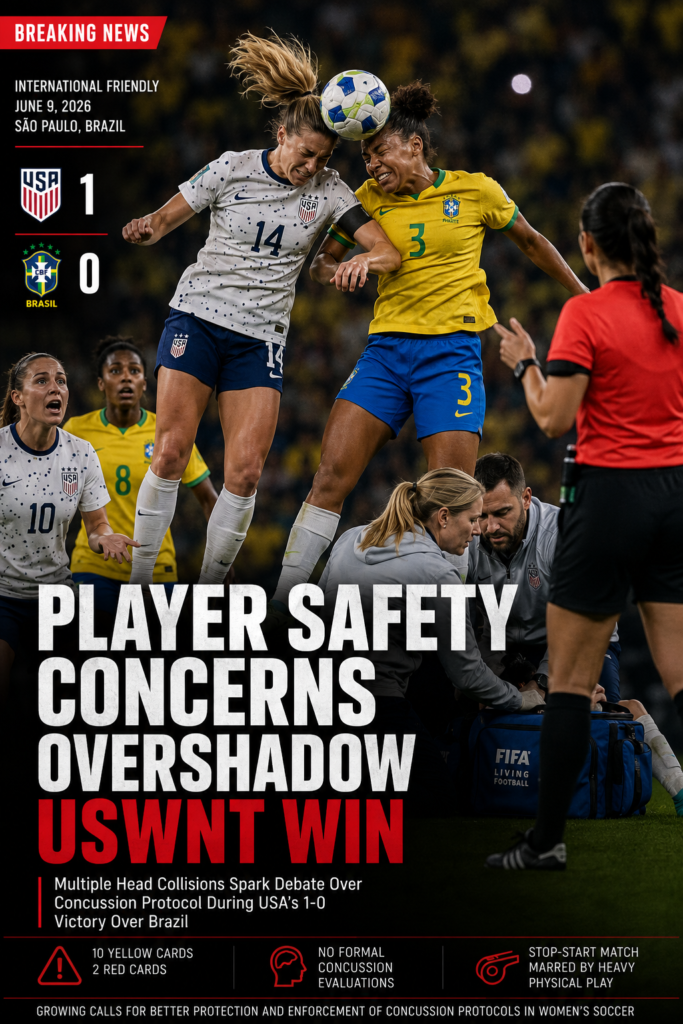
On June 9, 2026, the United States Women’s National Team defeated Brazil 1-0 in a highly physical friendly match in São Paulo, Brazil, but the victory was heavily overshadowed by growing player safety concerns. Disgruntled supporters took to social media to criticize the on-field USWNT vs Brazil concussion protocol after multiple high-velocity aerial collisions went completely unaddressed by match officials. With defensive star Emily Fox substituted at halftime and Brazil’s Dudinha forced off early with an injury, fans are demanding to know why elite players continue to be subjected to dangerous head trauma without immediate, independent medical intervention.
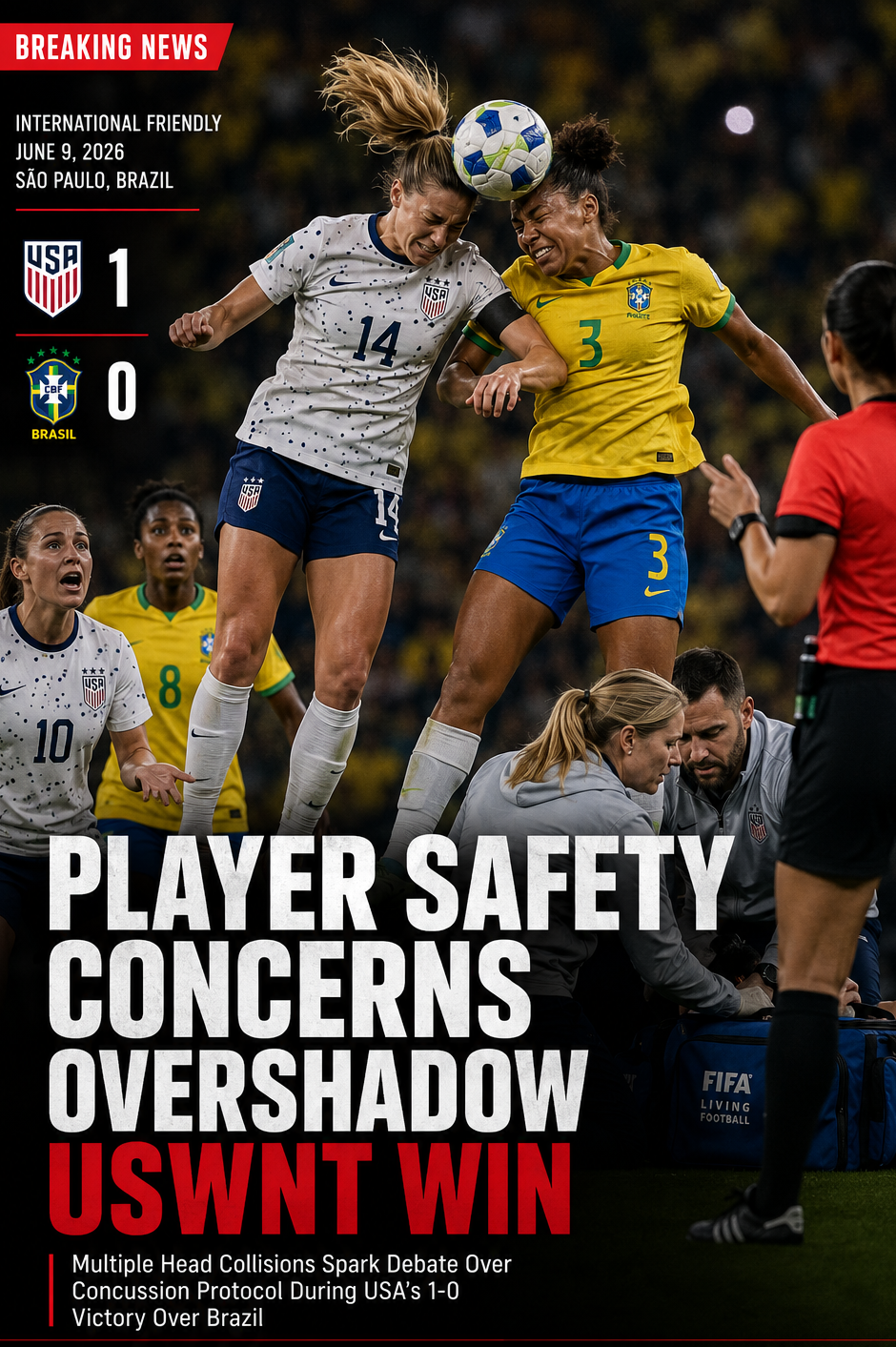
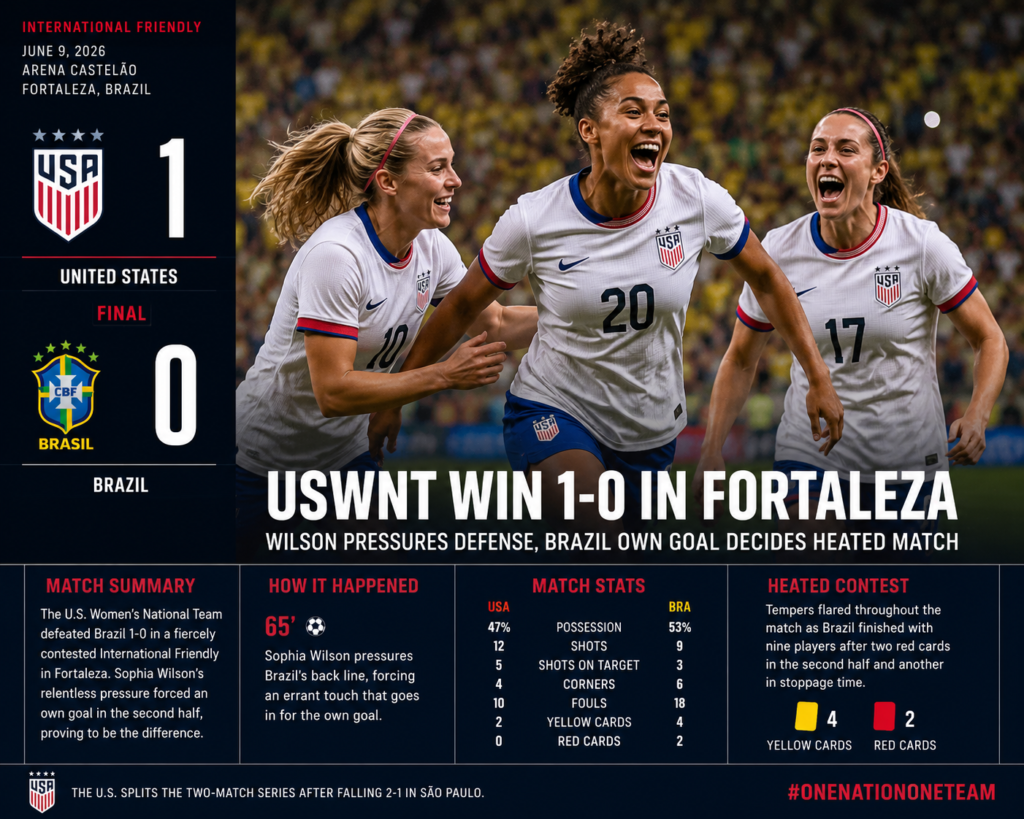
On June 9, 2026, the United States women’s soccer team took the pitch against Brazil in São Paulo for the second of two highly anticipated international friendlies. What was billed as a tactical preparation match quickly turned into an incredibly physical battle defined by intense midfield duels. The U.S. ultimately walked away with a hard-fought 1-0 victory, secured by an unfortunate own goal from Brazilian defender Isabela Chagas in the 62nd minute.
The match was far from a clean tactical display, quickly descending into a stop-start affair marked by heavy tackling. Referees struggled to maintain control as players on both sides committed aggressive challenges, resulting in a total of ten yellow cards and two expulsions. Brazil’s Beatriz Zaneratto João received her second yellow card in the 93rd minute of stoppage time, and her teammate Tarciane was shown a straight red card in the 98th minute to cap off a chaotic evening.
This physical escalation was a key highlight of our women’s soccer match report, but the lack of formal stoppages for head injury evaluations left fans highly concerned. Despite multiple instances of players colliding in the air, the medical staff did not initiate a single formal concussion evaluation on the pitch. This inaction drew immediate parallels to previous physical contests between these two nations, where head trauma went unaddressed
| Match Event / Metric | Statistics & Details |
|---|---|
| Match Date | June 10, 2026 (Publication Date) / June 9, 2026 (Local Time) |
| Final Score | Brazil 0 – 1 United States |
| Decisive Goal | Isabela Chagas (62′ Own Goal) |
| U.S. Yellow Cards | Rose Lavelle (16′), Lindsey Heaps (42′), Claire Hutton (81′), Claudia Dickey (90+4′), Emma Sears (90+7′) |
| Brazil Yellow Cards | Gio Garbelini (22′), Beatriz Zaneratto João (42′), Taina Maranhão (47′), Kerolin (88′), Marta (90+9′) |
| Red Cards (Brazil) | Beatriz Zaneratto João (90+3′), Tarciane (90+8′) |
| USWNT Key Sub | Trinity Rodman for Emily Fox (45′) |
| Brazil Key Sub | Beatriz Zaneratto João for Dudinha (32′ – Injury) |
Key Player Performances
In the midfield, U.S. captain Lindsey Heaps, a central figure in recent USWNT news, played a vital role in absorbing the brunt of Brazil’s physical press. Heaps stabilized the midfield alongside Emily Sonnett, showing the grit that has defined the American squad. However, Heaps was involved in a brutal aerial collision in the first half that mirrored a past controversial play where a Brazilian player crashed a forearm into her neck, leaving fans terrified of a potential neck or head injury.
The primary source of concern for U.S. supporters centered on defender Emily Fox, who started at right-back but was substituted at halftime for Trinity Rodman. Fox, a former first-overall pick in the 2021 NWSL Draft, has a highly concerning history of head injuries. In October 2022, she was forced to enter concussion protocols following a collision against England, and as recently as January 2026, she suffered an apparent head injury while playing for Arsenal in the FA Cup. Her sudden halftime removal during this friendly immediately sparked intense social media speculation that she had suffered another head impact.
On the Brazilian side, young forward Dudinha was expected to be a major difference-maker, but her night ended in the 32nd minute after she was forced off due to an injury. Dudinha has been a rising star in recent NWSL news for her playmaking ability with San Diego Wave FC. Her early exit disrupted Brazil’s attacking fluidity and forced head coach Arthur Elias to rely on more physical direct play, further escalating the match’s aggressive nature.

Tactical Analysis and the USWNT vs Brazil Concussion Protocol
From a tactical perspective, Brazil utilized a highly aggressive, physical high press to disrupt the U.S. team’s possession-based buildup. This strategy successfully limited the space available to creative U.S. midfielders but frequently resulted in reckless vertical challenges and aerial duels. Because the referee let play continue on several occasions after heavy contact, the physical threshold of the match steadily increased, culminating in the late-match red cards.
The decisive moment of the match came in the 62nd minute, when a swift U.S. transition forced Brazilian defender Isabela Chagas to slide back, inadvertently turning the ball into her own net. While this own goal was the turning point on the scoreboard, the physical toll on the players remained the central story. Fans watching the women’s soccer highlights on social media were quick to point out that the game’s high intensity came at the expense of player safety.
The ongoing controversy surrounding the USWNT vs Brazil concussion protocol highlights a systemic flaw in how head injuries are managed in soccer. Under current protocols, team doctors are often under immense pressure to make split-second decisions on the sideline while their team is playing at a disadvantage. This pressure often leads to a “play-on” mentality, where players who have sustained sub-concussive impacts are allowed to remain on the pitch, risking further neurological damage.
What Coaches or Players Said
Although official post-match press conferences focused heavily on tactical adjustments, the broader context of player safety remains a key priority for soccer officials. U.S. Soccer Chief Medical Officer Dr. George Chiampas has previously spoken extensively about the cultural barriers to reporting head injuries, noting that players often hesitate to step forward during the intensity of a match. Dr. Chiampas emphasized the need for a protective culture, stating, “When you’re a player or when you’re a coach, in that moment, you may not want to come forward and say, ‘I think I’m having some of the symptoms’ because you’re in the moment of playing”.
Dr. Chiampas has also highlighted that the vast majority of concussions occur during aerial challenges. By reducing these dangerous duels, the federation believes it can significantly decrease the incidence of head injuries. Furthermore, the anxiety surrounding player injuries was recently highlighted by U.S. star Trinity Rodman, who jokingly mocked her own back injury after scoring in an earlier friendly, but admitted that the “medical staff was freaking out” because of the immense pressure to protect player health.
What This Means for the Team
The fallout from this physical encounter has significant short-term and long-term implications for both squads. In the short term, the U.S. coaching staff must carefully evaluate Emily Fox’s fitness ahead of upcoming international commitments, especially given her extensive history with head injuries. Historically, when Fox has entered concussion protocols, the team has been forced to make major roster adjustments, such as calling up emergency replacements like Carson Pickett.
In the long term, this match underscores a growing body of scientific research showing that female athletes are particularly vulnerable to concussions from ball-to-head contact. Legendary figures like Briana Scurry, who suffered a career-ending concussion in 2010, have spoken out about how female players often “suffer in silence” and have advocated for independent medical assessments. Similarly, former USWNT champion Lori Chalupny was sidelined from the national team for five years due to U.S. Soccer’s strict stance on consecutive concussions, demonstrating that safety protocols can directly alter a player’s international career path.
What Comes Next
The timing of this controversial friendly is highly significant, as it took place just days before a historic shift in player safety regulations. On June 11, 2026, the FIFA World Cup will kick off under revolutionary new concussion rules introduced by the International Football Association Board (IFAB). These updates mandate that any player suspected of a head injury must be evaluated by an independent, neutral doctor rather than team medical staff, completely removing the team’s conflict of interest.
Additionally, teams will be permitted one dedicated concussion substitution per match that does not count against their standard five-substitution limit. This friendly between the U.S. and Brazil serves as a stark reminder of why these independent assessments are desperately needed in the modern game. As these regulations begin to cascade down to international friendlies and domestic leagues, the culture of “toughing it out” through head trauma will hopefully be replaced by a modern, medical-first baseline.
Frequently Asked Questions (FAQs)
Why were fans upset about the concussion protocols during the USWNT vs Brazil match?
Fans were outraged because several high-velocity aerial collisions and head impacts occurred during the match without any formal on-field medical evaluations being initiated.
Was Emily Fox substituted due to a concussion?
Emily Fox was substituted at halftime for Trinity Rodman. While no official concussion was reported immediately after the match, her extensive history of head injuries sparked immediate fan concern.
What injury did Brazil’s Dudinha suffer during the match?
Dudinha was forced off the pitch in the 32nd minute due to an unspecified injury and was replaced by Beatriz Zaneratto João.
What are the new FIFA concussion rules taking effect in June 2026?
Starting June 11, 2026, FIFA and IFAB are mandating independent concussion assessments by neutral physicians, dedicated concussion substitutions that do not count against regular limits, and expanded VAR oversight to flag head impacts.
Are female soccer players more susceptible to concussions?
Yes, research indicates that female soccer players have a high incidence of concussions, particularly from ball-to-head contact during aerial challenges.
Who scored the winning goal in the USWNT vs Brazil match?
The United States won 1-0 courtesy of an own goal by Brazilian defender Isabela Chagas in the 62nd minute.
What are your thoughts on this development? Do you think the introduction of independent neutral doctors will successfully resolve the issues seen in the USWNT vs Brazil concussion protocol? Let us know in the comments below!
External DoFollow Links: FIFA Concussion Campaign,(http://www.recognizetorecover.org/head-and-brain)