


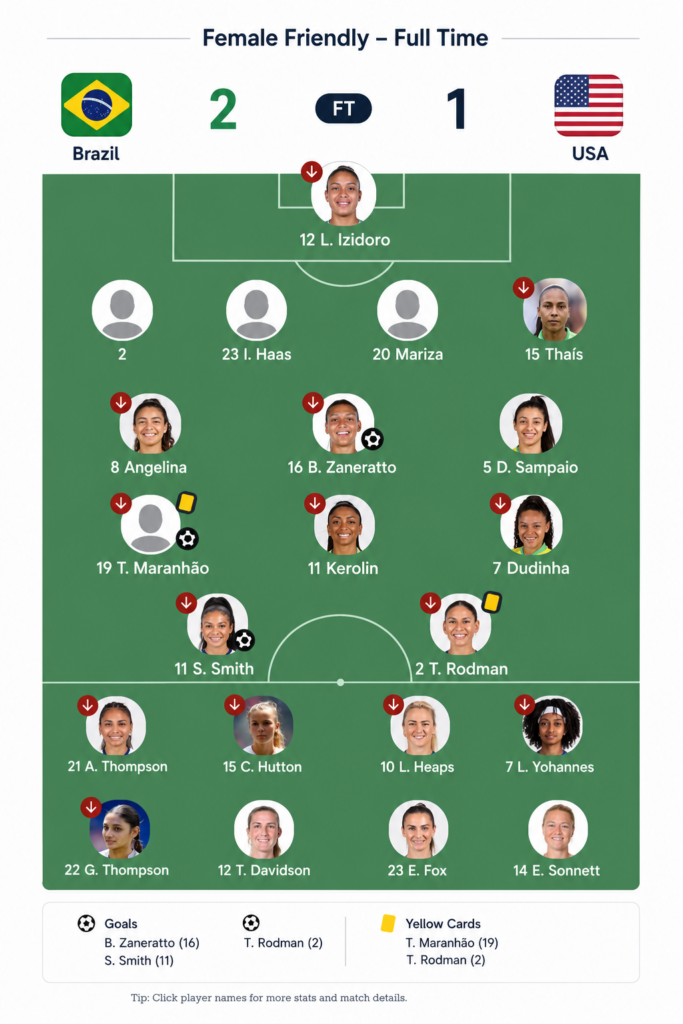
On June 6, 2026, the United States Women’s National Team (USWNT) contested the first of a two-match international friendly series against the Brazilian Women’s National Football Team at the Neo Química Arena in São Paulo, Brazil. Played before an intensely passionate crowd of over 31,000 spectators, the fixture served as a critical preparatory milestone for both nations. Brazil, as the designated host nation for the 2027 FIFA Women’s World Cup, sought to consolidate their competitive identity under head coach Arthur Elias. Conversely, the USWNT, under the technical direction of Emma Hayes, utilized the trip as a high-intensity pressure test ahead of the 2026 CONCACAF W Championship in late November—the definitive qualifying tournament for the upcoming World Cup.
The encounter concluded in a 2-1 victory for the home side, marking Brazil’s second consecutive and fifth overall win against the United States. Despite an early opening goal from American forward Sophia Wilson (formerly Smith) in the second minute of play, the USWNT conceded two rapid-fire goals in the 11th and 14th minutes due to structural defensive lapses. This analysis provides a detailed deconstruction of the tactical mechanics, player performance metrics, and broader strategic implications of the match as both teams navigate their developmental cycles toward 2027.
Tactical Breakdown of Goal Sequences and Early Transitions
The match in São Paulo was defined by starkly contrasting phases of play, characterized by early transition exploits, structural collapse, and subsequent low-block frustration.
The Early Ascent: High-Press Efficiency
The USWNT initiated the match with a highly aggressive, front-oriented defensive press. Within the opening 96 seconds, forward Trinity Rodman forced a turnover in Brazil’s defensive third, capitalizing on a lack of structural preparation in the hosts’ backline. Sophia Wilson intercepted the loose ball, drove diagonally toward the central channel, and executed a precise, low-curving strike from outside the penalty area into the bottom-left corner of the net past Brazilian starting goalkeeper Lelê (Letícia Izidoro).
This opening goal carried both tactical and personal significance. It represented Wilson’s 25th international goal and her first for the USWNT since October 2024, cementing her status as the ninth mother to score in the program’s history following her return from maternity leave. The immediate impact of the “Double Espresso” tandem—comprising Wilson and Rodman—highlighted the immense transitional threat the USWNT possesses when allowed to exploit vertical space.
Defensive Deconstruction: Three Minutes of Structural Failure
The initial tactical superiority of the USWNT was rapidly dismantled by a highly direct, physical Brazilian response. The visitors struggled to manage the physical load and transitional speed of the hosts, leading to two concessions in quick succession.
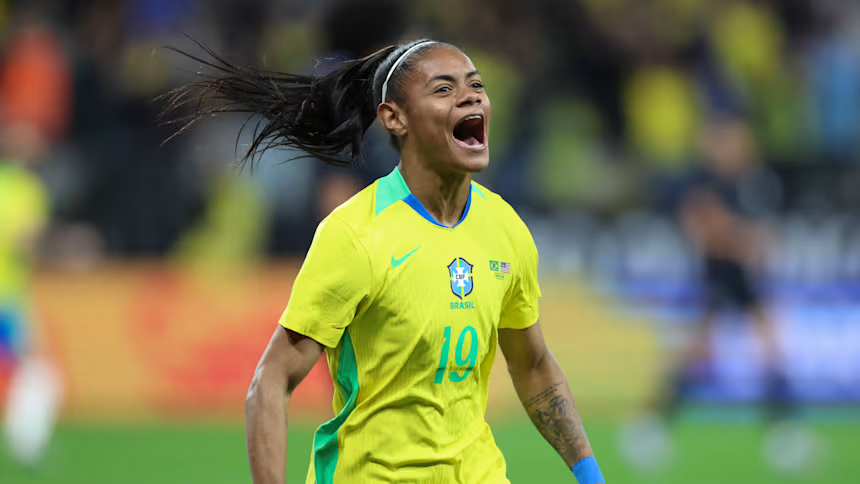
The equalizer in the 11th minute exposed a fundamental vulnerability in the USWNT’s defensive organization during restart sequences. Following a throw-in near the endline, Brazilian defender Isabela received the ball under minimal pressure and lofted a cross to the opposite post. The American zonal defense collapsed toward the ball, leaving Brazilian forward Tainá Maranhão entirely unmarked. Maranhão executed a clean header into the right corner of the net past starting goalkeeper Mandy McGlynn. This failure in spatial awareness highlighted a disconnect between the defensive line and the midfield screen, as second-ball coverage and post-marking responsibilities were entirely neglected.
In the 14th minute, Brazil secured the game-winner by exploiting a disjointed defensive transition. After the USWNT failed to delay a central counter-attack, Bia Zaneratto initiated a rapid give-and-go sequence with fellow forward Dudinha inside the penalty box. The fluid exchange completely bypassed the American center-backs, allowing Zaneratto to slip the ball past McGlynn to establish a 2-1 lead. The speed of the interaction illustrated the defensive hazards of an un-screened backline when confronted with elite, fast-paced 1v1 dribblers in central areas.
The Chaos Paradigm: Hayes’ Strategic Pressure Test
Prior to kickoff, Emma Hayes explicitly framed the friendly matches in Brazil as an exercise in “chaos management”. This philosophy underpinned the strategic decisions made by the coaching staff, even at the expense of defensive stability.
Patient Structure vs. Fragmented Physicality
The tactical challenge presented by Brazil differed fundamentally from the USWNT’s previous matches against Japan. While Japan represents a highly patient, structured, and possession-oriented opponent, Brazil operates with an aggressive, direct, and highly fragmented physical style. The directness of play can be modeled through the sequence length metric (S_L), where the probability of a sequence exceeding a specific length k is given by:

Picture by 2026 Getty Images
P(S_L > k) \approx 0 \quad \text{for} \quad k \ge 8
This mathematical constraint directly reflects Emma Hayes’ pre-match observation that Brazil’s tactical blueprint would enforce zero passing sequences exceeding eight passes, resulting in a highly disrupted, 1v1-dominated match structure. Furthermore, Hayes projected a 117% increase in throw-in occurrences, signaling that ball-retention would be secondary to winning second-contact duels and managing physical transitions.
Midfield Instability and Defensive Exposure
The absence of veteran defensive midfielder Sam Coffey due to injury forced the USWNT to deploy an incredibly young and unseasoned central pivot consisting of Claire Hutton and Lily Yohannes, both earning their 19th international caps. While talented, this midfield pairing struggled to establish physical dominance or slow down central transitions.
Without a physical screen to absorb first contacts, center-backs Tierna Davidson and Emily Sonnett were repeatedly forced into high-risk 1v1 situations against Dudinha, whose explosive pace in possession consistently threatened the visitors’ defensive structure. The physical toll of this direct style eventually culminated in late-match attrition, marked by a confrontation between Trinity Rodman and Giovana Queiroz that resulted in dual yellow cards, alongside an apparent late injury to Rodman.
Technical Performance and Squad Metrics
The selection of the starting XI and subsequent in-game adjustments underscore a deliberate emphasis on long-term squad development over short-term result optimization.
Lineup Analysis and Cap Distributions
Emma Hayes’ squad rotation policy has been historically aggressive, having awarded caps to 44 different players in 2025 and 40 players in 2026. The starting lineup in São Paulo possessed an average cap count of 57.7, a metric skewed significantly upward by veterans Lindsey Heaps (177 caps) and Emily Sonnett (117 caps). The mathematical representation of this cap distribution can be written as:
\bar{C} = \frac{1}{N} \sum_{i=1}^{N} C_i = 57.7
where C_i represents the individual caps of the starting players, and N = 11.
The starting lineups chosen by Arthur Elias and Emma Hayes for this high-intensity encounter are detailed below, reflecting contrasting levels of international experience.
| Nation | Player | Position | Cap Count | Professional Club / Tactical Role |
|---|---|---|---|---|
| Brazil | Lelê (Leticia Izidoro) | GK | — | Corinthians / Experienced shot-stopper; forced off injured in 82′. |
| Brazil | Mariza | DF | — | Corinthians / Structured right-sided center-back. |
| Brazil | Isa Haas | DF | — | Grêmio / Central anchor of the back three/four hybrid system. |
| Brazil | Thaís Ferreira | DF | — | UD Tenerife / Left-sided cover; subbed off in 81′ for Rafaelle Souza. |
| Brazil | Isabela | DF | — | Corinthians / Highly active wing-back; provided assist for Maranhão. |
| Brazil | Duda Sampaio | MF | — | Corinthians / Deep-lying playmaker; managed tempo under heavy press. |
| Brazil | Angelina | MF | — | Orlando Pride / Defensive screen; subbed off in 68′ for Ana Vitória. |
| Brazil | Kerolin | MF | — | North Carolina Courage / Attacking transition spark; subbed in 81′. |
| Brazil | Tainá Maranhão | FW | — | Palmeiras / Dynamic winger; scored 11′ equalizer; booked 26′; subbed 68′. |
| Brazil | Dudinha | FW | — | São Paulo FC / Assist for Zaneratto; terrorized US right flank; subbed 90+2′. |
| Brazil | Bia Zaneratto | FW | — | Kansas City Current / Match-winner scorer 14′; subbed off in 81′. |
| USA | Mandy McGlynn | GK | 6 | Utah Royals FC / Earned start due to strong NWSL form (86 saves in 2025). |
| USA | Gisele Thompson | DF | 11 | Angel City FC / Shared the pitch with sister Alyssa; struggled; subbed at half. |
| USA | Emily Fox | DF | 77 | Arsenal FC / Provided recovery pace; matched Leroux for 52nd all-time caps. |
| USA | Tierna Davidson | DF | 70 | Gotham FC / Tasked with marshaling a chaotic defensive block. |
| USA | Emily Sonnett | DF | 117 | NJ/NY Gotham FC / Most experienced defender; operated as a physical stopper. |
| USA | Claire Hutton | MF | 19 | Kansas City Current / Young pivot; struggled to disrupt Brazil’s counter-press. |
| USA | Lindsey Heaps (C) | MF | 177 | OL Lyonnes / Played under married name; passed Shannon MacMillan in caps. |
| USA | Lily Yohannes | MF | 19 | Ajax / Highly technical; physically bypassed by direct runners; subbed 79′. |
| USA | Trinity Rodman | FW | 56 | Washington Spirit / Assist for Wilson; booked 84′; subbed late due to injury. |
| USA | Alyssa Thompson | FW | 32 | Angel City FC / Stretched backline; subbed at half for Michelle Cooper. |
| USA | Sophia Wilson | FW | 62 | Portland Thorns / Scored in 2′; returnee mother; subbed off in 79′. |
The inclusion of Mandy McGlynn in goal—making only her sixth international appearance—exemplified this experimental approach. While McGlynn’s domestic performances for the Utah Royals were highly rated, the lack of familiarity between her and the central defensive pair of Davidson and Sonnett contributed to the communication breakdowns during Brazil’s rapid goal-scoring window. Additionally, the Thompson sisters, Gisele and Alyssa, set a USWNT record by sharing a starting lineup for the sixth time, though Gisele was substituted at halftime for Avery Patterson to stabilize the defensive flank.
Administrative Roster Evolution
The current USWNT cycle features notable personal and administrative transitions, illustrated by prominent name changes on the matchday roster. Captain Lindsey Heaps (formerly Horan) debuted her married surname following her marriage to soccer analyst Tyler Heaps in December 2024. Similarly, star forward Sophia Wilson (formerly Smith) began competing under her married name following her marriage to NFL player Michael Wilson. These changes mirror previous roster shifts, such as Mallory Swanson (née Pugh), Lynn Biyendolo (formerly Williams), and Julie Ertz (née Johnston), signaling a mature, experienced core navigating the peak of their professional careers.
## Tactical Adjustments and Match Timeline
The physical demands of the match prompted a series of highly calculated tactical substitutions and disciplinary moments, shaping the flow of the second half.
At halftime, recognizing the structural vulnerability on the right flank where Gisele Thompson was being isolated by Dudinha, Hayes substituted Gisele for Avery Patterson. Concurrently, she replaced Alyssa Thompson with Michelle Cooper up front to introduce a more physical, counter-pressing presence. These adjustments temporarily stabilized the backline and improved the USWNT’s transitional security.
As the second half progressed, the home side looked to consolidate their lead by deploying fresh defensive legs. In the 68th minute, Arthur Elias executed a double substitution, bringing on Ludmila for equalizer-scorer Tainá Maranhão and Ana Vitória for Angelina. These changes preserved Brazil’s high-pressing capability while reinforcing their midfield screen.
In the 79th minute, facing an increasingly compact Brazilian low block, Hayes committed her primary creative assets, introducing Rose Lavelle for Lily Yohannes and Ally Sentnor for Sophia Wilson. This structural change aimed to carve out central passing channels in the half-spaces. Elias immediately countered in the 81st minute with a defensive triple-change, inserting veteran defender Rafaelle Souza for Thaís, Aline Gomes for Kerolin, and Giovana Queiroz for goalscorer Bia Zaneratto.
The physical friction peaked in the 82nd minute when Brazilian goalkeeper Lelê, who had required medical attention during three prior stoppages, was finally forced off due to injury and replaced by Lorena. Shortly thereafter, in the 84th minute, a boiling point was reached near the sideline; Trinity Rodman aimed a throw-in directly at Giovana Queiroz, sparking a confrontation that resulted in dual yellow cards for both players. The physical toll forced Rodman to exit the pitch in the 88th minute with an apparent injury, replaced by Emma Sears, while Jaedyn Shaw replaced Claire Hutton in a final, desperate attacking push.
The comprehensive sequence of these in-game personnel adjustments and disciplinary events is detailed chronologically below.
| Match Minute | Team | Player Out | Player In / Booking | Event Category | Strategic Rationale / Description |
|---|---|---|---|---|---|
| 2′ | USA | — | Sophia Wilson | Goal (0-1) | Curved shot from outside the box off a Rodman transition assist. |
| 11′ | BRA | — | Tainá Maranhão | Goal (1-1) | Header past McGlynn off a lofted Isabela cross from a throw-in. |
| 14′ | BRA | — | Bia Zaneratto | Goal (2-1) | Counter-attack; give-and-go with Dudinha inside the penalty box. |
| 26′ | BRA | — | Tainá Maranhão | Yellow Card | Tactical foul during a promising American transitional build-up. |
| 45′ | USA | Alyssa Thompson | Michelle Cooper | Substitution | Tactical swap to inject physical presence and central hold-up play. |
| 46′ | USA | Gisele Thompson | Avery Patterson | Substitution | Defensive adjustment to secure the right flank against Dudinha. |
| 68′ | BRA | Tainá Maranhão | Ludmila | Substitution | Tactical swap for fresh legs in wide counter-attacking channels. |
| 68′ | BRA | Angelina | Ana Vitória | Substitution | Midfield reinforcement to combat Hayes’ possession structure. |
| 79′ | USA | Lily Yohannes | Rose Lavelle | Substitution | Creative substitution to unlock the central lanes of the low block. |
| 79′ | USA | Sophia Wilson | Ally Sentnor | Substitution | Fresh attacking runner deployed to stretch the Brazilian center-backs. |
| 81′ | BRA | Kerolin | Aline Gomes | Substitution | Defensive midfield substitution to preserve the one-goal lead. |
| 81′ | BRA | Bia Zaneratto | Giovana Queiroz | Substitution | Tactical change to deploy a physical, hold-up focal point up front. |
| 81′ | BRA | Thaís Ferreira | Rafaelle Souza | Substitution | Introduction of defensive experience to stabilize the low block. |
| 82′ | BRA | Leticia Izidoro (Lelê) | Lorena | Substitution | Injury-enforced goalkeeper change after multiple physical stoppages. |
| 84′ | USA | — | Trinity Rodman | Yellow Card | Booked for unsporting conduct during a sideline throw-in incident. |
| 84′ | BRA | — | Giovana Queiroz | Yellow Card | Booked for physical altercation with Rodman during the restart. |
| 88′ | USA | Trinity Rodman | Emma Sears | Substitution | Injury-enforced substitution following the physical sideline clash. |
| 88′ | USA | Claire Hutton | Jaedyn Shaw | Substitution | Ultimate attacking throw; deployment of a technical second striker. |
| 90+2′ | BRA | Dudinha | Amanda Gutierres | Substitution | Late tactical change to kill time and provide fresh defensive pressing. |
| 90+7′ | BRA | — | Lorena | Yellow Card | Booked for tactical time-wasting during a goal-kick restart. |
Statistical Evaluation and Technical Conclusions
Brazil Women’s National TeamThe overall match statistics reveal a highly competitive but ultimately inefficient performance by the USWNT, particularly in the final third of the pitch.
| Tactical Metric | Brazil | United States | Tactical Source |
|---|---|---|---|
| Final Score | 2 | 1 | |
| First-Half Goals | 2 | 1 | |
| Second-Half Goals | 0 | 0 | |
| Total Touches in Opposition Box | 25 | 32 | |
| Goalkeeper Saves | 2 | 4 | |
| Shots on Target | — | 2 | |
| Corner Kicks | — | 7 | |
| Yellow Cards | 3 (Maranhão, Giovana, Lorena) | 1 (Rodman) | |
| Total Stoppages for Injury | 4 | — |
Despite dominating territory and possession in the second half—evidenced by 32 touches inside the Brazilian penalty box and 7 corner kicks—the USWNT registered only two shots on target throughout the entire 90 minutes. This discrepancy points to a significant tactical bottleneck. Once Brazil secured the lead, they dropped into a compact low block, compressing the vertical space between their defensive and midfield lines. The USWNT’s possession sequences became horizontal and predictable, failing to generate high-quality expected goals (xG) or break down the hosts’ organized defensive structure.
The USWNT’s 2-1 defeat in São Paulo provides clear developmental markers for Emma Hayes as she refines the squad’s tactical blueprint. While the result was disappointing, the exposure of defensive and transitional cracks is exactly the type of diagnostic data required during an experimental phase. To resolve these vulnerabilities before the second friendly in Fortaleza and the critical CONCACAF W Championship in November, several tactical adjustments must be prioritized.
First, the coaching staff must address the structural profiling of the midfield pivot. The pairing of Hutton and Yohannes lacked the physical maturity required to disrupt direct, vertical transitions. If Sam Coffey remains unavailable, Hayes must consider dropping a more experienced player, such as Lindsey Heaps, into a deeper double-pivot role to screen the center-backs and dictate the tempo of physical transitions. Second, defensive zonal discipline on set pieces must be reinforced, transitioning from a purely zonal marking scheme to a hybrid system during restarts and wide free-kicks to ensure that clinical aerial targets are actively body-marked.
Furthermore, generating only two shots on target from 32 penalty-box touches and seven corners indicates a lack of creative variation against low blocks. The USWNT must integrate rapid, third-man combinations and late midfield runs from deep to disrupt organized backlines, rather than relying solely on individual wing play from wide forwards. Finally, the highly anticipated return of Mallory Swanson to active minutes will be vital. Her ability to operate as a central playmaker or a dynamic winger will relieve the creative burden on Sophia Wilson and Trinity Rodman, restoring the multi-dimensional threat of the “Triple Espresso” attacking line as the program marches toward 2027.