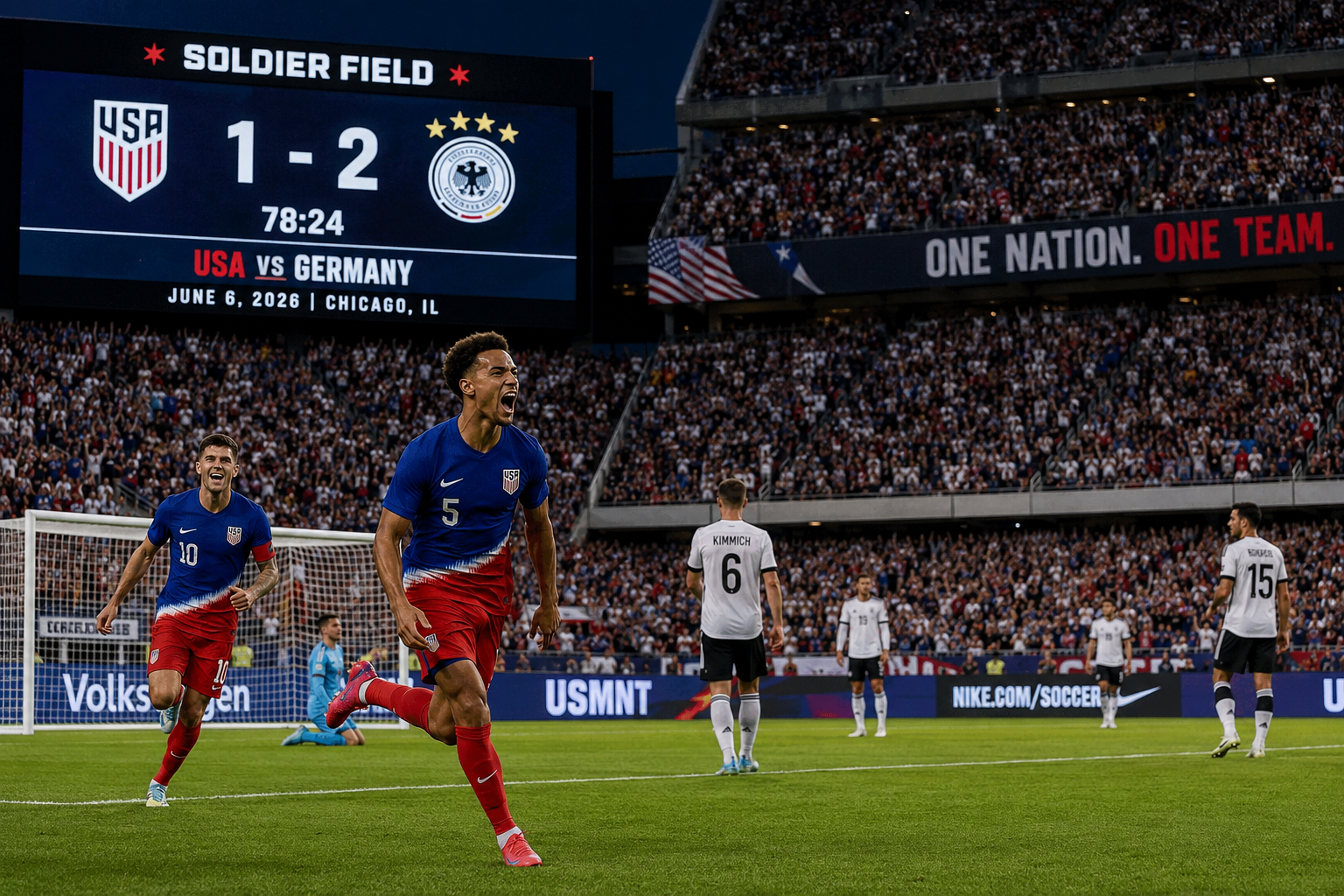
The stark contrast in public, media, and social media reactions to the identical 2-1 losses on June 6, 2026, stems from deeply embedded historical expectations, developmental trajectories, and the caliber of the opposition. For the USMNT, a narrow defeat against 10th-ranked Germany—a global titan and four-time FIFA World Cup champion—was widely interpreted as a encouraging sign of progress. Under head coach Mauricio Pochettino, the men’s program is actively trying to establish that it can compete with elite European heavyweights. Outshooting Germany 16 to 12 and earning 10 corner kicks at a packed Soldier Field fueled an optimistic narrative that the men are peaking at the right moment before hosting the FIFA World Cup 2026.
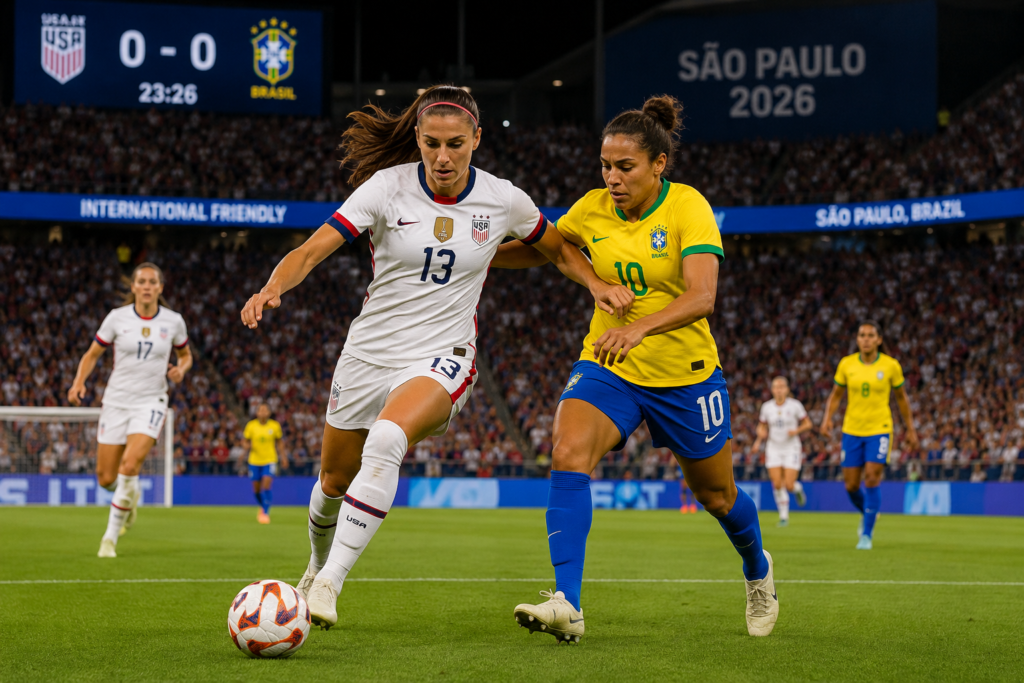
Conversely, the USWNT’s 2-1 loss to 6th-ranked Brazil in São Paulo triggered immediate concern and sharp tactical criticism across US women’s soccer platforms. The expectation for the women’s national team remains absolute dominance, a standard built on decades of international supremacy and an overwhelming historical record against Brazil. Prior to this match, the USA led the all-time series against Brazil 34W-4L-5D, having won nine of their last ten meetings. Because of this historical baseline, conceding two goals in a three-minute first-half span was viewed not as a competitive learning experience, but as an unacceptable defensive breakdown. The reaction demonstrates that while the USMNT is graded on a curve of aspirational growth, the USWNT continues to be evaluated against a standard of near-perfection.
The international window on June 6, 2026, offered soccer fans a double-header of high-stakes friendly matches that tested the tactical identity and depth of both American national programs.
USMNT vs. Germany
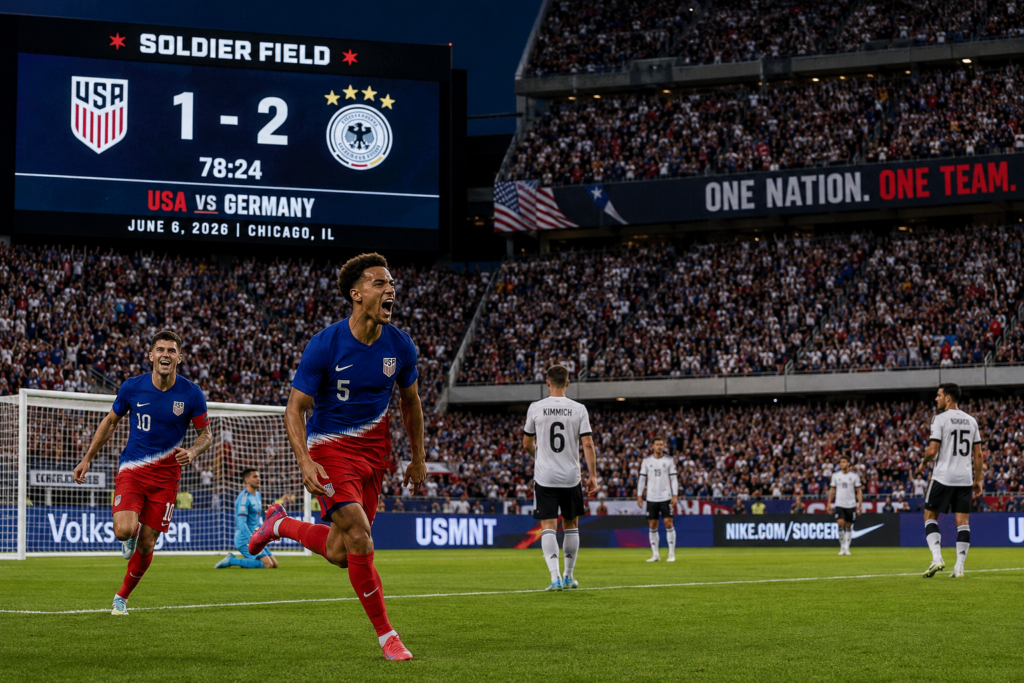
In Chicago, the USMNT hosted Germany in the Coca-Cola Send-Off Match, their final preparation fixture before the FIFA World Cup 2026 on home soil. In front of a record-setting, sold-out soccer crowd of 63,636 at Soldier Field, the atmosphere was electric despite a light rain and 77-degree weather. Germany struck early in the 2nd minute when Kai Havertz slipped past the American backline to head home a Joshua Kimmich free kick.
The USMNT responded with a high-energy, proactive press. Their persistence paid off in the 37th minute when a cleared German corner fell to defender Antonee Robinson, who hit a brilliant left-footed volley from the top of the penalty arc into the back of the net. In the second half, Germany found the decisive goal in the 57th minute when Leroy Sané fired a low strike that took a deflection past goalkeeper Matt Freese. Despite pushing for an equalizer, the USMNT fell 2-1, but their dominant attacking statistics—including outshooting the Germans 16 to 12—left fans highly optimistic.
USWNT vs. Brazil
Hours later in São Paulo, the USWNT faced Brazil at the Neo Química Arena in front of a loud crowd of 31,336. This friendly represented the first of two June matches against the 2027 FIFA World Cup hosts and marked the USA’s first appearance in Brazil since 2014.
The match began perfectly for the Americans when Sophia Wilson capitalized on a Trinity Rodman-forced turnover in the 2nd minute, curling a low, left-footed shot into the bottom corner. However, the lead evaporated quickly. In the 11th minute, Brazil equalized when Tainá Maranhão headed home an Isabela cross following a throw-in deep in the U.S. defensive third. Just two minutes later, Brazil sliced through the central defense with a rapid counter-attack, as Bia Zaneratto played a quick give-and-go with Dudinha to score the game-winner.
The USWNT dominated the second half, pinning Brazil in their own half and generating multiple scoring chances down the wings. However, they struggled to unlock Brazil’s low block, which was aided by several tactical injury stoppages. A late VAR review denied a U.S. penalty shout for a handball, sealing a 2-1 victory for the hosts and marking only Brazil’s fifth-ever win against the USA
| Team | Opponent | Score | Venue | Attendance | Key Event |
|---|---|---|---|---|---|
| USMNT | Germany | 1-2 | Soldier Field, Chicago, USA | 63,636 | Antonee Robinson scored a spectacular 37th-minute volley. |
| USWNT | Brazil | 1-2 | Neo Química Arena, São Paulo, Brazil | 31,336 | Sophia Wilson scored in the 2nd minute; Brazil responded with two quick goals. |
Player Performances
Evaluating individual player performances during this double-fixture weekend reveals how specific players are cementing their roles or facing mounting pressure within their respective squads.
USMNT Individual Analysis
The standout player for the USMNT was defender Antonee Robinson, who was named the Man of the Match. Beyond his defensive duties on the left flank, Robinson’s spectacular volley from the edge of the box showcased his technical quality under pressure.
In goal, Matt Freese made his 15th international appearance, getting the nod ahead of Matt Turner as Mauricio Pochettino continues to evaluate his goalkeeper depth. While Freese made two saves, he was left relatively exposed on both German goals.
In the attacking third, Christian Pulisic earned his 86th international cap, moving into 22nd place on the USMNT’s all-time appearances list. Pulisic was a constant threat before being substituted in the 62nd minute, keeping the German defense occupied and facilitating play for forward Folarin Balogun.
Additionally, young defender Alex Freeman started his 16th consecutive match for the national team, a remarkable streak dating back to June 2025, demonstrating his growing importance to the defensive structure. Tim Ream captained the side for the 29th time, tying Pulisic for seventh on the USMNT’s all-time captains list.
USWNT Individual Analysis
For the USWNT, forward Sophia Wilson highlighted her clinical finishing by scoring her 25th international goal in the opening minutes. This milestone made her the ninth mother to score for the USWNT, a testament to her enduring impact on the program.
Her attacking partner, Trinity Rodman, was crucial in creating the opening goal, utilizing her signature defensive work rate to force a turnover in Brazil’s defensive third. However, Rodman’s frustration bubbled over late in the match, resulting in an 83rd-minute yellow card during a physical sequence.
In the midfield, veteran Lindsey Heaps earned her 177th cap, passing Shannon MacMillan for sole ownership of the 18th most appearances in USWNT history. Heaps attempted to dictate the tempo during the dominant second half but struggled to find the killer pass to break Brazil’s disciplined low block.
Defender Emily Fox also reached a milestone, earning her 77th cap to tie Sydney Leroux for 52nd on the all-time list, putting in a solid shift despite the early defensive lapses that compromised the backline.
| Player | Team | Caps (Post-Match) | Key Match Statistic / Milestone |
|---|---|---|---|
| Antonee Robinson | USMNT | 54 | Named Man of the Match; scored left-footed volley in 37th minute. |
| Christian Pulisic | USMNT | 86 | Moved to 22nd all-time in USMNT appearances. |
| Tim Ream | USMNT | 82 | Captained the squad for the 29th time. |
| Alex Freeman | USMNT | 17 | Played in his 16th consecutive match since June 2025. |
| Sophia Wilson | USWNT | N/A | Scored 25th goal; became 9th mother to score for USWNT. |
| Lindsey Heaps | USWNT | 177 | Passed Shannon MacMillan for 18th most caps in history. |
| Emily Fox | USWNT | 77 | Tied Sydney Leroux for 52nd most caps in history. |
Tactical Analysis or Turning Point
The tactical dimensions of both matches highlight the contrasting developmental stages of the two coaching staffs as they prepare their squads for major tournaments.
USMNT Tactical Progression
Pochettino utilized a highly aggressive 4-2-3-1 formation, making five changes from the previous week’s starting XI against Senegal. His system focused on high-tempo wing play and overloading the flanks, which successfully pinned Germany back and generated 10 corner kicks. The primary tactical turning point occurred in the 2nd minute. Germany executed a set-piece routine where Havertz used a physical pick on veteran defender Tim Ream. This block allowed Havertz to slip behind the American zonal marking scheme and head home the opening goal unchallenged.
While the USMNT recovered well to dominate possession and find an equalizer through Robinson, their high defensive line remained vulnerable to elite counter-attacking transitions. This vulnerability was exposed in the 57th minute when Germany bypassed the U.S. midfield pressing trigger with rapid, one-touch passing inside the penalty area, resulting in Sané’s deflected match-winner. Pochettino’s decision to wait until after the 60th minute to make his first set of substitutions demonstrated a desire to test his starting group’s physical and tactical endurance against world-class opposition.
USWNT Tactical Transition
Under Emma Hayes, the USWNT set up in a fluid pressing system designed to force turnovers high up the pitch. This tactic worked perfectly in the 2nd minute when Rodman’s pressure forced the turnover that led to Wilson’s goal. However, the tactical breakdown that followed between the 11th and 13th minutes exposed serious vulnerabilities in defensive transitions.
For Brazil’s equalizer, the U.S. defense failed to organize quickly during a throw-in, allowing Isabela to cross to an unmarked Maranhão. Just two minutes later, Brazil exploited a massive gap between the U.S. midfield and defensive lines. A rapid vertical counter-attack saw Zaneratto play a simple give-and-go with Dudinha, easily slicing open the central pairing of the U.S. defense.
In the second half, Hayes adjusted by instructing her fullbacks to overlap and stretch Brazil’s defensive block. While the USWNT successfully “tilted the field” and controlled the tempo, they struggled with central penetration. Brazil’s physical, low-block defensive shape, combined with frequent stoppages, disrupted the Americans’ attacking rhythm. The lack of a creative playmaker to unlock compact defenses remains a significant tactical puzzle for Hayes to solve.
| Tactical Metric | USMNT (vs. Germany) | GER (vs. USMNT) | USWNT (vs. Brazil) | BRA (vs. USWNT) |
| :— | :— | :— | :— | :— |
| Shots | 16 | 12 | Dominant (2nd Half) | Counter-Heavy |
| Shots on Goal | 4 | 4 | N/A | N/A |
| Corner Kicks | 10 | 2 | High Volume (2nd Half) | Low |
| Fouls | 11 | 10 | Chippy / Physical | High (Tactical Stoppages) |
| Offsides | 3 | 4 | N/A | N/A |
Public Reaction and Social Media Response
Analyzing social media platforms, sports talk radio, and major media outlets reveals a stark divergence in public patience for the two national teams.
USMNT: Optimism and Trust in the Process
The prevailing narrative surrounding the USMNT’s 2-1 defeat was overwhelmingly positive. On platforms like X and Instagram, fans celebrated the team’s aggressive, proactive style of play against a European heavyweight. Rather than criticizing the loss, commentators highlighted that the USMNT outshot Germany and forced them into a defensive posture for long stretches of the match.
Media coverage echoed this sentiment, framing the match as a highly encouraging dress rehearsal that proved the Americans can compete with elite nations when playing with tactical intensity. The sold-out, record crowd of 63,636 at Soldier Field was cited as a major victory for soccer’s growing popularity in the United States ahead of the World Cup. Fans expressed confidence in Pochettino’s long-term vision, accepting that friendly defeats are necessary teaching moments.
USWNT: Concern and High Expectations
In contrast, USWNT news forums and social media channels were filled with frustration and tactical scrutiny following the loss in São Paulo. Fans analyzing women’s soccer highlights expressed deep concern over the defensive transition lapses that allowed Brazil to score two goals in quick succession.
The criticism was intensified by the USWNT’s historical dominance over Brazil. Because the U.S. has historically won major championships and dominated this specific rivalry, a loss to Brazil is never treated as a normal friendly result.
Online discussions focused on:
- The team’s struggle to create high-quality chances against compact defenses.
- The perceived lack of tactical adaptability under physical pressure.
- The pressure on Emma Hayes to deliver immediate results while rebuilding the roster.
The reaction highlighted the unique challenge facing the USWNT: they must undergo a generational rebuild while maintaining their status as global leaders.
What Coaches or Players Said
While official post-match press conference quotes from USMNT head coach Mauricio Pochettino are unavailable in match recaps, his tactical focus was evident in his roster decisions and his post-match adjustments. Pochettino prioritized keeping his core starting XI on the pitch deep into the second half, showing a clear emphasis on building physical resilience and tactical familiarity ahead of the World Cup group stage.
On the women’s side, USWNT head coach Emma Hayes had accurately anticipated the challenges her team would face in São Paulo. Prior to the match, Hayes predicted a “chaotic, chippy and highly aggressive match” with hostile atmospheres, a prediction that was fully realized on the pitch.
The pressure surrounding the USWNT’s transition has been a consistent theme for the coaching staff. Regarding the high expectations and the need to balance development with immediate success, Hayes previously emphasized:
”That is why everyone’s reputation is on the line. While there is real reason to look toward the future, so much of where this program sits requires winning in the here and now. Failure to do so will set the moment back.”
This statement perfectly captures the demanding environment of the women’s program, where development cannot come at the expense of winning.
What This Means for the Team
The identical scorelines carry very different short-term and long-term implications for the two national programs as they navigate their respective competitive cycles.
USMNT Outlook
- Short-term: The USMNT enters the FIFA World Cup 2026 with high match fitness and tactical clarity. The match against Germany exposed specific defensive vulnerabilities, particularly set-piece defending and transition marking, which Pochettino must address in final training sessions.
- Long-term: The performance confirmed that the USMNT is developing a proactive, possession-oriented identity. Moving away from a conservative, counter-attacking style against elite opposition suggests that the program is maturing and building a sustainable foundation for the World Cup cycle.
USWNT Outlook
- Short-term: Hayes must quickly address the team’s defensive organization during transitions before their second June friendly against Brazil. The coaching staff must also work on tactical variations to help players find space and create better opportunities against low-block defenses.
- Long-term: The defeat serves as a reminder that the gap at the top of the women’s global game has closed. The USWNT is undergoing a generational shift, and finding the right balance between developing young talent and meeting the non-negotiable demand to win immediately remains their biggest challenge heading into the 2026 Concacaf W Championship and the 2027 FIFA World Cup.
What Comes Next
Both teams now face distinct pathways as they transition into the next phases of their international calendars.
USMNT Upcoming Matches
Having concluded their friendly schedule, the USMNT will head directly into the group stage of the FIFA World Cup 2026 on home soil. Meanwhile, Germany will travel to Houston, Texas, to open their World Cup campaign against Curaçao on June 14, 2026, at NRG Stadium.
USWNT Upcoming Matches
The USWNT will remain in South America to face Brazil in the second match of their June friendly series, looking to rebound in a hostile away environment. Following this camp, the players will return to their clubs before regrouping in the fall for the 2026 Concacaf W Championship, which serves as the direct qualification pathway for the 2027 FIFA Women’s World Cup.
Conclusion
The divergent reactions to the identical 2-1 defeats suffered by the USMNT and USWNT on June 6, 2026, highlight the different expectations and histories of the two programs. For the USMNT, a competitive loss to a world power like Germany is seen as a positive step forward, showing they can compete with elite teams just before hosting the World Cup. For the USWNT, a loss to Brazil is met with concern, as fans expect immediate excellence and absolute dominance even during a transitional phase under new leadership. These matches show that while both teams are progressing, they are evaluated on entirely different scales of success.
FAQ Section
Why did fans react so differently to identical 2-1 losses by the USMNT and USWNT?
The difference is rooted in historical success and expectations. The USMNT is viewed as an developing program; a close loss to a traditional powerhouse like Germany, while outshooting them 16-12, is seen as progress. The USWNT is held to a historic standard of global dominance, meaning any loss—even an away friendly against 6th-ranked Brazil—is heavily scrutinized.
How did the USWNT perform in their friendly against Brazil?
The USWNT started strong with a Sophia Wilson goal in the 2nd minute, but conceded twice in the 11th and 13th minutes due to defensive transition lapses. Despite dominating possession and pressure in the second half, they struggled to break down Brazil’s physical low block, resulting in a 2-1 defeat.
What were the key takeaways from the USMNT’s loss to Germany?
The USMNT showed they can compete with elite European sides, outshooting Germany 16 to 12 and earning 10 corner kicks. Antonee Robinson scored a spectacular volley, but the match also highlighted defensive areas that need improvement, particularly set-piece defending and central counter-attack management.
What are the current coaching situations for both national teams?
The USMNT is led by Mauricio Pochettino, who is focused on implementing a proactive style and building confidence before the 2026 World Cup. The USWNT is coached by Emma Hayes, who is working to integrate young talent while managing the intense pressure to win immediately.
What upcoming matches do both national teams have?
The USMNT enters the group stage of the FIFA World Cup 2026. The USWNT will play the second match of their June friendly series against Brazil before focusing on the Concacaf W Championship in the fall of 2026.
What do these results mean for the future of U.S. Soccer?
The USMNT’s competitive showing suggests they are prepared to face elite teams on home soil. For the USWNT, the loss emphasizes that the gap at the top of the women’s game has closed, requiring the team to improve their transition defense and find ways to unlock compact, physical opponents.