The defining moment of Portugal’s 2026 FIFA World Cup opener against DR Congo wasn’t the 1-1 draw on the pitch. It was a post-match interview that exposed the fragile ecosystem of a national team caught between its glittering past and its necessary future.
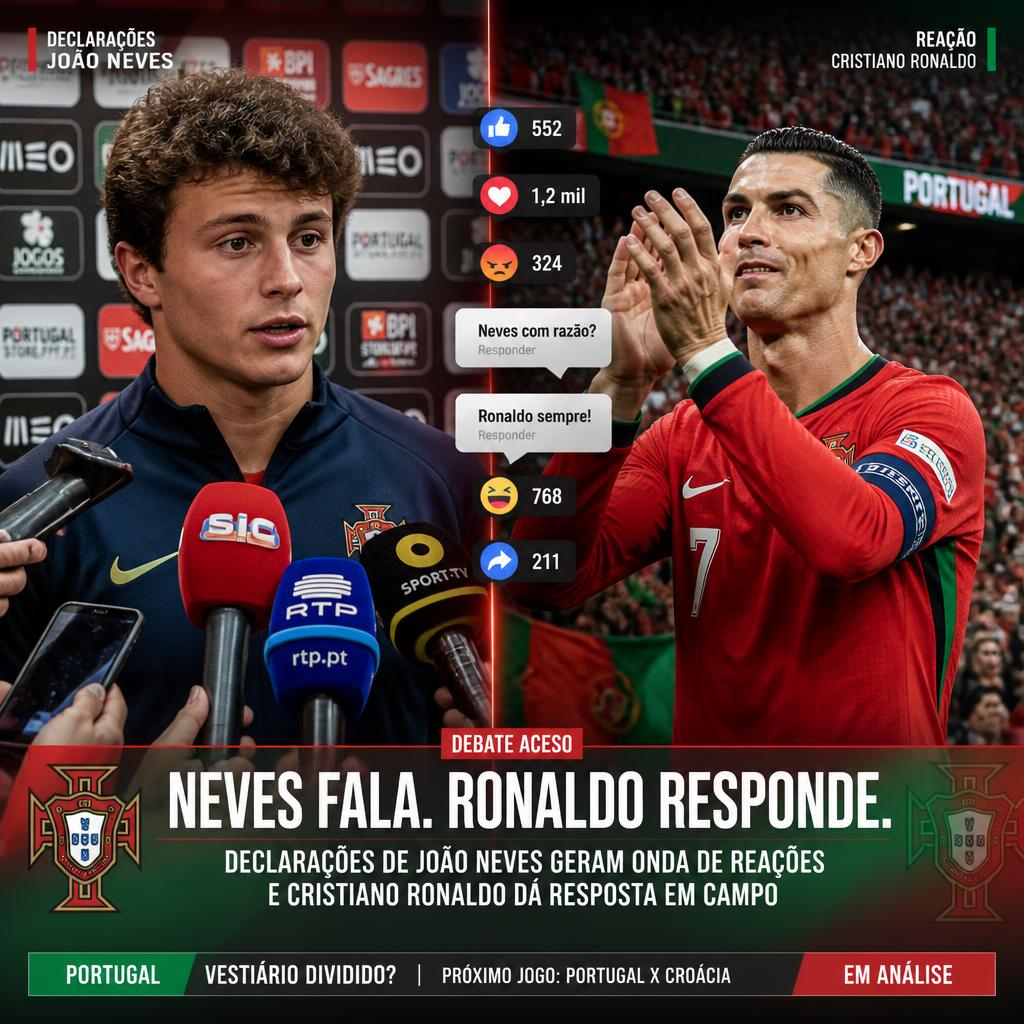
When 21-year-old Paris Saint-Germain midfielder Joao Neves was asked about Cristiano Ronaldo’s lackluster performance, he offered a brutally honest, distinctly modern assessment: “We know what Cristiano has done for us… But at this moment, he is no different. He is just another player here to help… NO different from the others.”
The internet reaction was swift and toxic, with the Joao Neves Cristiano Ronaldo dynamic instantly becoming the biggest story of the tournament. Neves and his girlfriend were bombarded with online abuse from fans demanding deference to the 41-year-old icon. But if we look past the social media noise, Neves didn’t commit a sin of disrespect; he committed the sin of stating a tactical reality.
Here is why a single quote has thrown a World Cup contender into chaos, and what it reveals about Roberto Martinez’s squad moving forward.
Table Of Contents
Key Takeaways
- The Catalyst: Following a disappointing 1-1 draw with DR Congo, Joao Neves described captain Cristiano Ronaldo as “just another player,” triggering massive fan backlash.
- The Tactical Reality: At 41, Ronaldo’s diminished mobility forces Portugal’s midfield into an impossible compromise between pressing structure and providing constant service to a static target.
- The Culture Clash: The controversy highlights the friction between a new generation raised on system-first, collective football (Neves) and a fanbase loyal to a superstar-centric model.
- The Manager’s Dilemma: Head coach Roberto Martinez must now navigate an intense dressing room divide ahead of a must-win match against Uzbekistan.
Main Story: The Quote Heard ‘Round the World

The facts of the incident are straightforward, but the interpretation is where the controversy lies.
Joao Neves was Portugal’s brightest spark in their tournament opener in Houston, scoring the team’s only goal while anchoring the midfield. Ronaldo, by contrast, was an isolated figure. He failed to register a single shot on target and touched the ball just three times in the first half. When pressed by reporters to explain the offensive disconnect, Neves opted to emphasize team unity and collective responsibility over individual hero worship.
Ronaldo loyalists interpreted the “just another player” remark as profound disrespect to the five-time Ballon d’Or winner and Portugal’s all-time leading scorer. The backlash spilled out of control, resulting in coordinated harassment campaigns on the Instagram accounts of Neves and his partner, Madalena Aragao. Manager Roberto Martinez was forced into immediate damage control, stating that Neves’ comments were “easily misunderstood” and reiterating Ronaldo’s undeniable historical status.
But the real story isn’t the fan reaction—it’s that Portugal’s youngest star felt the need to publicly demystify his captain in the first place.
Why It Matters: The Burden of Legacy
To understand the weight of this drama, you have to look at the historical and psychological burden of the Portuguese national team.
For two decades, the tactical instruction for Portugal has essentially been: Get the ball to Cristiano. That strategy won them Euro 2016 and a Nations League title. However, the current iteration of the Seleção is arguably the most talented collective they have ever produced. Players like Neves, Bruno Fernandes, Ruben Dias, and Rafael Leao play for elite European clubs where the tactical system supersedes any individual player.
Neves’ comments represent a generational breaking point. He was speaking the language of modern European club soccer—a language of egalitarian pressing, collective defensive shape, and shared offensive burdens. The backlash from the fanbase proves that a massive segment of Portugal’s supporters still view the national team primarily as a vehicle for Ronaldo’s personal legacy, rather than a cohesive sporting project.
Tactical or Strategic Analysis: The Midfield’s Impossible Job
The friction off the pitch perfectly mirrors the tactical friction on it. When you analyze the 1-1 draw against DR Congo, the problem wasn’t a lack of effort; it was a fundamental structural flaw.
| Player | Role vs. DR Congo | Key Match Statistic (Match 1) |
|---|---|---|
| Joao Neves | Box-to-box Midfielder | Scored Portugal’s only goal |
| Cristiano Ronaldo | Target Forward | 0 Shots on Goal, 3 first-half touches |
At 41 years old, Ronaldo can no longer execute a high press, nor can he consistently run the channels to stretch opposing defenses. This forces Portugal to play in a low or mid-block when out of possession, inviting pressure. When they win the ball back, the midfield—led by Neves and Fernandes—is tasked with progressing the ball while simultaneously trying to feed a striker who largely operates in a fixed, central location.
Neves’ assertion that Ronaldo “is no different” is a tactical plea. If Ronaldo is given special exemption from defensive duties, the rest of the team must cover extraordinary amounts of ground to compensate. DR Congo exploited this by bypassing Portugal’s disjointed press and attacking the midfield directly. Neves isn’t asking for Ronaldo to be benched; he is asking for the team to operate as an 11-man unit rather than 10 men working to serve one.
Bigger Picture Impact: The Messi Comparison
It is impossible to analyze this situation without bringing in the historical comparison to Argentina and Lionel Messi.
During Argentina’s 2022 World Cup run, players like Rodrigo De Paul and Enzo Fernandez explicitly stated they were willing to “go to war” for Messi. They happily accepted a tactical setup designed entirely to mask Messi’s defensive deficiencies because it yielded results.
Many Ronaldo supporters look at Argentina and demand that Neves, Fernandes, and the rest of the Portuguese squad show the same blind, sacrificial loyalty. But this ignores a crucial difference: Messi drops deep to orchestrate play and create for others, making the trade-off viable. Ronaldo requires the team to create for him. When he goes ten consecutive games without a goal in major international tournaments (Euro and World Cup play dating back to 2022), the young players doing the heavy lifting naturally begin to question the arrangement. The illusion cracks.
What Comes Next
Portugal faces a defining moment in their next Group Stage match against Uzbekistan. Roberto Martinez is trapped between a rock and a hard place.
If Martinez benches Ronaldo, he risks alienating the captain and causing an even larger media circus. If he continues to start him at the expense of squad fluidity, he risks losing the dressing room—a room increasingly populated by young stars who agree with Neves, even if they won’t say it to the press.
Watch closely to see how Bruno Fernandes and Bernardo Silva interact with Neves on the pitch. If the squad rallies around their young midfielder, it will be a clear signal that the team has internally moved past the Ronaldo era, regardless of who wears the armband.
Conclusion
Joao Neves did not insult Cristiano Ronaldo; he inadvertently verbalized the growing pains of a team trying to step out of a giant’s shadow. The modern international game is ruthless, requiring all 11 players to be seamlessly integrated cogs in a tactical machine. The backlash against Neves is a nostalgic defense of a bygone era. For Portugal to survive the 2026 World Cup, they must stop playing for the history books and start playing for the present.
FAQ Section
What did Joao Neves say about Cristiano Ronaldo?
Following a 1-1 draw with DR Congo, Neves stated that while he respects Ronaldo’s legacy, the forward is “just another player here to help” and should be viewed no differently than anyone else on the current squad.
Why are fans mad at Joao Neves?
Many loyal supporters of Cristiano Ronaldo felt the comments lacked respect for Portugal’s all-time greatest player, leading to severe online abuse directed at Neves and his girlfriend.
Did Joao Neves unfollow Cristiano Ronaldo on Instagram?
No. Rumors and manipulated screenshots circulated online suggesting Neves unfollowed Ronaldo after the backlash, but these claims have been entirely debunked.
What is Roberto Martinez’s stance on the drama?
The Portuguese head coach defended both players, stating Neves’ comments were “easily misunderstood” while reaffirming that Ronaldo’s status in the team “cannot be diminished.”