Published September 5, 2026
NWSL players can no longer freely sign their own shoe sponsorships without consequence. Under a new footwear exposure agreement the league has rolled out this year, any cleat or glove brand other than official outfitter Nike must pay the NWSL directly for the right to have its logo visible on the field — and players whose sponsors haven’t opted in face fines of up to $32,000 per violation if they don’t cover the branding.
Key Takeaways
- The NWSL has introduced a footwear exposure agreement requiring cleat and glove brands other than official outfitter Nike to pay the league for the right to have their logos visible during matches.
- Players whose sponsors haven’t opted into the framework must cover the branding on their boots or face fines of up to $32,000 per violation.
- The policy could generate at least $320,000 in annual retail value from Nike alone, according to the league, and sets a $5,000 minimum payment that participating brands must make directly to sponsored players.
- The framework is modeled closely on the WNBA’s existing footwear policy, including a real-world precedent: WNBA player Courtney Williams was repeatedly fined over a sponsorship with Moolah Kicks, a brand that hasn’t signed on with that league.
- The NWSLPA says it supports a league-wide footwear framework in principle but is still negotiating protections for players who already had individual brand deals before the policy was announced.
NWSL’s New Shoe Sponsorship Rule Sparks Real Pushback
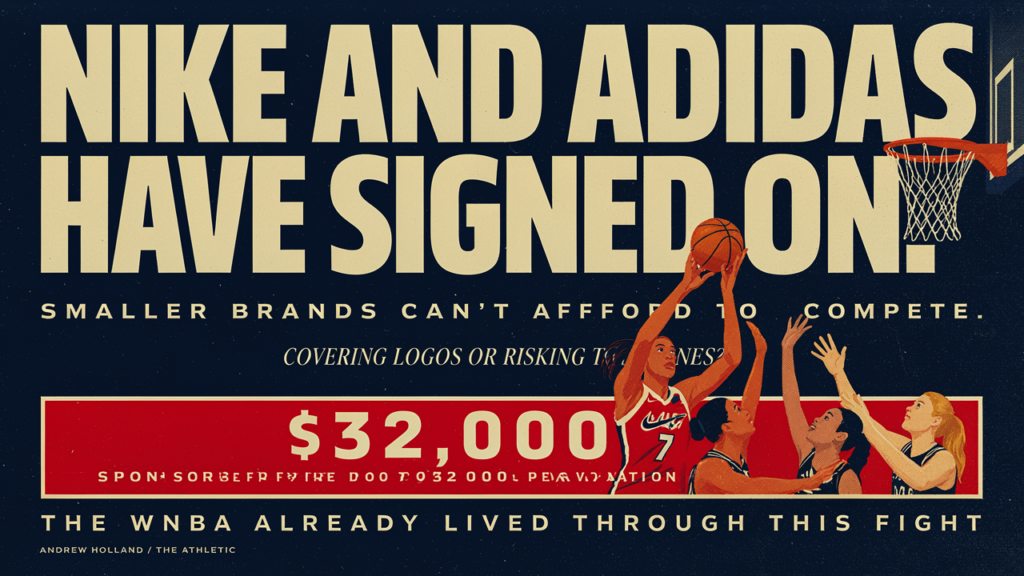
The policy, which took effect with June’s Challenge Cup final between Gotham FC and the Kansas City Current, requires any footwear or glove brand that isn’t part of the league’s official Nike partnership to formally join the NWSL’s sponsorship framework — and pay for the privilege — before its branding can appear on the field during matches. Brands that don’t participate leave their sponsored players with two options: cover the logo during games, or risk league fines that can run as high as $32,000 per violation.
The NWSL says the structure benefits the league broadly. It provides “additional product and equipment support for players without individual sponsorship agreements” and creates “expanded marketing opportunities” for brands that do sign on, according to a memo obtained by Front Office Sports. Nike and Adidas have already joined; the league says the deal is worth at least $320,000 in annual retail value from Nike’s participation alone, and it sets a $5,000 minimum payment that participating brands must make directly to any player they sponsor.
That model is deliberately borrowed. The NWSL built its framework around the WNBA’s existing footwear policy, which requires the same $5,000 qualifying payment and has already produced a real cautionary tale: Minnesota Lynx guard Courtney Williams was fined multiple times last season over her sponsorship with Moolah Kicks, a women’s sneaker brand that still doesn’t have a deal with the WNBA, before eventually covering the logo herself. Moolah Kicks’ founder, Natalie White, has said the league’s asking price for brands to join was “prohibitive.”
Why It Matters
The policy is a real inflection point for a league whose valuations, salaries and attendance have all grown rapidly in recent years. As the NWSL becomes a more valuable media and marketing property, it’s asserting more direct control over revenue streams that used to flow almost entirely to individual players and their personal sponsors — the same tension that’s already played out publicly in the WNBA. For a league still building its financial footing relative to more established American sports leagues, the extra revenue is a real incentive; for individual players and the smaller or independent brands that sponsor them, the policy raises real questions about who gets squeezed out.
That concern is sharpest for brands without Nike- or Adidas-level resources. Smaller footwear companies — often the ones most willing to sign individual deals with NWSL players in the first place — may not have the budget to meet the league’s participation requirements, effectively pricing them out of visibility even if a player genuinely prefers their product. Multiple sources described the rollout itself as a source of friction, saying brands felt the policy arrived abruptly and without enough lead time to plan around already-allocated marketing budgets.
Where Does the NWSL PA Stand on the New Rule?
The players’ association has taken a measured public position: it supports the concept of a league-wide footwear framework, telling Front Office Sports the policy “has been voted on and approved by the NWSLPA,” but it says it’s still negotiating specific protections for players who signed individual brand deals before the framework existed. That’s a meaningful distinction — a policy that only affects new sponsorship deals going forward is very different from one that retroactively disrupts contracts players already signed in good faith.
What Comes Next
The policy remains in its early implementation phase, and the coming months should clarify two things that remain genuinely unresolved: whether more footwear brands beyond Nike and Adidas join the framework, and how the NWSLPA’s ongoing negotiations resolve for players with pre-existing individual sponsorships. The WNBA’s experience with Courtney Williams and Moolah Kicks offers a preview of how messy that can get in practice — a real athlete, a real fine, and a real brand left out in the cold — and it’s a scenario the NWSL will want to avoid repeating in its own league.
Conclusion
The NWSL’s new footwear framework is, at its core, a bet that centralizing sponsorship revenue will grow the league’s overall financial pie faster than leaving those deals entirely in individual players’ hands. That bet might pay off. But the WNBA’s experience suggests the early implementation is likely to produce exactly the kind of friction the NWSL is now navigating — real players caught between brand loyalty and league rules, and real smaller brands wondering whether they can afford to stay in the game at all.
Frequently Asked Questions
What is the NWSL’s new footwear sponsorship rule?
The NWSL now requires cleat and glove brands other than official outfitter Nike to pay the league for the right to have their logos visible during matches. Players whose sponsors haven’t joined the framework must cover the branding or face fines of up to $32,000 per violation.
Why did the NWSL create this footwear policy?
The league says the framework generates additional revenue — at least $320,000 in annual retail value from Nike alone — while guaranteeing a $5,000 minimum payment from participating brands to sponsored players, and providing product support for players without individual sponsorships.
Is this similar to a WNBA policy?
Yes. The NWSL modeled its framework closely on the WNBA’s existing footwear sponsorship policy, including the same $5,000 minimum player payment. The WNBA’s version has already produced disputes, including repeated fines for Minnesota Lynx guard Courtney Williams over an unaffiliated sponsorship.
Does the NWSL Players Association support the new rule?
The NWSLPA says it supports a league-wide footwear framework in principle and confirmed it was voted on and approved by the union, but it’s still negotiating protections for players who had individual brand sponsorships before the policy was introduced.