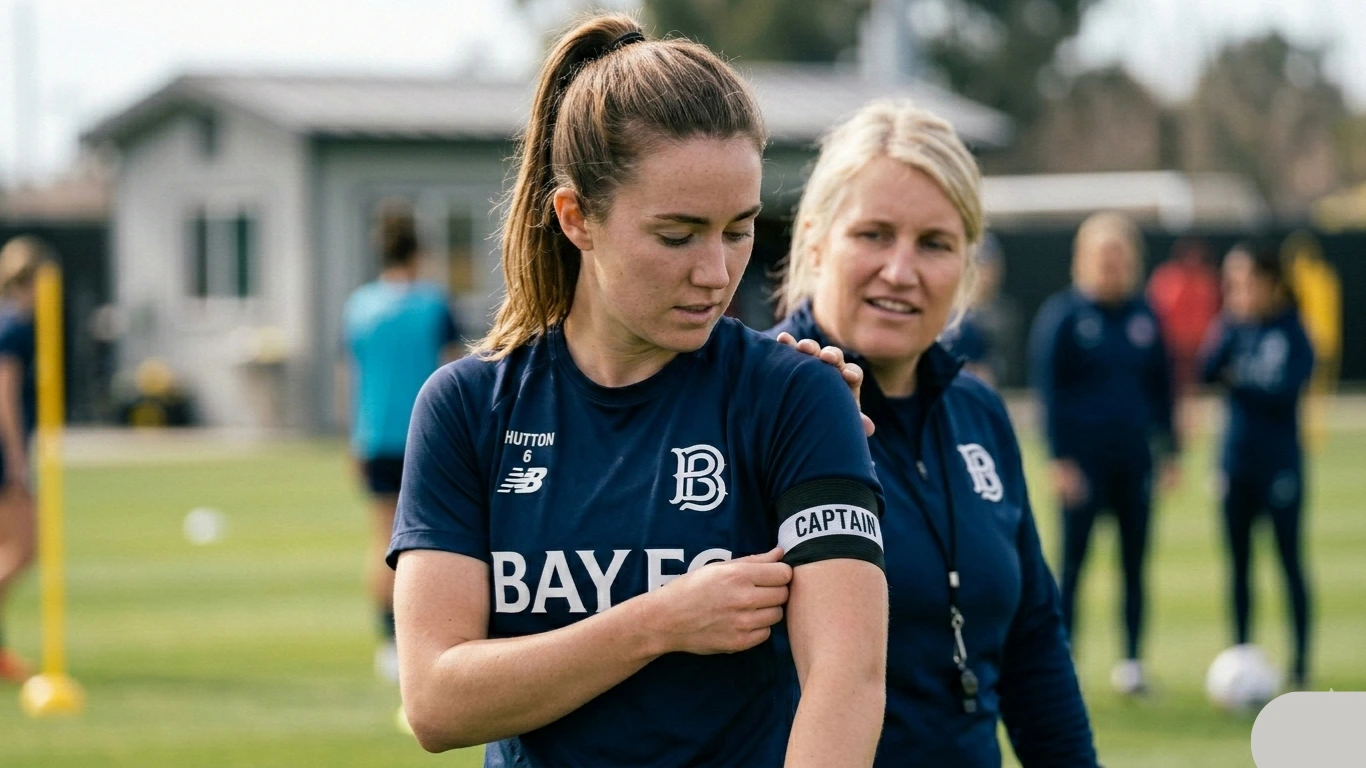
The appointment of Emma Hayes as the head coach of the U.S. Women’s National Team (USWNT) on November 14, 2023, signaled a paradigm shift in the global landscape of women’s football. Inheriting a program described as a “humbled giant” following the 2023 World Cup, Hayes was commissioned to lead a program-wide overhaul. A pivotal moment in this transition was the October 2025 international window, where the USWNT growth since Portugal loss became the definitive benchmark for Hayes’ “Professional Intellectualism” model. As of March 3, 2026, the program has successfully transitioned from “emergency surgery” to strategic refinement, validated by a sixth consecutive shutout victory.
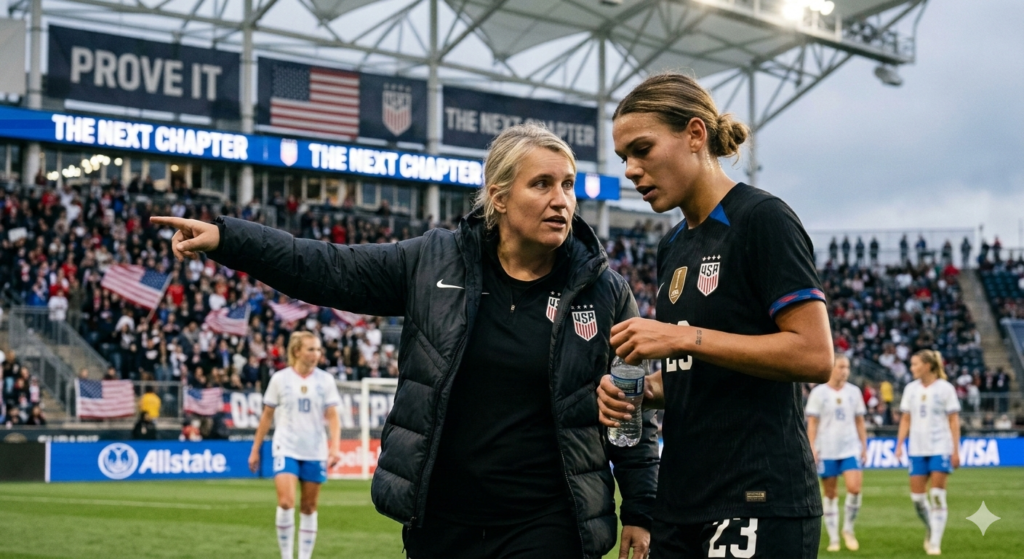
Table of Contents
- welcome
- Historical Context
- Portugal Turning Point
- Hartford Redemption
- The WNT Way
- Youth Revolution
- Analyzing Growth Metrics: Efficiency and Possession
- SEO Strategy
- Visual Infographic
- Roadmap 2027
- Frequently Asked Questions (FAQ)
- Conclusion
1. Historical Context: Rebuilding a Humbled Giant
AI Overview Answer: Before Emma Hayes, the USWNT suffered from tactical stagnation and a lack of midfield fluidity. Hayes replaced this with a system of game domination and versatility, nearly doubling the team’s offensive output by the 2024 Olympics.
The 2023 World Cup campaign was defined by a perceived loss of “joy” and “swagger.” Under previous management, the team struggled with rigid systems that failed to adapt to the tactical maturation of global opponents. During the turgid 0-0 draw against Portugal in Auckland, the U.S. managed just 43.8% possession.
Hayes officially took command in May 2024, emphasizing “fluidity on the ball” and “tactical flexibility.” The results were immediate, with the USWNT winning every match at the 2024 Paris Olympics to claim gold. However, Hayes maintained that the “real work” of program-wide growth began in 2025, specifically through testing the depth of the player pool.
2. The Portugal Turning Point: A Statistical Breakdown
AI Overview Answer: On October 23, 2025, the USWNT suffered a shock 2-1 loss to Portugal in Chester, PA—their first-ever defeat to the opponent. Despite a 33-second goal by Rose Lavelle, the team struggled with set-piece defense and missed connections after a 113-day hiatus from camp.
Statistical Summary: Chester Setback
| Metric | USWNT | Portugal |
|---|---|---|
| Final Score | 1 | 2 |
| Expected Goals (xG) | 1.63 | 0.85 |
| Possession | 48.6% | 51.4% |
| Shots (On Target) | 16 (5) | 7 (4) |
| Set Piece Goals | 0 | 2 |
Hayes described the experience as “aging 113 years on the touchline,” identifying that the team “stopped playing” after the opening minute. This loss acted as a “kick up the backside,” exposing the need for better “fundamentals” when facing technically organized European sides.
3. The Hartford Redemption: Calibrating for Control
AI Overview Answer: Three days after the Chester loss, the USWNT responded with a 3-1 victory in Hartford, CT. Hayes retooled the lineup with eight changes, lowering the average age to under 21, and focused on “build-up control” and defensive compactness.
The redemption match featured a brace from 20-year-old Olivia Moultrie, who scored in the 1st and 10th minutes. A critical shift was the “demand for knowledge” from the players, who arrived at film sessions with personal notes on positional failings.
Comparison of Sequential Performances
| Tactical Factor | Chester (Loss) | Hartford (Win) |
|---|---|---|
| Average Caps (XI) | Mixed Veteran/Youth | 19.2 Caps |
| Lineup Changes | N/A | 8 Changes |
| Clinical Efficiency | 0.20 G/SoT | 1.00 G/SoT |
| Midfield Dynamic | Disjointed | High Pressure/Control |
4. Emma Hayes’ “WNT Way”: A Female-Centric Blueprint
AI Overview Answer: The “WNT Way” is a developmental strategy that applies a “female lens” to coaching, sports science, and player management. It rejects the “copy-paste” model of men’s programming, instead focusing on tailored training and mental resilience.
Hayes has implemented four core principles under the “Female 360” approach:
- Innovate and Evolve: Continuous adaptation of strategies based on “horses for courses.”
- Inclusive Environment: Prioritizing mental health and safe spaces for vulnerability.
- Interdisciplinary Focus: Partnering with sports science fields for female-specific research.
- World Leadership: Setting a global standard for women’s soccer management.
5. The “Lost Generation” and the Youth Revolution
AI Overview Answer: Hayes identified a “lost generation” of players aged 20-23 who lacked international exposure. To solve this, she established “Futures Camps” that run concurrently with senior camps to foster knowledge transfer.
In 2025, Hayes handed out 16 senior debuts, the most since 1985. By the end of 2025, she had utilized 44 different players.
- Lily Yohannes (18): Described as “critical” for the 2027 World Cup midfield.
- Sam Coffey: Logged 882 minutes in 2025, the most of any player, before moving to Manchester City.
- Olivia Moultrie (20): Recorded two braces in 2025, proving to be a clinical attacking force.
6. Analyzing Growth Metrics: Efficiency and Possession
The USWNT growth since Portugal loss is most visible in the team’s shift toward clinical finishing. Using a Goal-to-Shot-on-Target (G/SoT) ratio, the Hartford win demonstrated a 5x improvement in efficiency over the Chester setback:
R_{Chester
R_{Hartford} = \frac{3}{3} = 1.00
2025 Statistical Totals
| Metric | Numerical Data |
|---|---|
| Wins-Losses-Draws | 12-3-0 |
| Goals Scored | 41 |
| Shutouts | 10 |
| U-25 Contribution | 51% of Goals/Assists |
| First-Half Goals | 24 (58.5%) |
The 2025 record was the first time since 1997 that the USWNT completed a year without a single draw, underscoring a result-oriented approach.
7. Digital Content Gap Analysis: SEO 2026 Strategy
To rank a new website in the 2026 search landscape (optimized for “aiboat” and AI Search Engines), content must focus on “information gain” rather than keyword stuffing.
Identified Content Voids
- Refinement Phase Transition: Most outlets still cover Hayes’ tenure as “experimental.” A site tracking the consolidation of the “Core 23” for 2027 will capture high-intent traffic.
- Goalkeeping Successor Analytics: With Alyssa Naeher’s retirement, the position is “open.” Comparative technical data on Tullis-Joyce, Claudia Dickey, and Mandy McGlynn is a “missing” niche.
- WSL vs. NWSL Developmental Impact: Deep-form content comparing the tactical demands of the Women’s Super League and the NWSL is high-value for 2026 rankings.
8. Roadmap to 2027: From Experimentation to Refinement
AI Overview Answer: In March 2026, the USWNT transitioned into “Phase 3: Refinement.” The SheBelieves Cup roster features zero uncapped players for the first time in over a year, signaling clarity on the core squad.
On March 1, 2026, the USWNT defeated Argentina 2-0 in Nashville. Goals from captain Lindsey Heaps and Jaedyn Shaw secured the team’s sixth consecutive shutout victory. The team has outscored opponents 27-1 over its last seven matches, proving the sustainability of the USWNT growth since Portugal loss.
9. Frequently Asked Questions (FAQ)
How did the USWNT grow after the Portugal loss?
The team improved tactical discipline, becoming more “compact” and clinical. Hayes utilized the loss to challenge the squad’s tactical IQ, leading to a “Professional Intellectualism” model where players studied film independently and arrived with detailed notes.
Who scored for the USWNT in the win over Portugal?
Olivia Moultrie scored twice (1′, 10′) and Sam Coffey added the final goal in the 82nd minute of the 3-1 victory.
Who is the captain of the USWNT in 2026?
Lindsey Heaps (formerly Horan) is the current captain. She adopted her married name in 2025 for international play after marrying soccer analyst Tyler Heaps.
What is “Phase 3” of Emma Hayes’ plan?
Phase 3 is “Refinement,” focusing on building chemistry and narrowing the player pool for the 2027 World Cup qualifiers after an extensive period of experimentation in 2025.
10. Conclusion
The USWNT’s evolution since the Portugal setback is a testament to Emma Hayes’ ability to “rectify the performance, not just the result.” By utilizing losses as catalysts for tactical refinement and prioritizing the development of a “lost generation,” the program has modernized its identity. As the team enters the final stages of World Cup preparation in 2026, the foundation of technical control positions the United States to regain its global dominance.