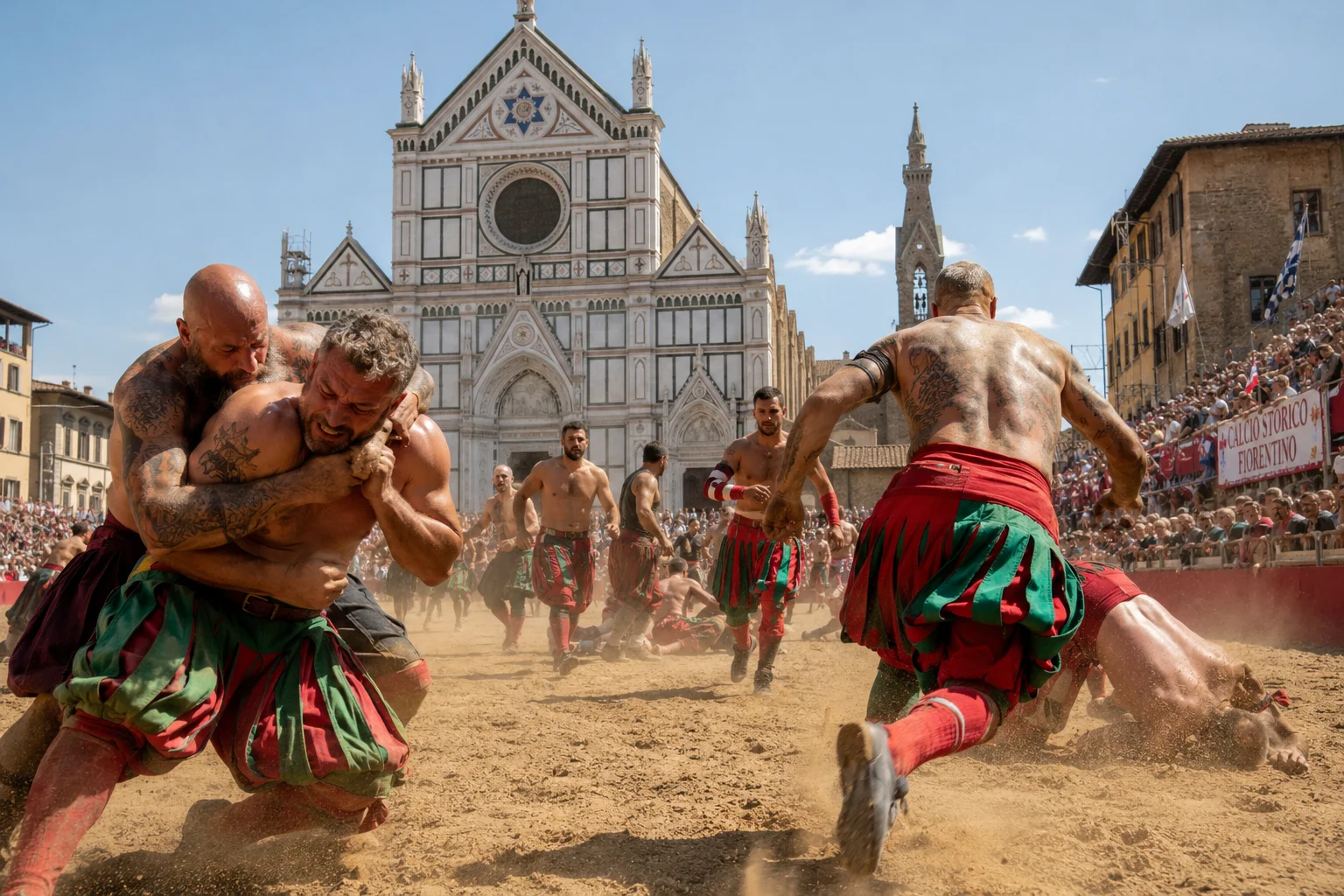
The historic dirt-sand arena of Piazza Santa Croce in Florence, Italy, played host to a weekend of unprecedented physical warfare and athletic dominance as the Calcio Storico 2026 semifinals took place on June 13 and June 14, 2026. Defending champions Rossi of Santa Maria Novella and the tactical powerhouse Azzurri of Santa Croce crushed their respective opponents, Verdi and Bianchi, to book their tickets to the prestigious final on June 24, 2026. Playing in front of a sold-out crowd of over 5,000 spectators, these four historic neighborhoods clashed in Florence’s annual showcase of heritage and raw athletic brutality.
Table Of Contents
- Key Takeaways
- What Happened: Comprehensive Match Reports
- Tactical Breakdown of the Calcio Storico 2026 Semifinals
- Opponent Goal (Net)
- (4 Goalkeepers)
- Verified Quotes from the Sand of Santa Croce
- Comprehensive Match and Performance Data
- What Comes Next
- Conclusion
- FAQ Section
- When are the dates for the Calcio Storico 2026 tournament?
- Who is playing in the Calcio Storico 2026 final?
- What were the exact scores of the 2026 semifinals?
- Why is the Calcio Storico final held on June 24?
- Where are the Calcio Storico matches played?
- What is the controversy surrounding the modern Calcio Storico rules?
Key Takeaways
- Record-Breaking Offense: Defending champions Rossi secured an unprecedented 22–2 blowout victory over the Verdi in Saturday’s opening semifinal.
- Azzurri Domination: The Azzurri overcame an early deficit against the Bianchi to secure an 18.5–4 victory on Sunday, setting up a highly anticipated final.
- Regulatory Backlash: Coaches and sports commentators strongly criticized the modern “scontro” rule, arguing that numerical advantages from injuries and expulsions ruin the competitive nature of the historical sport.
- Championship Match Confirmed: The Rossi will clash with the Azzurri in the grand final on Wednesday, June 24, 2026, coinciding with the Feast of Saint John the Baptist.
What Happened: Comprehensive Match Reports
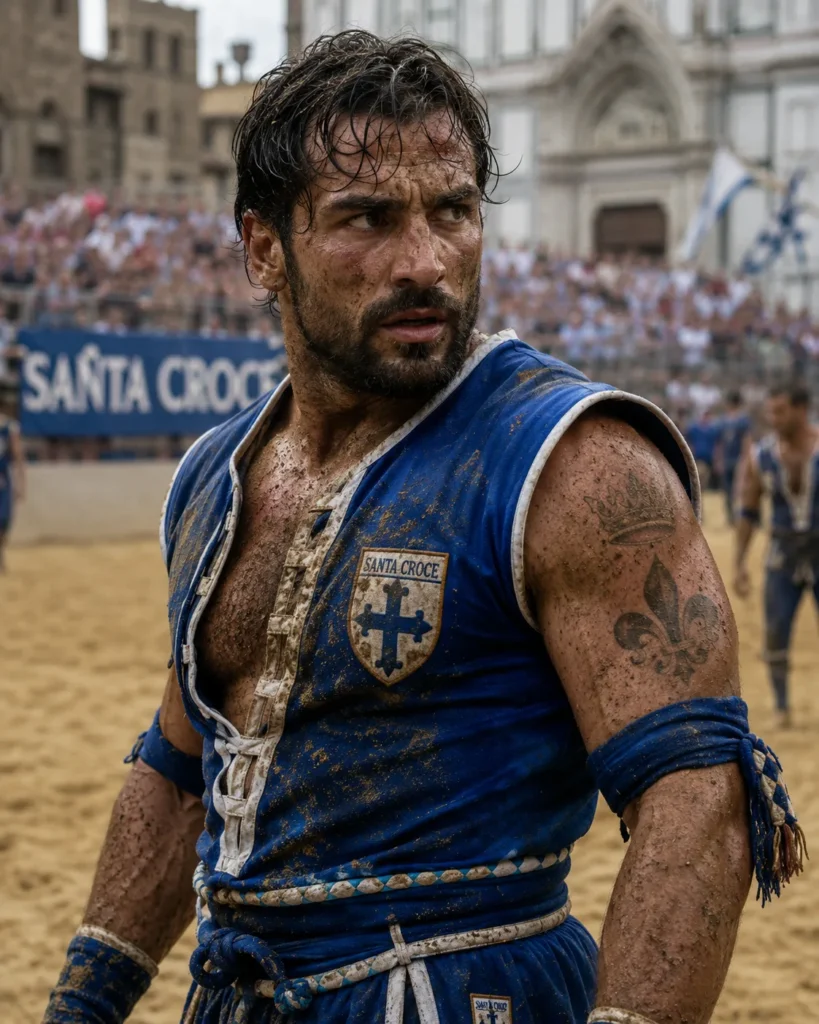
The historic tournament, which has captivated Florentine citizens since at least 1530, returned to its traditional venue with an expanded spectator seating capacity of 700 extra spots. This year’s initial fixtures delivered a shocking display of offensive dominance, resulting in some of the most lopsided scorelines witnessed in the modern era of the sport.
Saturday, June 13: Rossi vs. Verdi
The first semifinal featured a highly anticipated rematch of the previous year’s championship final between the Rossi (Red) of Santa Maria Novella and the Verdi (Green) of San Giovanni. The Verdi opened the match with explosive momentum when playmaker Matteo Ottimi broke free and delivered a pinpoint pass to Giovanni Prezioso, who scored the opening caccia (goal) in just the third minute.
However, the defending champions responded immediately when Enrico Ferrara equalized in the sixth minute. Just two minutes later, veteran attacker Manuel Lopez converted a swift counterattack to put the Rossi ahead 2–1, initiating an offensive onslaught that would continue completely unchecked.
The physical toll of the match escalated rapidly as the Rossi executed high-intensity physical tackles to isolate Green defenders. A severe injury forced an unidentified Verdi player to be evacuated from the arena on a stretcher by the Misericordia di Firenze.
The game slipped entirely out of reach for the Verdi when their star scorer, Giovanni Prezioso, was ejected. In total, Referee Bertelli handed out seven ejections during the chaotic, highly physical contest.
With the Verdi severely depleted, the Rossi marched down the sand to score nearly uncontested, sealing a historic 22–2 victory in a match terminated slightly early due to manifest superiority.
Sunday, June 14: Bianchi vs. Azzurri
The second semifinal pitted the Bianchi (White) of Santo Spirito against the Azzurri (Blue) of Santa Croce. Led by legendary coach Dimitri Rocchi, the Bianchi engineered a masterful start, quickly building a 3–1 lead by the 12th minute via clinical scores from debutant rugby player Elia Toni, Gabriele Piccini, and Riccardo Torzuoli.
The Azzurri were struggling to establish possession, but the momentum shifted entirely when the Bianchi suffered several costly expulsions and physical injuries. Seizing their numerical advantage, the Azzurri mounted a furious comeback.
Azzurri star Jobel De Castro cut the deficit with an unassisted goal, followed immediately by Davide Ceccherelli’s equalizing score to tie the match at 3–3. Although Giacomo Fusi briefly put the Bianchi back in front 4–3 in the 18th minute, the Azzurri took absolute control from that moment onward.
With three Bianchi players ejected and two carried off on stretchers, the Azzurri defense suffocated any remaining opposition. Attacker Mattia Serra and playmaker Paolo Bologna scored at will, directing a massive scoring wave that ended the match early at 18.5–4 in favor of the Azzurri.
Tactical Breakdown of the Calcio Storico 2026 Semifinals
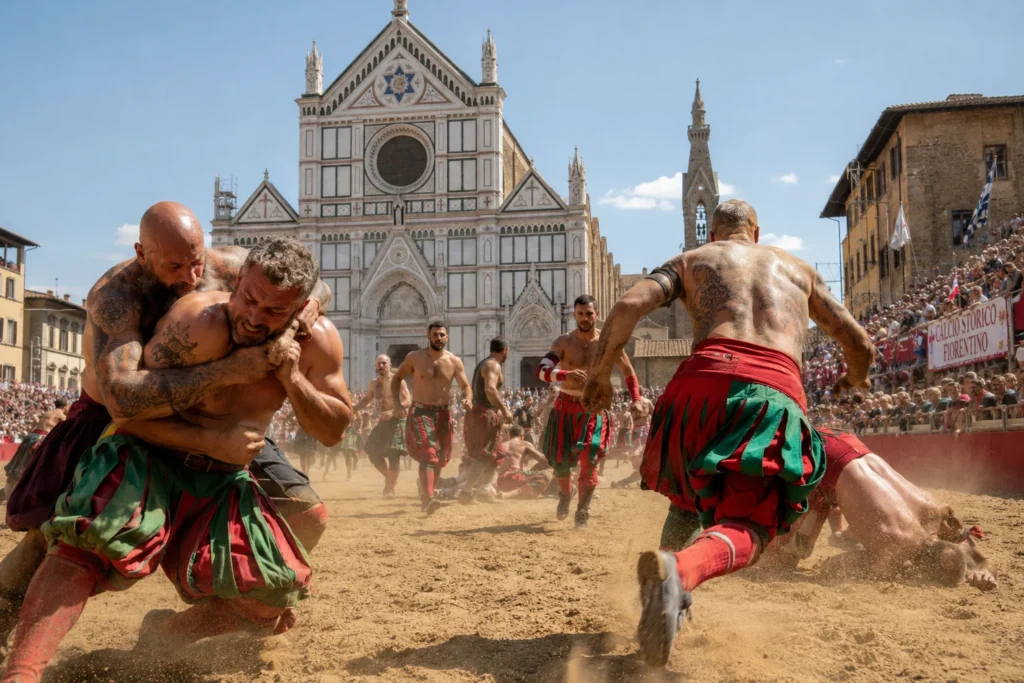
Both semifinal matches illustrated how modern athletic conditioning and tactical structures have transformed this ancient, mud-soaked tradition into an intensely organized team sport. Modern coaching staffs now plan specific positional roles and pressing schemes to exploit the limitations of the arena.
Tactical Analysis of Medieval Formations
The tactical footprint of a modern Calcio Storico team mimics a highly organized military vanguard. Each squad consists of 27 active players (calcianti) deployed across specific zones of the 50-meter dirt pitch.
- Datori Indietro (Goalkeepers): 4 defensive specialists who line the rear net to intercept long-range throws and block incoming runners.
- Datori Innanzi (Halfbacks): 3 tactical playmakers who distribute the heavy leather ball and direct transitional play from the defensive zone.
- Sconciatori (Blockers/Wrestlers): 5 heavy-set enforcers whose sole responsibility is to physically engage, pin, and disable opposing defenders to create open lanes.
- Innanzi (Runners/Forwards): 15 swift attackers tasked with executing direct sprints and scoring cacce once a corridor is opened by the blockers.
Opponent Goal (Net)
[Innanzi][Innanzi][Innanzi][Innanzi][Innanzi] (15 Forwards)
(5 Blockers)
(3 Halfbacks)
(4 Goalkeepers)
Own Goal (Net)
In the modern era, the possession approach is slow and highly calculated. Rather than rushing forward, halfbacks like Emanuele Ceccherelli maintain lateral passing lanes, waiting patiently for the blockers (sconciatori) to win their individual wrestling matches in the central corridor.
Once a blocker successfully pins an opponent, a forward (innanzi) immediately exploits the empty space. If a player attempts a shot and misses over the net, half a point (mezza caccia) is awarded to the opposing team, making precision passing paramount.
During the 2026 semifinals, both the Rossi and Azzurri deployed an incredibly aggressive, high-pressing defensive structure. Rather than retreating to protect their goal lines, their blockers engaged the opposing attackers immediately upon kickoff, initiating intense head-to-head combat.
This high-intensity press forced early errors, leading directly to the key expulsions of Verdi’s Prezioso and the Bianchi’s core defensive line. Once the numerical advantage was secured, both winning squads transitioned to a wide-area passing game, stretching the remaining defenders past their physical limits.
Verified Quotes from the Sand of Santa Croce
The brutal nature of the weekend’s matches led to strong public statements regarding the evolution of the sport’s regulations and competitive balance.
Azzurri coach and legendary former player Marcelo Segundo expressed deep frustration with the current state of refereeing and match flow:
> “Le regole vanno riviste. E’ una manifestazione unica al mondo – sospendere la partita e mandare tutti a casa cinque minuti prima della normale fin della gara significa che qualcosa non va. Non si capiscono molte espulsioni, è un problema grande. Il calcio storico di adesso non è così attrativo.”
Michele Pierguidi, the president of the Calcio Storico organizing committee, initially expressed optimism about the playing conditions prior to Saturday’s kickoff:
”The sand is a bit slow but we expect a beautiful match between two very strong teams.”
However, following Saturday’s physical contest, Pierguidi pointed out that the players failed to adhere to safety protocols:
”The players should have detached from one another at the moment of the ball’s restart after each caccia.”
Comprehensive Match and Performance Data
The following tables summarize the structural data, individual scoring efforts, and medical outcomes of the semifinal round of the 2026 tournament.
Calcio Storico 2026 Semifinal Match Summary
| Category | Semifinal 1 | Semifinal 2 |
|---|---|---|
| Competition | Calcio Storico Fiorentino 2026 | Calcio Storico Fiorentino 2026 |
| Venue | Piazza Santa Croce, Florence | Piazza Santa Croce, Florence |
| Date | June 13, 2026 | June 14, 2026 |
| Teams | Rossi vs. Verdi | Bianchi vs. Azzurri |
| Final Score | Rossi 22, Verdi 2 | Azzurri 18.5, Bianchi 4 |
| Attendance | Sold Out (~5,000+ spectators) | Sold Out (~5,000+ spectators) |
| Honorary Figures | Matteo Del Fante, Beatrice Agrifoglio | Elena d’Elia, Laura Perego |
What Comes Next
The tournament moves directly to its historic climax on Wednesday, June 24, 2026. This day marks the Feast of Saint John the Baptist, the patron saint of Florence, turning the entire city into a massive cultural celebration.
- Morning (8:30 AM CET): The Ceremony of Candles (La Cerimonia dei Ceri) commences at the Piazza Duomo, featuring a magnificent historical parade through the city’s center.
- Afternoon (4:00 PM CET): The historical parade of the Corteo Storico della Repubblica Fiorentina departs from Piazza Santa Maria Novella, arriving at Piazza Santa Croce.
- Evening (6:00 PM CET): The championship final kickoff between the Rossi and the Azzurri in Piazza Santa Croce.
- Night (10:00 PM CET): The spectacular Fochi di San Giovanni firework display launched from Piazzale Michelangelo, visible along the banks of the River Arno.
Italian tennis star Flavio Cobolli, who recently competed as a finalist in the Roland Garros, will serve as the honorary Magnifico Messere for the final match. Tickets for the final have completely sold out.
Fans without tickets can watch the live broadcast of the final on regional television via Toscana TV, or stream it internationally through major digital sports networks.
Conclusion
The Calcio Storico 2026 semifinals delivered a weekend of unparalleled physical drama, leaving the Rossi and Azzurri standing as the class of the tournament. While the lopsided scores have sparked a serious debate regarding the future of the sport’s rules, the excitement in Florence remains at a fever pitch. On June 24, the historic dirt of Piazza Santa Croce will host a final battle for civic pride, neighborhood honor, and the legendary palio
FAQ Section
When are the dates for the Calcio Storico 2026 tournament?
The first semifinal took place on Saturday, June 13, 2026, and the second semifinal followed on Sunday, June 14, 2026. The highly anticipated final is scheduled to take place on Wednesday, June 24, 2026, coinciding with the Feast of Saint John.
Who is playing in the Calcio Storico 2026 final?
The final match will feature the Rossi (Red) of Santa Maria Novella against the Azzurri (Blue) of Santa Croce. The Rossi advanced by defeating the Verdi, while the Azzurri secured their spot with a victory over the Bianchi.
What were the exact scores of the 2026 semifinals?
In the first semifinal on June 13, the Rossi defeated the Verdi by a record score of 22–2. In the second semifinal on June 14, the Azzurri defeated the Bianchi with a final score of 18.5–4.
Why is the Calcio Storico final held on June 24?
The final is traditionally played on June 24 to celebrate the feast day of Saint John the Baptist (San Giovanni), the patron saint of Florence. The holiday is celebrated across Florence with religious ceremonies, historic parades, and fireworks.
Where are the Calcio Storico matches played?
All tournament matches are played in a temporary dirt-and-sand arena erected in Piazza Santa Croce, located in the historic center of Florence, Italy. The square is covered in dirt to replicate its Renaissance-era setting.
What is the controversy surrounding the modern Calcio Storico rules?
Critics and coaches argue that the modern “scontro” rule prevents substitutions when players are injured or ejected. This creates a severe numerical advantage that allows dominant teams to run up uncompetitive, excessively high scores