The international trajectory of Cristiano Ronaldo represents one of the most compelling paradoxes in modern sports history. Despite establishing himself as the most prolific goalscorer in international football and leading Portugal to its first major silverware at Euro 2016, the FIFA World Cup trophy has remained tantalizingly out of reach. This analytical report evaluates the structural, tactical, and logistical factors that historically hindered Ronaldo’s World Cup ambitions. Furthermore, it addresses the core contemporary question: was Portugal’s highly touted “Golden Generation” actually good enough, or did the structural integration of an aging, high-volume forward ultimately create systemic imbalances that prevented the collective from achieving absolute global dominance?
The Tactical Dilemma of the Portuguese Golden Generation
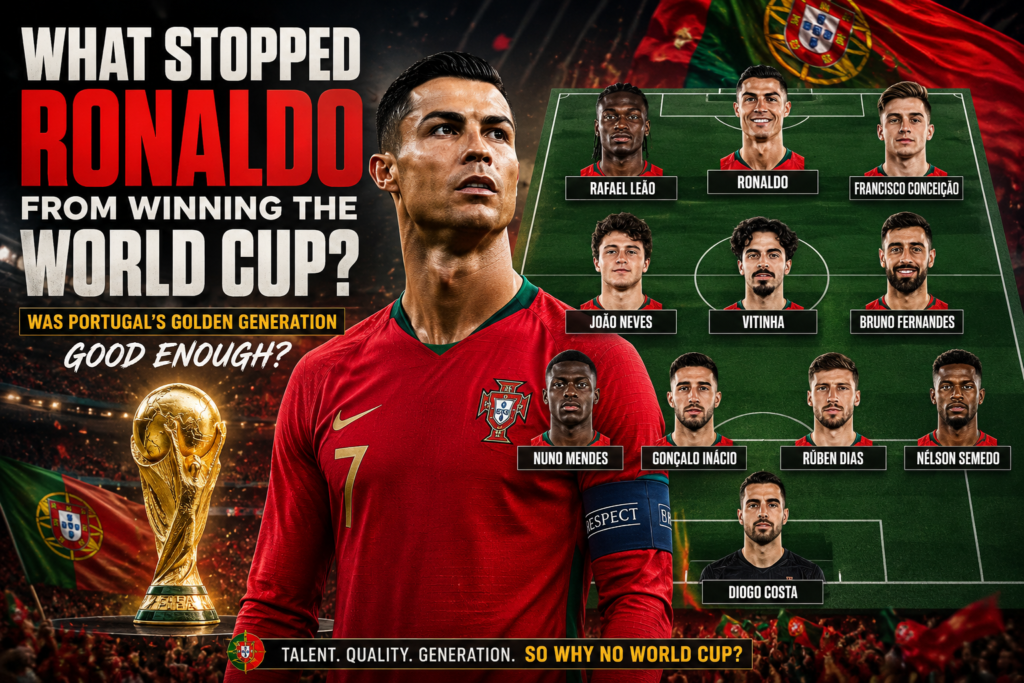
The debate surrounding Portugal’s modern squad centers on whether the sheer abundance of elite technical talent has been optimized or merely compiled. For over a decade, the national team operated under the defensive, pragmatic philosophy of Fernando Santos. While this low-block, transition-based model secured the European Championship, it frequently struggled to maximize the creative output of the emerging talent pool.
The appointment of Roberto Martínez initiated an offensive paradigm shift, moving the team toward an expansive, possession-dominant style. This transition was statistically validated during the Euro 2024 qualifying cycle, where Portugal achieved a perfect record of ten victories in ten matches, outscoring opponents by a margin of 38\text{ to } 2.
However, this offensive philosophy has exposed a deep tactical contradiction. Martínez’s system requires high physical mobility, aggressive counter-pressing, and fluid positional interchanges.
At this stage of his career, Ronaldo’s style of play is highly stationary, focused on occupying central defenders and converting chances inside the penalty area. Consequently, the coaching staff has faced a structural dilemma: deploy a fluid, modern attacking unit that presses from the front, or compromise collective pressing triggers to accommodate the clinical finishing of the team’s greatest individual goalscorer.
The Structural Architecture of the 2026 Squad
To understand why this star-studded squad has struggled to find a balance between defensive security and offensive output, the individual profiles of Portugal’s starting XI must be analyzed. Under Martínez, the team’s nominal tactical setup is a 4\text{-}3\text{-}3 system that dynamically alters its shape during possession phases.
The build-up phase relies on a flexible 3\text{-}2 or 3\text{-}4\text{-}3 rotation. The left-sided full-back, Nuno Mendes, pushes high and wide to act as a traditional winger, while the right-sided full-back, Nélson Semedo or Nuno Tavares, tucks inside to form a temporary three-man defensive line alongside Rúben Dias and Gonçalo Inácio.
This defensive structure allows the team to play out from the back, utilizing the exceptional distribution of goalkeeper Diogo Costa. Meanwhile, the midfield double pivot of Vitinha and João Neves provides press-resistant ball circulation, allowing Bruno Fernandes to operate in the half-spaces and direct the final-third attack.
Tactical Profile of Portugal’s Key Squad Members
| Player | Position | Primary Tactical Role | Key Systemic Contribution |
|---|---|---|---|
| Diogo Costa | Goalkeeper | Sweeper-keeper; progressive distributor | Initiates build-up from deep, bypassing high presses with long-range accuracy. |
| Rúben Dias | Center-Back | Defensive anchor; primary cover defender | Manages the defensive line during aggressive transition phases. |
| Gonçalo Inácio | Center-Back | Left-sided ball-playing defender | Executes vertical passing lines directly into the midfield half-spaces. |
| Nuno Mendes | Left-Back | High-pressing wing-back | Stretches opposing low-blocks by running the entire length of the left flank. |
| Nélson Semedo / Nuno Tavares | Right-Back | Inverted full-back / defensive cover | Balances the defensive line when Mendes advances into the final third. |
| Vitinha | Central Midfielder | Deep-lying playmaker; tempo regulator | Controls possession under pressure and dictates the speed of the attack. |
| João Neves | Central Midfielder | High-intensity box-to-box engine | Recovers possession quickly and links defense to attack. |
| Bruno Fernandes | Attacking Midfielder | Creative engine; pressing trigger manager | Delivers decisive final-third passes and directs the counter-pressing structure. |
| Rafael Leão | Left Winger | Direct 1\text{v}1 transition threat | Bypasses defensive blocks with raw pace and dribbling power. |
| Francisco Conceição | Right Winger | Dynamic, technical inside forward | Isolates defenders in the final third to deliver crosses or cut inside. |
| Cristiano Ronaldo | Center-Forward | Focal point striker; high-volume finisher | Capitalizes on crosses and vertical passes inside the penalty area. |
Tactical Friction and the Ronaldo Centricity Dilemma
The primary structural debate centers on the concept of “vacated space”. Modern international defenses are highly organized, often deploying compact low-blocks that require attacking players to constantly rotate and draw defenders out of position. Martínez’s system uses this concept by encouraging players to drop deep, drag their markers with them, and expose gaps for runners coming from deep positions.
When Ronaldo operates as a fixed central striker, this fluid rotation can become stagnant. Because of his physical profile, Ronaldo rarely drops into midfield to assist in build-up play, nor does he consistently run into wide channels to create space for others. Consequently, the attack can become highly predictable.
Opposing central defenders can remain compact, knowing that the majority of Portugal’s final-third actions will culminate in a cross directed toward Ronaldo in the penalty area. During qualification, Ronaldo averaged S_{\text{shots}} = 5.7\text{ shots per } 90\text{ minutes}, showing how heavily the team’s attacking output was channeled through a single player.
Furthermore, the defensive trade-offs of this setup are significant. In elite modern football, defensive solidity begins with the forward line. If the central striker does not execute pressing triggers, opponents can build out of defense cleanly, bypassing the first line of pressure. This forces the midfield double pivot of Vitinha and João Neves to cover excessive horizontal distance, which can leave the central defenders exposed to rapid counter-attacks.
Comparative Campaign Analysis and Historic Exits
To determine if the squad was “good enough” across Ronaldo’s career, one must analyze the specific structural reasons behind each of Portugal’s World Cup exits.
Chronological Breakdown of Portugal’s World Cup Exits
| World Cup Year | Exit Stage | Opponent | Key Tactical or Generational Cause of Failure |
|---|---|---|---|
| 2006 | Semi-finals | France | Lack of a world-class center-forward to convert chances created by Luis Figo and a young Ronaldo. |
| 2010 | Round of 16 | Spain | Defensive passivity; a rigid low-block under Carlos Queiroz that offered no attacking support for Ronaldo. |
| 2014 | Group Stage | N/A | Extreme squad imbalance; a severely injured Ronaldo forced to carry a squad lacking elite international quality. |
| 2018 | Round of 16 | Uruguay | Severe vulnerability to counter-attacks; inability to break down a compact, low-block defense. |
| 2022 | Quarter-finals | Morocco | Tactical predictability; defensive lapse from a cross combined with an inability to break down Morocco’s defense. |
The data reveals a distinct shift in the team’s structural issues. In 2010 and 2014, Portugal suffered from a genuine lack of high-level talent, relying almost entirely on Ronaldo’s individual brilliance to navigate matches.
By 2022, however, the problem had inverted. The squad possessed world-class talent across every position, but struggled to integrate its aging star into a cohesive team structure. This dynamic was highlighted during the 2022 World Cup knockout stages, where the team’s most fluid performance—a 6\text{-}1 victory over Switzerland—occurred with Ronaldo on the bench, showing the tactical benefits of a more mobile, pressing front line.
Logistical and Contemporary Case Studies: The Road to 2026
The ongoing challenge of managing Ronaldo’s integration is demonstrated by contemporary performances in the lead-up to the 2026 World Cup. A prime example of this dynamic was the international friendly against Chile on June 6, 2026. Under Martínez’s management, the starting line-up featured a blend of established stars and younger talents, illustrating how the coaching staff is rotating the squad to manage player fatigue.
In the Chile match, Ronaldo was substituted off at halftime after playing 45 minutes, registering two shots with one on target. After a scoreless first half, the team’s dynamics shifted in the second period. Despite Rafael Leão receiving a red card at the end of the first half, Portugal secured a 2\text{-}1 victory through goals from Gonçalo Guedes and Bruno Fernandes.
This match serves as a useful tactical case study. It demonstrates that even with ten men, a more fluid, dynamic attacking setup can generate high-quality chances by exploiting space, rather than relying on a single central target.
        [span_121](start_span)[span_121](end_span)    Diogo Costa (GK)
                  |
Semedo —- R. Dias —- G. Inácio —- N. Mendes
|
Vitinha —- J. Neves
|
B. Fernandes
|
F. Conceição —————– R. Leão
|
C. Ronaldo
Logistical preparations for the 2026 World Cup also highlight Martínez’s focus on managing player fatigue. Unlike other national teams that established early bases in North America, Portugal chose a late arrival strategy.
According to Martínez, this decision was designed to let players recover from grueling domestic seasons in a familiar environment before entering the high-intensity atmosphere of the tournament. This focus on recovery is particularly important for older squad members, such as Ronaldo, who require careful physical management to maintain peak performance during a major tournament.
Systemic Rest-Defense and Transition Vulnerability
While public attention often focuses on Portugal’s attacking output, tactical analysis indicates that defensive transition vulnerability has been the primary cause of the team’s tournament exits. The offensive system used by Martínez commits both full-backs forward, leaving the center-backs exposed to direct counter-attacks.
This structural issue is illustrated by advanced midfield metrics. When Portugal plays with a double pivot of Vitinha and another deep midfielder, the team’s “control minutes”—phases where they complete three or more consecutive passes under pressure in the middle third—increases to C_{\text{control}} \ge 57\%.
Furthermore, when Bruno Fernandes and Bernardo Silva execute coordinated pressing, the “ball-free pressure suffocation rate” reaches P_{\text{suffocation}} \ge 62\%, allowing Portugal to dominate possession.
However, when this press is broken, the rest-defense is often compromised. If the forward line fails to slow down the opponent’s initial build-up, the opposition can transition rapidly into wide areas, isolating defenders like Rúben Dias in 1\text{v}1 situations.
This tactical vulnerability was evident in friendly matches, where teams like Sweden and Finland scored multiple goals with very few shots on target, highlighting the defensive risks of Portugal’s expansive style.
Strategic Recommendations and Tactical Solutions
To address these long-standing structural issues and maximize Portugal’s chances in major tournaments, the coaching staff should consider the following tactical adjustments:
- Implement a Flexible Forward Rotation: Rather than deploying Ronaldo as an undisputed 90\text{-}minute starter, Martínez should utilize him as a high-impact tactical option. Starting matches with a high-pressing forward like Gonçalo Ramos can disrupt opposing defensive structures early on, allowing Ronaldo to enter later in the match when spaces open up and his elite movement inside the box can be maximized.
- Commit to a Three-Man Defensive Base: To protect against transition vulnerabilities, Portugal should formalize a three-man rest-defense structure. When Nuno Mendes advances, the right-back must stay deep to form a rigid back-three alongside Rúben Dias and Gonçalo Inácio, protecting the central channels against counter-attacks.
- Utilize the Double Pivot for Rest-Defense Security: The midfield double pivot of Vitinha and João Neves should prioritize spatial coverage over deep offensive runs. By maintaining a compact double-pivot screen in front of the back-three, Portugal can sustain its P_{\text{suffocation}} \ge 62\% pressing metric while providing a safety net when possession is lost.
- Vary the Final-Third Service: The attacking game plan must move away from a reliance on half-space crosses directed at Ronaldo. By utilizing the direct 1\text{v}1 dribbling of Rafael Leão and Francisco Conceição to cut inside, Portugal can create central shooting opportunities and vertical combination play, making the attack more unpredictable.