

Introduction


Emma Hayes officially took charge of the United States Women’s National Team (USWNT) in May 2024, tasked with rebuilding a squad that had suffered its earliest World Cup exit in history in 2023. Facing immense pressure, Hayes immediately implemented a tactical overhaul that transformed the team’s identity in time for the Paris 2024 Olympics. By introducing possession-based, highly adaptable systems—tactics so entirely foreign to traditional American run-and-gun play that analysts metaphorically dubbed them “alien” to the USWNT’s historical style—Hayes successfully guided the team to a Gold Medal. This analysis breaks down the verified changes, roster adjustments, and tactical shifts that define the Emma Hayes era.
The Decline: Why the USWNT Needed an Unorthodox Intervention
For decades, the USWNT dominated global soccer through superior physical conditioning, transitional speed, and sheer athleticism. However, as European federations heavily invested in technical development and domestic leagues, the global gap closed. By the 2023 FIFA Women’s World Cup, the traditional American strategy had become predictable, resulting in a Round of 16 elimination.
The hiring of Emma Hayes, fresh off a historic, multi-title tenure with Chelsea FC Women, signaled a mandate from U.S. Soccer: the team needed a complete modernization of its tactical identity. The goal was no longer just to outrun opponents, but to out-think them.
Tactical Analysis: The Emma Hayes System
Upon her arrival, Hayes implemented structural adjustments designed to control the tempo of the game, rather than relying strictly on counter-attacks.
Shift from Pure Athleticism to Tactical Possession
Under previous management, the USWNT primarily utilized a rigid 4-3-3 formation designed to funnel the ball quickly to wide forwards. Hayes introduced fluidity. While still nominally deploying a 4-3-3 or a 4-2-3-1, the shape shifts dynamically in possession. Hayes mandates playing out from the back, requiring center-backs and the goalkeeper to draw the opposition’s press before breaking lines with precise vertical passing. This “out of this world” departure from traditional American soccer prioritizes ball retention over forced forward momentum.
The Double Pivot and Midfield Control

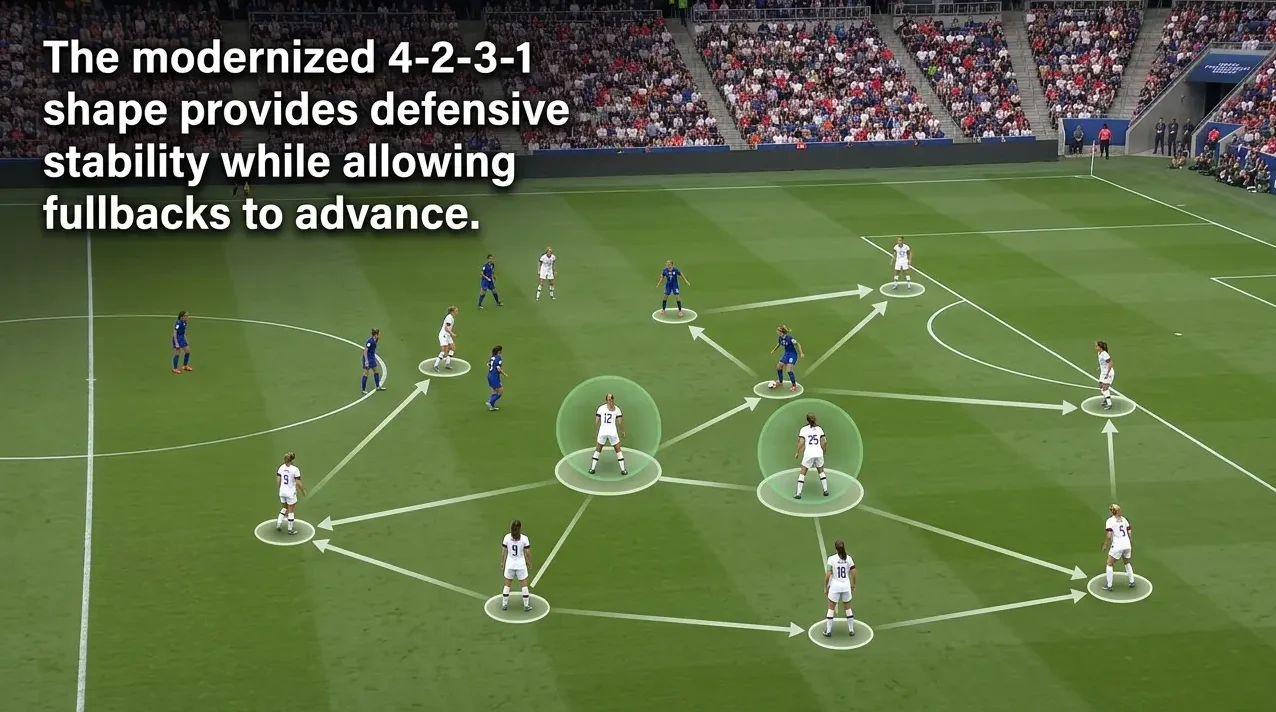
A hallmark of the USWNT Emma Hayes tactics is the reliance on a double pivot in the midfield. By positioning two holding midfielders to screen the defense, Hayes stabilized the transition phase. This structure allows fullbacks to advance securely and provides the attacking midfielder with the freedom to operate in the half-spaces between the opposition’s midfield and defensive lines. The result is a more resilient defensive block that effectively suffocates opponent counter-attacks.
Roster Overhaul: Integrating New Talent
Hayes did not rely solely on veteran presence to execute her vision. Her roster selections for the 2024 Olympics prioritized technical proficiency and positional flexibility over legacy status.
The emergence of a dynamic front line—often featuring Trinity Rodman, Sophia Smith, and Mallory Swanson—showcased a hybrid approach. While retaining elite pace, these forwards were tasked with complex pressing triggers and interchangeable positioning, confusing defensive markers and creating isolated 1v1 opportunities in the final third.
Data Tables: Player Roles and System Metrics
Table 1: Key Player Roles & Positional Status Under Hayes
| Player | Position | System Role & Update | Date Verified |
|---|---|---|---|
| Naomi Girma | Center-Back | Primary ball-playing defender; orchestrates build-up play. | 2024-2026 Cycle |
| Lindsey Horan | Midfielder | Advanced playmaker; operates in the half-spaces. | 2024-2026 Cycle |
| Trinity Rodman | Winger | High-pressing forward; inverted winger responsibilities. | 2024-2026 Cycle |
| Sophia Smith | Striker/Winger | Central focal point; interchangeable movement. | 2024-2026 Cycle |
Table 2: Tactical Shifts (Pre-Hayes vs. Hayes Era)
| Category | Traditional USWNT Style | Emma Hayes USWNT Tactics |
|---|---|---|
| Primary Build-up | Direct, over-the-top passes | Short passing, drawing the press |
| Midfield Structure | Single pivot (No. 6) | Double pivot for stability |
| Defensive Shape | High-energy, individual pressing | Coordinated zonal pressing |
| Attacking Focus | Crosses from wide areas | Central penetration and half-spaces |
Context & Impact Analysis
Short-Term Implications: The immediate impact of Hayes’ tactical shift was evident at the Paris 2024 Olympics. The team demonstrated a newfound ability to manage game states, selectively slowing the tempo to rest in possession rather than forcing transitions. This conserved energy during a grueling tournament schedule, directly contributing to their Gold Medal victory.
Long-Term Significance: Hayes’ methodology is actively reshaping the USWNT’s developmental pipeline. By proving that American players can successfully execute complex, European-style possession systems, U.S. Soccer is establishing a new standard for youth development. The focus moving toward the 2027 Women’s World Cup is entirely centered on technical mastery, ensuring the USWNT remains at the forefront of the rapidly evolving women’s game.
Conclusion
Emma Hayes did not just change the USWNT’s lineup; she dismantled an outdated philosophy and installed a modernized, highly analytical system. By integrating a possession-based approach and structured midfield controls—tactics once entirely foreign to the American squad—Hayes has successfully stabilized the program and returned the USWNT to the pinnacle of global soccer.
FAQ Section
Q: When did Emma Hayes take over the USWNT?
A: Emma Hayes officially began her tenure as head coach of the USWNT in late May 2024, following the conclusion of her season with Chelsea FC Women.
Q: What is the main difference in Emma Hayes‘ tactics?
A: Hayes prioritizes possession-based build-up play, a double-pivot midfield for defensive stability, and coordinated pressing, moving away from the USWNT’s traditional reliance on pure transitional speed.
Q: Did the USWNT win the Olympics under Emma Hayes?
A: Yes, Emma Hayes led the USWNT to a Gold Medal at the 2024 Paris Olympics shortly after taking charge of the team.