

Published September 22, 2026
Eighteen current and former stars of women’s soccer — Alex Morgan, Marta, Crystal Dunn and Lindsey Heaps among them — sent an open letter to FIFA on Sept. 15 asking the governing body to move the U-20 Women’s World Cup into an official international match window. It’s a request this site’s own coverage anticipated weeks earlier, when several of the exact players affected by the current system were left off the U.S. roster because their clubs simply weren’t required to release them.
The Problem, Restated by the People It Actually Affects

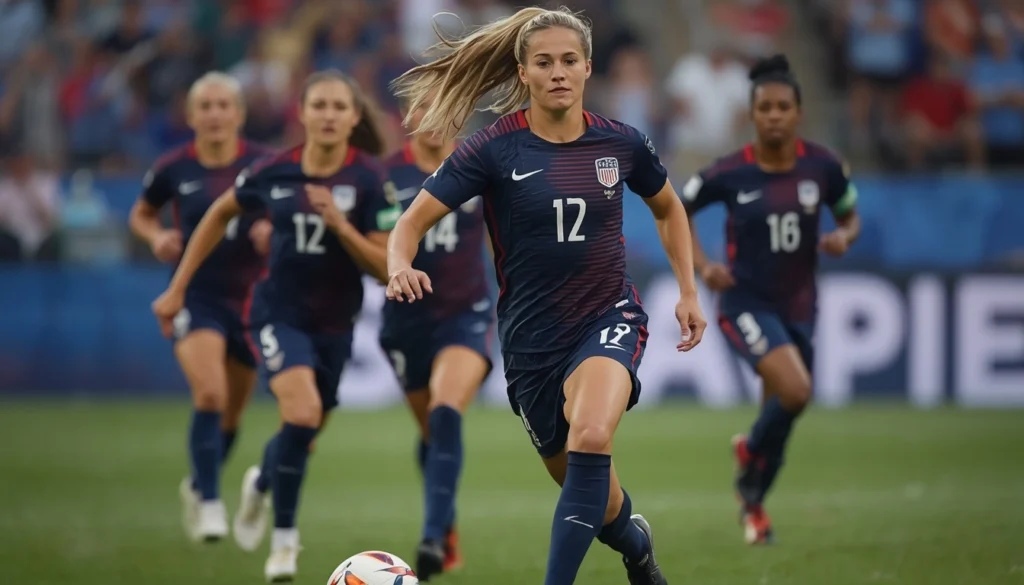
This site covered the U.S. Under-20 roster back in August, when head coach Vicky Jepson confirmed the absences of Claire Hutton, Lily Yohannes, Kimmi Ascanio, Alex Pfeiffer and Jordyn Bugg — all age-eligible, all previously part of the U-20 picture, all kept home because the tournament falls outside FIFA’s mandatory release windows. Jepson called it “upsetting” at the time. It’s the same structural quirk that governs senior World Cup call-ups differently: clubs must release players for those tournaments. For this one, they don’t have to.
What’s changed isn’t the rule. It’s who’s now saying it publicly and by name. Hutton and Pfeiffer — two of the players actually kept home — signed the letter themselves, alongside Melanie Barcenas and current U.S. youth captain Kennedy Fuller, whose hat trick against New Zealand and penalty-shootout appearance against Brazil this site covered in detail earlier this month. The letter isn’t outside advocacy on their behalf. It’s partly written by the players living the consequence.
What the Letter Actually Asks For
The request is specific: align the U-20 tournament with FIFA’s official international match calendar, which would obligate clubs and universities to release selected players the way they already must for senior World Cups. “Aligning the tournament with the international match calendar would enable federations to select their strongest possible squads,” the letter states, arguing the change would benefit clubs’ own season planning as much as it would the players and federations involved.
The full signatory list carries real institutional weight beyond the U.S. picture: Brandi Chastain, Julie Ertz, Sydney Leroux, Vivianne Miedema, Yui Hasegawa, Hinata Miyazawa, Leslie Osborne, Jaedyn Shaw, Danielle Slaton, Aly Wagner and Sophia Wilson also signed, alongside Marta — a signal this isn’t a U.S.-specific complaint but a broader push from established internationals across multiple countries.
Why the People Signing It Care So Much
There’s a specific reason so many of these particular names are the ones raising it. Alex Morgan and Sydney Leroux were both on the 2008 U.S. team that won the tournament, scoring a goal apiece in a 2-1 final win over North Korea. Crystal Dunn and Julie Ertz — then Johnston — were part of the last U.S. team to win it, in 2012. These aren’t players speaking abstractly about a youth competition. They’re players whose own careers were shaped by a tournament they’re now watching operate with a structural gap that, in the current calendar, doesn’t apply to them the way it applied to the current generation.
Emma Hayes’ position adds further weight from inside the senior program. The USWNT head coach has called the U-20 World Cup the “biggest platform” for player development and told ESPN she has real concerns about the long-term direction of that development pipeline if the current calendar situation continues.
The Part This Site Already Connected: Did It Cost the U.S. a Deeper Run?
This site covered the U.S. team’s tournament arc in real time: an opening loss to Italy, a draw with Japan, a must-win 9-0 rout of New Zealand to survive the group stage, and, on Sept. 16, a Round of 16 exit against Brazil decided by a single missed penalty after 120 scoreless minutes. Separate reporting connecting the calendar issue to that result has raised a reasonable, if unprovable, question: would a fuller roster — with Hutton, Yohannes, Ascanio, Pfeiffer and Bugg all available — have changed a shootout that came down to one save?
There’s no way to answer that with certainty, and this piece isn’t going to claim otherwise. What’s fair to say is that the margin was thin enough, and the list of missing eligible players specific enough, that the question isn’t unreasonable to ask. It’s also exactly the kind of concrete, recent example that gives the open letter’s abstract argument — “clarity and confidence” for players, “strongest possible squads” for federations — a specific tournament to point to rather than a hypothetical one.
What Happens Next
FIFA had not responded to the letter as of the most recent reporting available. The next U-20 Women’s World Cup is scheduled for 2028, with FIFA yet to confirm dates or a host location; the organization’s broader international women’s match calendar currently runs through 2029, which is the practical window in which any change driven by this letter would need to happen. Separately, a coalition representing major European leagues has filed an expanded complaint to the European Commission alleging “abusive conduct” in how FIFA manages the international calendar for women’s competitions more broadly — a larger, parallel institutional fight that this specific letter sits alongside rather than inside.
For now, the letter is a request, not a resolution. But it’s a request now carrying the signatures of the exact players who watched the current system keep their own teammates home, made in the same month those absences became part of the story of how the tournament actually played out.