

Published September 20, 2026
A note before this piece begins: it involves a player’s serious medical event and pending litigation. Everything below is reported as either confirmed fact or a clearly attributed legal allegation — no claims of medical negligence are treated as established, since that determination belongs to the court the case was filed in.
Racing Louisville and USWNT midfielder Savannah DeMelo has filed a lawsuit against University of Louisville Health and two of its physicians, alleging they failed to properly diagnose and treat a heart condition in the months before she went into cardiac arrest during an NWSL match last September. The filing came one day after the anniversary of her collapse — and alongside it, DeMelo shared publicly for the first time exactly what had happened to her that night.
What DeMelo Revealed, in Her Own Words

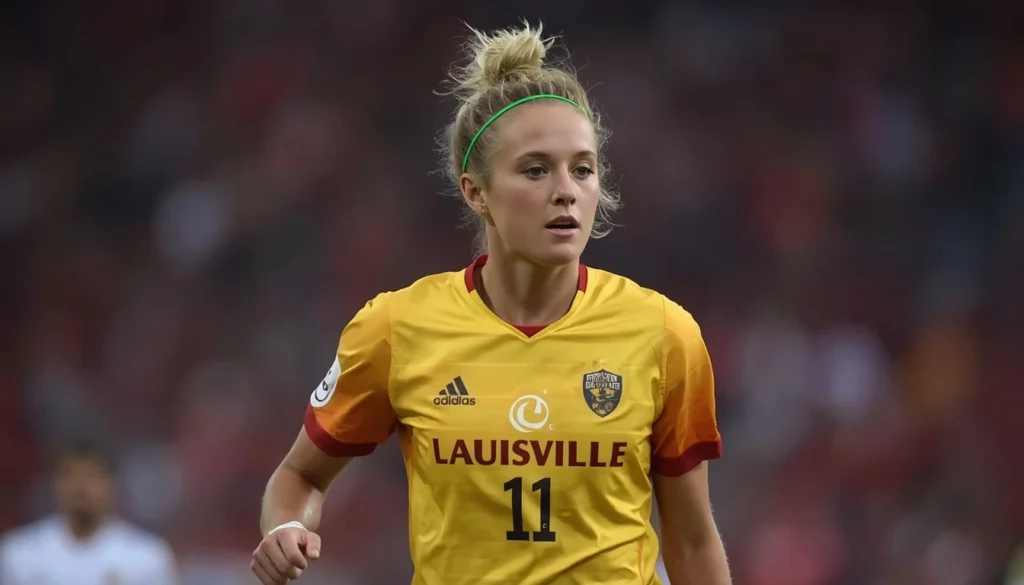
For a year, the specifics of DeMelo’s on-field collapse against the Seattle Reign on Sept. 14, 2025, had remained largely private. The match was suspended while she was scoreless, medical personnel treated her on the field, and she was transported to a Seattle hospital; Racing Louisville described her at the time as “stable and alert.” What caused the collapse wasn’t publicly detailed.
That changed on Monday, the one-year anniversary. In an Instagram post, DeMelo wrote that she had “collapsed due to an undiagnosed cardiac arrhythmia, that caused me to go into cardiac arrest.” She described the past year as emotionally difficult, thanked doctors at the University of Washington and the Mayo Clinic for her subsequent care, and credited her fiancé, family and friends for their support throughout. She has not played in an NWSL match since the incident.
What the Lawsuit Alleges
The nine-page complaint, filed Tuesday in Jefferson Circuit Court in Kentucky, names the University of Louisville Health system, UofL Physicians, and two doctors: Dr. Jennifer Daily, Racing Louisville’s chief medical officer, and Dr. Sarabjeet Suri. According to the filing, DeMelo was under Dr. Daily’s care beginning in January 2024. In March 2025, after she reported chest pain, dizziness and shortness of breath, Daily referred her to Suri, who took a history, performed a physical exam and ordered diagnostic tests. Nearly six months later, DeMelo suffered the cardiac arrest. She was subsequently diagnosed with ventricular tachycardia — an abnormally fast heart rhythm originating in the heart’s lower chambers, one capable of seriously impairing the heart’s ability to pump blood.
The lawsuit alleges the defendants “failed to act as a reasonably prudent and competent medical practice,” and states that this alleged negligence was a substantial factor in DeMelo’s cardiac arrest and the injuries that followed, including medical and ongoing care costs, lost income, and what the filing describes as a permanent impairment to her ability to work and earn a living. As of this writing, neither the University of Louisville Health system nor Racing Louisville had issued a public response to the lawsuit.
One detail is worth stating plainly, because it clarifies what the lawsuit is and isn’t about: Racing Louisville’s own medical and training staff have been separately commended for their swift on-field response the night DeMelo collapsed, and they are not named as defendants. The complaint is directed at the outside health system alleged to have managed her cardiac risk factors in the months leading up to the event, not at the team’s emergency response when it happened.
Why This Isn’t an Isolated Incident in the League’s Recent History
DeMelo’s collapse was the second known on-field cardiac incident in the NWSL within a single season. In May 2025, Angel City FC defender Savy King collapsed during a match and was later diagnosed with a previously unidentified heart abnormality requiring surgery. That match, notably, continued after a long delay — a decision that drew significant criticism, including from the NWSL Players Association, over player safety.
The league’s response to that criticism is what made DeMelo’s incident play out differently four months later: when she collapsed in Seattle, her match was suspended rather than continued, consistent with a policy change the league had committed to after the King incident. Whatever the outcome of DeMelo’s lawsuit against her outside medical providers, the in-game protocol change itself is already a confirmed, documented shift in how the league handles a player’s on-field medical emergency — one that came directly out of criticism of how the earlier case was managed.
Where Things Stand
DeMelo, 28, hasn’t returned to competitive play since her collapse, and nothing in her public statements or the lawsuit itself indicates a timeline for a possible return. The legal process will determine whether her allegations against the University of Louisville Health system and its physicians hold up; that process is only beginning. What’s already clear, independent of how the case resolves, is that a player who spent a year managing an undisclosed health crisis largely in private has now put both the human toll and the legal question in public view at the same time.